

Crypto's 2026 Shutdown Wave: 81 Projects Gone Quiet
Prices held up, but trading vanished—stacking 81 shutdown notices reveals what actually died and what survived.
BusinessWatch the trading volume, not the price
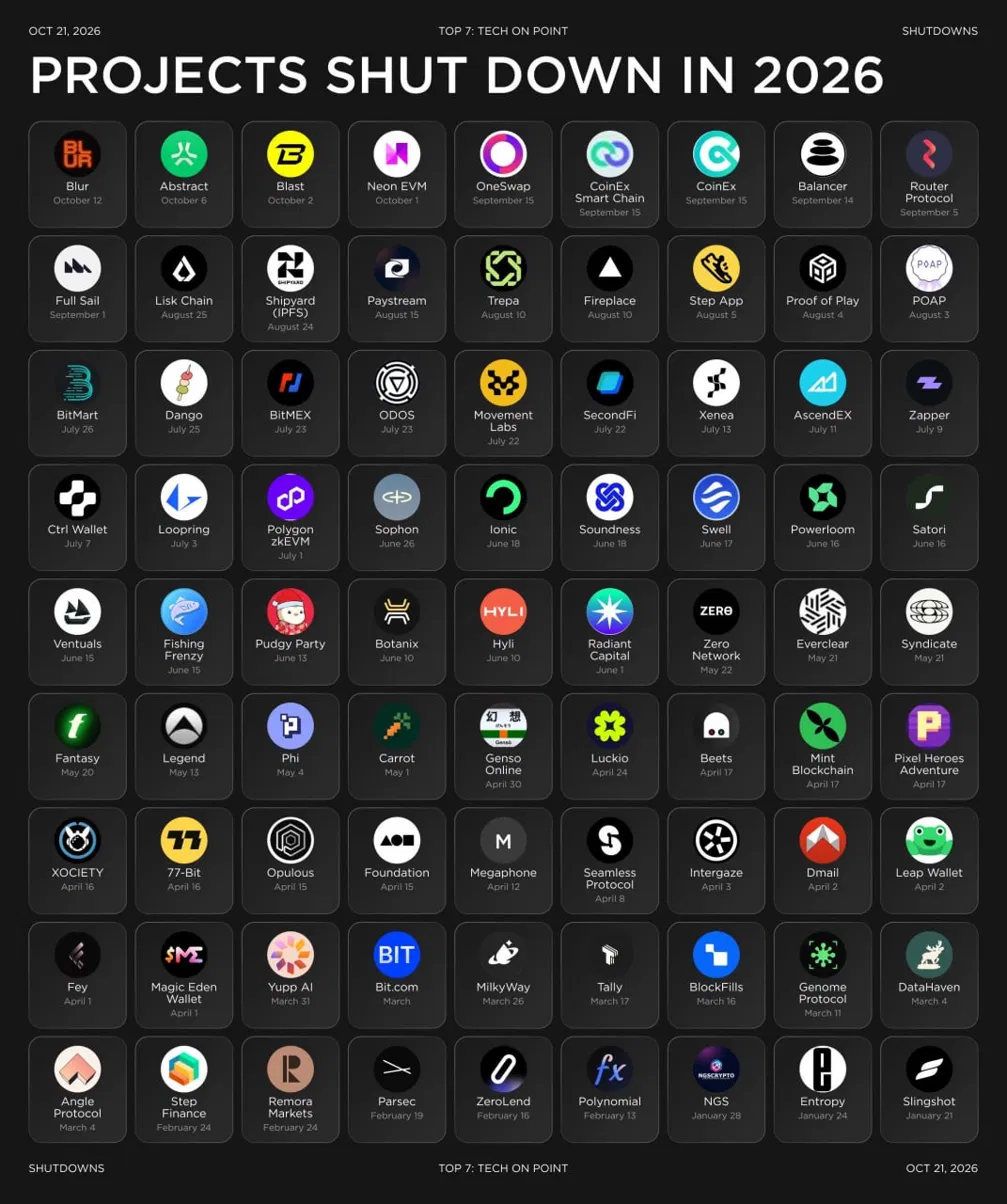
The image above is a table of crypto projects that shut down or announced plans to shut down in 2026. Nine entries per row, nine rows—81 in total. From Slingshot on January 21 to Blur on October 12, there’s been roughly one shutdown announcement a week. The dates in the table are announcement dates, so the actual service shutdowns usually came later. Since it’s a third-party compilation, it’s not an exhaustive census, but for this piece I went back and verified the bigger names against their original announcements and press coverage.
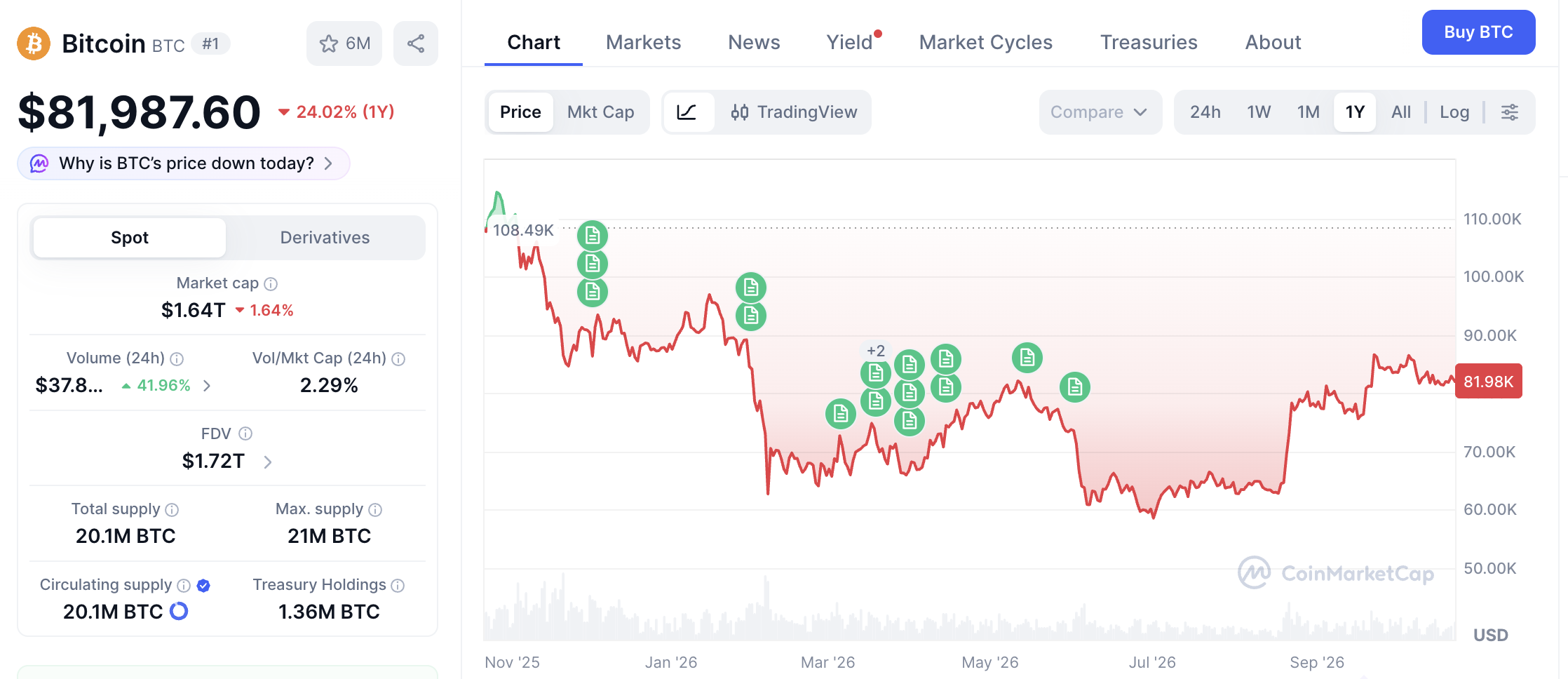
If you only look at price, this table might seem exaggerated. On October 22, Bitcoin was trading around $82,800. That’s down about 35% from its 2025 peak of $126,000, but still higher than its 2021 peak. Here’s the thing, though: I think that price is a mirage. Nobody’s actually trading at it. This isn’t a winter—it’s a deep freeze.
Today I want to talk about why this happened, and how to separate blockchain technology itself from this carnage. One note up front: this piece is a commentary on market structure, not investment advice on any specific asset.
Exchanges Are Emptying Out
Let’s start with the numbers. According to data analytics firm Kaiko, the average daily trading volume across 44 spot exchanges in early August was around $15 billion. That’s a 70% drop from the January peak. Back in February, there were two separate days when volume topped $100 billion. The monthly figures tell the same story. By CryptoQuant’s count, centralized exchange spot volume in April came in at $679 billion — the lowest since October 2023 — and in July, every single one of the top 14 exchanges saw volume decline month-over-month, without exception. TokenInsight’s total Q2 volume figure (including derivatives) was $16.5 trillion, a little over half the $31 trillion peak reached in Q3 2025.
Some exchanges have simply vanished. BitMEX, which pioneered perpetual futures1, announced its shutdown on July 23 and ended trading on September 23. A platform that held 57% of the derivatives market in 2018 ended with just 0.08%. Reports say its parent company tried and failed to sell the exchange for roughly $1 billion before deciding to close it. Three days later, BitMart announced it was following the same path, and in September, CoinEx did too.
The ETF side has gone quiet as well. US spot bitcoin ETFs saw $2.4 billion in outflows in May and $4.5 billion in June, and by mid-October, net outflows had already passed $500 million for the month.
Running a chain costs money every month
The most common type on this list is layer 22: Blast, Abstract, Sophon, Polygon zkEVM, Loopring, Swell, Zero, Mint. Nearly ten chains built on top of Ethereum have either shut down this year or announced plans to.
Abstract is a more complicated case. Launched in January 2025 by the Pudgy Penguins NFT brand to bring its fan base onchain, the chain had racked up over 300 million cumulative transactions. Judging by the numbers alone, it wasn’t a failure. Yet its parent company, Igloo, announced on October 6th that it had lost tens of millions of dollars over two years and would shut the chain down on December 15th. Daily chain fees ran around $3,900, while the apps running on top of it generated roughly $39,000 in revenue. Even with users, the chain’s own cut couldn’t cover its costs. Igloo also considered issuing a token to stay afloat, but dropped the idea, citing uncertainty about demand.
Sophon raised $60-70 million to build its chain, yet had only 100-200 daily users and around $30 in daily fee revenue. Its annual operating costs exceeded $3 million. Polygon, meanwhile, had grown Hermez — acquired for $250 million in 2021 — into Polygon zkEVM, before switching off its sequencer in early July.
Why did all this converge on 2026? A layer 2’s revenue is the gap between the fees users pay and the cost of posting data to the Ethereum mainnet. The 2024 Dencun upgrade (EIP-4844)5 made that data cost much cheaper. That was good for users, but competition pushed fees down along with it. High-volume chains can still make the math work through sheer scale, but for low-volume chains, that margin falls below operating costs. This is the backdrop for Vitalik Buterin’s February 5th post arguing that layer 2s need a reason to exist beyond generic scaling.
The reasons the survivors are surviving are just as clear. Polygon’s core team drew some mockery right after Abstract’s shutdown by posting “we are not a shutdown announcement,” but Polygon persists because it’s used as a payments network and carries Polymarket’s traffic. By GrowThePie’s tally, layer 2s’ overall share of onchain economic activity actually topped 30% this year. Users didn’t disappear — they consolidated onto a handful of chains.
Billions Changed Hands Without a Single Fee
If Layer 2 was a cost problem, another group of protocols never had a revenue model to begin with.
Blur was the exchange that overtook OpenSea in 2023 to become Ethereum’s largest NFT marketplace. According to an October 12 announcement, it will shut down its website on November 12, and its lending protocol Blend will also stop matching new loans. Monthly trading volume, which stood at $1.43 billion in March 2023, had fallen below $7 million by March 2026 — a drop of more than 99.5%. But the most important number in that announcement is a different one. According to Token Terminal, Blur’s protocol revenue over 3 years has been $0. It never charged fees. Billions of dollars changed hands, and the company made no money from any of it — what kept traders around was the token airdrop. When the token’s price fell from $5 in early 2023 to 1.5 cents today, the traders left with it.
Back in August, writing about Farcaster and Kaito, I argued that paying for posts turns communities into subcontracted labor markets — that what moves people isn’t wages but lottery tickets. Blur applied the same design to an exchange. When the lottery ends, so does the subcontracting.
Pay People to Post and Your Community Becomes a Gig MarketThe fork in the road that a 570,000-person experiment revealed: whether the reward can be cashed out.Balancer is a different kind of tragedy. It suffered a $128 million hack in November 2025, and its monthly revenue collapsed from $1.13 million to $56,000. The operating entity shut down in March, and on September 14 the former CEO posted a one-line epitaph — “Balancer tried” — along with a proposal to wind down the protocol. The $9 million left in the treasury exceeded the token’s entire market cap, so the plan was to burn the tokens and split the treasury among holders. The September 29 vote passed with 99.2% in favor. In other words, liquidation had become more valuable to token holders than continuing to operate.
Movement Labs filed for bankruptcy protection in a U.S. court in July. Right after its exchange listing, a market maker dumped roughly 66 million of its tokens; once the price collapsed, investigations followed.
Add it all up and the picture is this: Bitcoin.com counted more than 60 projects that shut down, went bankrupt, or disappeared between January and July; RootData counted 95 to 110 as of late July. Galaxy Research puts Q1 crypto VC investment at 355 deals totaling $4 billion — half the volume of the previous quarter. These were companies that raised money at lofty 2021 valuations and survived on token prices and the next funding round — until the next round never came.
Why 2026, Specifically
I can’t leave out the external environment. Three things converged.
Money got expensive. The 10-year US Treasury yield kept crossing above and below 5% in mid-October. That’s reason enough to hold less of an asset that pays no interest. The period when $6.9 billion flowed out of bitcoin ETFs in May and June overlaps with the period when rates were climbing.
The rules got only half-written. The GENIUS Act, which governs stablecoin6 issuers, passed in July 2025, and this year the Office of the Comptroller of the Currency (OCC) finalized its implementing rules. The CLARITY Act, which would set the rules for the market as a whole, on the other hand, stalled in a Senate procedural vote on September 15 by 49 to 50 — it needed 60. The sticking point was whether exchanges and wallets could pay interest-like rewards to stablecoin holders, which banks opposed on the grounds it would drain deposits. JPMorgan CEO Jamie Dimon said publicly that banks simply would not accept that provision. Another vote before the November 3 midterms looks unlikely. The year is ending with stablecoins legal, but what you can actually build on top of them still undecided.
The money dried up. The VC funding cut in half, which I mentioned above, belongs here too. Abstract abandoning its token launch is emblematic. It means the path of funding operating costs through a token launch was closed off in 2026.
But blockchain had its busiest year yet
Let me flip the table over. There are numbers that set records in the same period.
According to Visa’s onchain analytics dashboard, June’s adjusted stablecoin transaction volume hit an all-time high of $1.79 trillion. That’s up 63% from the previous month and 125% year-over-year. By a16z’s count, $4.5 trillion moved in Q1 alone, two-thirds of it originating in Asia. In that same June, stablecoin issuance balances fell by $7.7 billion — the steepest drop since the Terra collapse of 2022. But the money that left didn’t exit the market; it moved into yield-bearing tokenized Treasuries like BlackRock’s BUIDL or Circle’s USYC. Money kept moving, faster and without rest, doing more work with a smaller balance.
Tokenized real-world assets (RWA)7 grew more than 50% this year to $32.9 billion — up tenfold from under $3 billion three years ago. Prediction market volume hit $43.2 billion in Q2, 18 times what it was a year earlier. And futures trading volume for traditional assets like gold, silver, and oil hit all-time highs on crypto exchanges this year too.
So while exchanges went quiet, the chain stayed busy. But the star of that busyness wasn’t Bitcoin, altcoins, or NFTs. It was the dollar. Stablecoins made up 75% of all crypto trading volume in Q1 — an all-time high share. This is the trend Ryan Kirkley, CEO of Global Settlement Network, pointed to in August when he named stablecoins, digital banking, and institutional settlement infrastructure as the winners of this shakeout.
Oswarld’s Lens
Looking at this table, the first thing I thought was: calling it “winter” is wrong. Winter implies spring is coming. That’s what the 2022 downturn was like — prices fell, trading volume dropped, and then ETFs came in and things recovered. Right now, prices remain but trading has vanished. This isn’t frozen so much as cryopreserved. And cryopreservation only ends when someone actively thaws it out.

So where should we draw the line? I think one question settles it: does the usage survive if the token price goes to zero? For Blur, when the token ended, so did the trading. For Blast and Sofon, once the rewards stopped, so did the users. On the other hand, stablecoin remittances hit an all-time high while Bitcoin was down 35%, and tokenized Treasuries actually pulled in more capital during that very downturn. These users weren’t using the chain hoping prices would rise — they were using it to send money and collect interest. The former is the protagonist of 2026’s cruel story; the latter is what blockchain actually accomplished in 2026. Even on the same chain, these are two different businesses.
Viewed through this lens, the gridlock over the CLARITY Act reads differently too. What banks are trying to block is the model where holding a stablecoin pays you interest. That’s deposit-taking territory, and banks have no intention of ceding ground there. What banks didn’t oppose was the model of using the chain to move money — which is why the GENIUS Act passed. In other words, this year’s U.S. regulatory stance drew a line accepting blockchain as payment-and-settlement infrastructure, while refusing to accept it as a yield-bearing asset. The spot where the market froze and the line regulators drew turn out to be nearly the same place.
Closing
The 81 names in the table aren’t a list of dead technologies — they’re a list of businesses that only run if the token price holds them up. Meanwhile, blockchain carried more dollars than any other year. If you can hold both of those facts in the same sentence, I’d say you’ve actually understood 2026.
💬 Reader, did any of the crypto services or wallets you used this year get a shutdown notice? Tell us in the comments what it was and how the process of moving your assets went.
📨 If you have a colleague who still thinks “cryptocurrency” and “blockchain” are the same thing, send them this piece.
Already a subscriber? Sign in to join the conversation


References & Further Reading
Primary sources
- The Block, “Blur to shut down frontend next month as NFT trading volume dwindles”, Oct 12, 2026. ··· This has Blur’s original announcement and Blend’s lending wind-down schedule.
- Cryptorank, “Blur to Shut Down NFT Marketplace Website After Volumes Collapse 99%”, Oct 13, 2026. ··· This covers the drop in monthly trading volume from $1.43 billion to $7 million, and Token Terminal’s record of $0 in protocol revenue.
- The Block, “Paradigm-backed Layer 2 Blast to wind down network as costs exceed revenue”, Oct 2, 2026. ··· This quotes Blast’s original announcement and the $32 million TVL figure.
- CoinDesk, “Pudgy Penguins’ Abstract becomes second Ethereum layer 2 to shut in a week”, Oct 7, 2026. ··· This compares Abstract’s $3,900 in daily chain fees against $39,000 in app revenue.
- TokenPost, “Blast and Abstract Shutdowns Test Ethereum Layer 2 Sustainability”, Oct 10, 2026. ··· This lays out how EIP-4844 squeezed revenue for smaller layer 2s, and references Vitalik’s February 5 post.
- Bitcoin.com News, “Sophon Set to Pull Plug on Layer 2 Network After $70M Funding Push”, Oct 20, 2026. ··· This covers Sophon’s $3 million annual operating cost and its November 30 shutdown date.
- Cryptopolitan, “The year of shutdowns: which networks are winding down in 2026?”, Oct 2026. ··· This has the reasons Polygon survived and GrowThePie’s data on layer 2 share of on-chain economic activity.
- The Block, “Balancer proposes winding down protocol and distributing treasury to BAL holders”, Sep 15, 2026. ··· This covers Balancer’s wind-down proposal and how its $9 million treasury would be distributed. Vote results are drawn from CoinPaprika’s summary.
- CoinDesk, “BitMEX shuts down: perpetuals pioneer officially closes its doors after 11 years”, Sep 23, 2026. ··· This traces BitMEX’s shutdown. The slide in market share from 57% to 0.08% is drawn from 24/7 Wall St.’s summary.
- Crypto Briefing, “Crypto spot volume drops to $15B as liquidity thins across exchanges”, Aug 8, 2026. ··· This has Kaiko’s tally of $15 billion in daily volume and 60% concentration across six exchanges.
- TokenInsight, “Crypto Exchange Report Q2 2026”, Jul 2026. ··· This compares Q2’s $16.5 trillion against the Q3 2025 peak of $31 trillion.
- Bitcoin.com News, “Over 60 Crypto Firms and Projects Fold in 2026 as Bankruptcies, Bear Market and Hacks Rip Industry Apart”, Jul 28, 2026. ··· This tallies over 60 firms between January and July, and covers how Movement Labs, Sophon, and Polygon zkEVM wound down.
- Forbes, “The Stablecoin Market Shrank For The First Time In Four Years. Watch The Volumes Instead.”, Jul 27, 2026. ··· This covers June’s $1.79 trillion record, a $7.7 billion drop in outstanding issuance, and the shift toward tokenized treasuries.
- BeInCrypto, “Crypto Bear Market? These Reports Say the Industry Has Never Been Stronger”, Jul 2026. ··· This has Bitwise’s Q2 report figures: $32.9 billion in tokenized assets and $43.2 billion in prediction markets.
- Forbes, “‘Nearly Two-Thirds’—Stablecoins Suddenly Hit $4.5T Q1 Volume Record”, Apr 29, 2026. ··· This has a16z’s Q1 tally of $4.5 trillion and the Asia share.
- CEX.IO, “Stablecoins in Q1 2026: Rising Similarities With the 2022 Bear Market”, May 2026. ··· This is the source for stablecoins’ 75% share of Q1 trading volume.
- FinTech Weekly, “CLARITY Act Tracker: Status, Timeline & What Happens Next”, Sep 26, 2026. ··· This covers the September 15 vote of 49 to 50 and the bank lobby’s points of contention.
- TFTC, “Bitcoin ETF Flows”, Oct 2026. ··· This tracks monthly net inflows and outflows for spot Bitcoin ETFs.
Background
- KuCoin News, citing Galaxy Research’s tally, “Over 100 crypto projects closed in 2026 amid industry consolidation”, Aug 18, 2026. ··· This has Q1 VC investment of $4 billion and Ryan Kirkley’s outlook on who wins.
- Au79 Macro Research, “20Oct2026 - Crypto & Macro-Liquidity”, Oct 20, 2026. ··· Referenced for when the 10-year Treasury yield crossed 5%.
Issues worth reading alongside this one
- Pay for Posts, and Communities Become Subcontractors ··· This piece covers how token rewards reshape communities — the same structure as Blur’s design.
- The Company That Bought 140 Million Views With Fake Bets ··· This is the other face of this year’s record-setting prediction markets.

📝 Glossary
Footnotes
-
Perpetual swap: A derivative product you can hold indefinitely, with no expiration date. BitMEX first created it in 2016, and today it accounts for most crypto trading volume. ↩
-
Layer 2: A secondary chain built on top of a base chain like Ethereum that processes transactions first and only records the results on the base chain. The goal is lower fees and higher speed. ↩
-
TVL (Total Value Locked): The total value of assets users have deposited into a given chain or service. It’s a go-to metric for gauging how much users stick around. ↩
-
Sequencer: The role on a layer 2 that orders transactions, bundles them, and posts them to the base chain. Layer 2 operators typically take on this role and earn fees for it. ↩
-
EIP-4844 (the Dencun upgrade): An Ethereum upgrade from March 2024 that sharply cut the cost for layer 2s to post data to the base chain. User fees fell, but so did layer 2 operators’ margins. ↩
-
Stablecoin: A cryptocurrency pegged to the value of a fiat currency like the dollar. It’s designed to avoid price swings so it can serve as a payment and settlement tool rather than an investment. ↩
-
Tokenized Real-World Assets (RWA): this means representing real-world assets — like government bonds, funds, or gold — as tokens on a blockchain. Interest-bearing government bond tokens make up the largest share. ↩
Related issues
Servers Take 2 Months, Foundries Take 4 Years
The further upstream in the supply chain, the later today's decisions are graded.
BusinessKorea's Mobile Plan Overhaul Came in 5 Waves, Not 1
Persistent search spikes reveal why consumers are still struggling to decode what actually changed months after the official rollout.
BusinessFour Months on Leave, and the AI Models Changed
The share of women in AI roles drops sharply as compensation tiers climb, LinkedIn data reveals.
Business
Your take shapes the next issue
What resonated most in this issue, or where has your experience been different?