

How a 33K-Follower Creator Earns $140,000 a Year
A closer look at the payout breakdown behind one micro-influencer's six-figure income.
BusinessThe Structure Behind 30,000 Followers and a $140,000 (~₩190,000,000) Annual Income
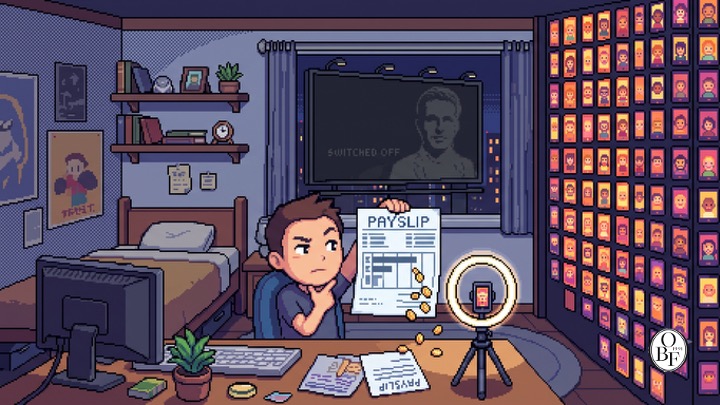
Anna Fenstermaker, 30, lives in Florida and recently had her content-creator earnings from last year made public. The total came to $140,000, roughly ₩190,000,000 (~$140,000). Her TikTok following sits at 33,000. By day she works a full-time job in the hotel industry; after hours, she posts home-decor and fashion content — an entirely ordinary working professional.
What Bloomberg’s breakdown of her earnings statement reveals is fascinating. Brand-sponsored posts brought in $29,000, about a fifth of the total. The largest share — $91,000 — came from the Amazon Influencer Program, which pays a commission whenever a follower buys something she’s recommended.
What stands out here isn’t her follower count — it’s the composition of her income. Commission from product sales dwarfed the fees from sponsored posts. Let’s take a look at how the way brands pay creators is changing.
A ‘creator middle class’ is emerging
For a while, making a living as an influencer sounded like saying you’d become a Hollywood actor — theoretically possible, but a path where only a tiny fraction ever succeed. What’s being observed in the US lately, though, is a different picture. Instead of stars with millions of followers, more and more “ordinary creators” with follower counts in the tens of thousands are pulling in mid-manager-level incomes.
 Let’s look at a few cases Bloomberg interviewed. Abby Flatock, a 25-year-old marketer in New York, landed her first brand deal when she had 8,000 followers. Now, with about 25,000 followers, she’s signed $25,000 worth of brand deals this year alone. Bonsa Nemera, a 28-year-old dental resident earning a $76,000 salary at her hospital job, has already landed $180,000 in deals this year from the content she creates on the side. In two months, her contract earnings more than doubled her annual salary from her main job. That said, contract value and actual income received are two different things.
Behind this is the expansion of the market as a whole. The influencer marketing market grew from $1.7 billion in 2015 to roughly $33 billion in 2025 — about ₩46 trillion (~$33 billion). That’s nearly a 20-fold increase in a decade. But to me, the more important signal isn’t that the market grew — it’s where that growing pool of money is being allocated. Increasingly, it’s flowing toward the “small accounts.”
Why Brands Sign Dozens of Small Accounts Instead of One Star
Let’s look at the math from the advertiser’s side. Ally Grant, co-founder of the creator management firm Digital Department, put it this way to Bloomberg: “Brands are taking the budget they’d spend on a few macro creators and using it to hire micro creators in bulk instead.”
The data backing this shift is pretty solid. A study in the Journal of Marketing, one of the top journals in the field, is a good example. The research team tracked roughly 1.9 million sales through influencer-specific discount codes, using data from a direct-to-consumer company in Europe. The results are striking. Macro influencers1 generated 6 times the sales of nano influencers, but cost 18 times as much. Measured as sales per ad dollar spent, smaller accounts were roughly 3 times more efficient. That figure doesn’t tell us anything about profit margins, to be clear.
Engagement data points the same direction. By industry-standard measures, micro influencers post an average engagement rate2 of 3.2%, nearly three times the 1.1% posted by macro influencers with over a million followers. One reading is that readers feel closer to recommendations from smaller accounts. But an engagement gap alone doesn’t prove trust is the cause.
It’s worth breaking down the pricing structure here. According to Grant, a single TikTok post from a creator with 50,000 followers runs $3,500 or more, while one from a creator with 500,000 followers runs around $10,000. On a per-follower basis, the bigger account actually looks cheaper. But what brands actually want isn’t exposure — it’s conversion into purchases. Once you factor in engagement and purchase conversion, the results flip: smaller accounts come out ahead. It’s a familiar trap for anyone who’s worked with data — the definition of “cheap” changes completely depending on what you divide by.
Korea is moving in the same direction. Domestic influencer marketing reports uniformly name the rise of nano and micro influencers as a key trend for 2025. Brands are increasingly signing based on engagement and trust rather than follower count, and Korea is actually ahead of the curve in commission-based settlement models — like Instagram gongdong-gumae (group-buy campaigns run by individual sellers) — where creators are paid a cut of actual sales.
The biggest line item wasn’t ad fees — it was sales commissions
Let’s go back to Anna’s statement. Of the $140,000 total, brand advertising fees accounted for only $29,000. $91,000 came from Amazon Affiliates3 — that is, commissions earned every time a product sold. Similar ratios show up in the income breakdowns of other creators.
In Anna’s case, product sales outweighed ad payments as a revenue source. Ad fees come out of brand marketing budgets, while commissions come from actual sales. Ad income is shaped by how brands allocate their budgets; commission income is shaped by actual purchase volume and commission policy. Neither guarantees a stable income. Whether the creator middle class can become a “sustainable class” hinges, in large part, on this distinction.
Still, we can’t only look at the upside. The data on the other side is just as clear. When Influencer Marketing Hub surveyed 3,000 full-time creators, 57% said their content income fell short of a living wage. Income volatility is severe, too. To borrow Abbie Flatoc’s phrase, it’s a world where “some months are $0 and some months are $10,000.” What’s more, this middle class rests on a platform’s foundation. As the 12-hour TikTok blackout in the US last year showed, algorithms and monetization policies are variables creators cannot control. “Middle class” is the right term — but it’s a middle class with no unemployment insurance, no severance pay.
Oswarld’s Lens
While building GTM (go-to-market) strategies, I’ve spent a lot of time putting marketing budgets and sales-org budgets side by side. From that vantage point, what’s happening now isn’t a shift in advertising trends — it’s the same money migrating from marketing budget lines into something that looks a lot more like sales cost. When a brand pays 100 micro-influencers on a sales-commission basis, that’s less “running an ad” and more “outsourcing a performance-based sales team.” You’re not buying ad space; you’re renting a sales channel. So on the books it shows up as advertising spend, but functionally it’s standing in for sales-force compensation.
From the brand’s side, splitting a contract across 100 micro-creators makes it easier to measure who sold how much than betting everything on a single star creator, and it lowers dependence on any one creator’s individual problems compared to concentrating the whole budget on one person. Ad dollars that used to flow to a handful of major media outlets are now fragmenting across a multitude of small channels — that’s the structural shift I see in the advertising market. It’s also a redistribution: the margin that used to sit with media companies and big talent agencies is flowing back out to individuals.
The implication for creators connects directly to last Sunday’s issue, where I drew a line between “people who sell their time” and “people who own an asset.” The trust that 30,000 followers extend to a creator is unmistakably an asset. But how much of your content actually reaches those followers is governed by the platform’s algorithm and policies — that relationship and reach don’t automatically travel with you if you move to another service. So I think the next stage of this market is creators taking their commission income and converting it into a customer relationship they manage directly, outside the platform — through a newsletter or their own brand, for instance.
Closing
Let me sum up. A “creator middle class” is emerging — creators with tens of thousands of followers earning what amounts to a mid-manager’s salary. The driving force is a shift in how brands do the math. In the direct-to-consumer study I mentioned earlier, smaller accounts generated roughly 3x more revenue per ad dollar spent. That’s the kind of result that justifies splitting budgets across smaller channels. In Anna’s case, commission from sales outweighed ad fees, and the platform she built her activity on is one she has no control over. More people are climbing into that middle income bracket, but below it, incomes remain thin and swing wildly month to month — as one survey found, 57% of full-time creators earn less than the minimum cost of living.
If you happen to be the one managing a marketing budget, I’d suggest re-running this quarter’s influencer spend using cost-per-conversion instead of cost-per-follower. You can check for yourself whether bigger or smaller accounts actually come out ahead.
Reader, which side of this have you experienced? If you’ve worked with micro-influencers as a brand or marketer, how did results stack up against expectations? Or if you’ve made content on the side, was your income structured around ads or commissions? Drop a comment — if enough stories come in, I’ll put together a domestic-market version of this breakdown in the next issue.
📨 If you know a marketer wrestling with influencer budgets, pass this piece along.
Keep the perspective, not the noise.
We choose one consequential shift and trace what sits beneath it, every other day.
Confirm once to finish subscribing.
Already a subscriber? Sign in to join the conversation


References & Further Reading
Primary sources
- Bloomberg, “The Creator Economy Has a New Middle Class”, 2026. ··· This is the article that sparked today’s piece. Just the graphic of Anna Fensternmacher’s earnings statement gets you halfway there.
- Beichert, M., Bayerl, A., Goldenberg, J. & Lanz, A., “Revenue Generation Through Influencer Marketing”, Journal of Marketing, 2024. Link ··· This is the source for the “6x revenue, 18x cost” figure. It compares nano and macro returns using 1.9 million real sales transactions. Just keep in mind the limitation: it’s based on data from a single European company.
- Influencer Marketing Hub, “Creator Earnings Report”, 2025. Link ··· This is the source for the counterpoint data showing 57% of full-time creators fall below a living wage. Read it alongside the rest so you don’t get too swept up in the middle-class narrative.
Background
- Openads, “Influencer Marketing Data Analysis: Marketing Trends to Watch in 2025”, 2025. Link ··· A report tracking the rise of nano and micro influencers based on domestic campaign data. Useful for checking the temperature of the Korean market.
- Morning Consult, “Gen Z and the Creator Economy”, 2023. Link ··· A survey in which roughly 60% of Gen Z respondents said they’d become influencers given the chance. It explains why the supply side keeps growing.
Past issues worth reading alongside this one
- Issue 164: Why Does the Freelance Developer Deliver Food Every Night?
- Issue 56: arXiv’s Independence — Keeping Free Papers Sustainable

📝 Glossary
Footnotes
-
Macro/micro/nano influencer: A classification based on follower count. Typically, 1,000,000+ followers is macro, 10,000–100,000 is micro, and under 10,000 is nano. Thresholds vary slightly by organization. ↩
-
Engagement rate: The share of followers who actually respond via likes, comments, shares, or saves. In the ad industry, 3% is considered solid and 10% is regarded as very high. ↩
-
Affiliate marketing: A setup where you earn a commission on sales made through your link. Rather than getting paid upfront for ad placement, you’re compensated based on actual sales. ↩
Related issues
The Phone on the Table Nobody Asks About Anymore
AI recording has quietly become the default in meetings, and asking for consent is no longer part of the conversation.
BusinessWhy a Freelance Coder Delivers Food Every Night
A Chengdu developer's delivery earnings match his rent to the yuan—a window into freelance wages and Korea's platform labor data.
BusinessHousehold Wealth Rose $40T—Only 20% From Real Investment
MGI's global balance sheet update shows most of this year's wealth gain was paper markups, not new factories or homes.
Business
Your take shapes the next issue
What resonated most in this issue, or where has your experience been different?