

Household Wealth Rose $40T—Only 20% From Real Investment
MGI's global balance sheet update shows most of this year's wealth gain was paper markups, not new factories or homes.
BusinessHousehold wealth rose $40 trillion, and only 20% of that gain was real investment
This week brought two threads worth pulling together: fresh global wealth statistics, and news of Korea-US AI investment cooperation.
The first is a statistical release. On July 23rd, the McKinsey Global Institute (MGI) updated its balance sheet of the entire world. Global household wealth hit an all-time high of $570 trillion. It grew by $40 trillion over the past year alone—more than 20 times Korea’s annual GDP—in asset valuations. That doesn’t mean $40 trillion worth of new cash or income actually appeared. And of that increase, only 20% came from real investment: building factories, putting up houses, installing equipment. Nearly 60% was simply existing assets getting a new price tag—what MGI calls “paper wealth.”1
The second is news from the world of actual investment contracts. On July 24th (local time), at a San Francisco venue called The Midway, President Jae-myung Lee, Jay Y. Lee, Tae-won Chey, Eui-sun Chung, Haejin Lee, Jensen Huang, Sam Altman, Dario Amodei, and Hock Tan are gathering. According to a Bloomberg flash report, this meeting could result in a “very large” long-term memory-chip supply agreement between Samsung Electronics and SK Hynix, plus concrete progress on more than half of an 8GW first-phase AI data center plan.
Taken separately, these look like two unrelated pieces of economic news. But the two announcements are connected. Much of the recent rise in household wealth came from the appreciation of existing assets. What caught my attention is that if AI-related company valuations are to keep rising, that value has to eventually be backed by real investment and productivity gains. The deals being discussed in San Francisco are exactly that kind of real investment. Below, I’ll walk through both announcements in turn.
World net worth reaches 5.1 times annual GDP
Let’s start with what the MGI report actually measures. National economies are usually measured by GDP—one year’s worth of income. But just as you’d look at someone’s assets rather than their salary to gauge how rich they are, MGI has been building a global balance sheet since 2021. This update is based on a sample of 23 countries that together account for 70% of world GDP.
By 2025, the world’s total assets had grown to roughly $1,800 trillion. But financial assets—deposits, loans, bonds, stocks—cancel out globally, since they’re simultaneously someone’s asset and someone else’s liability. Once you net financial assets against their corresponding liabilities, world net worth comes to about $600 trillion. That figure tracks the value of things actually held—real estate, machinery, infrastructure, intellectual property—not income generated in a given year. It’s 5.1 times the world’s annual GDP.
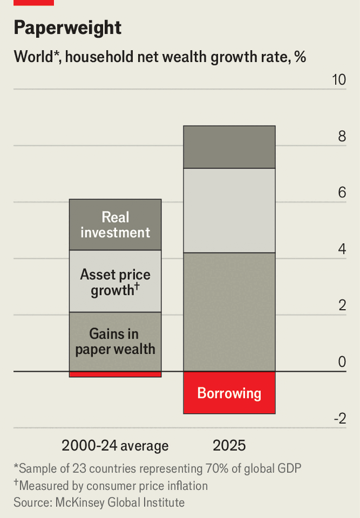 The real issue isn’t the scale of this wealth but how it grew. Looking at the long-run average from 2000 to 2024, “paper wealth” accounted for about a third of the increase in household wealth. But look at 2025 alone, and that share jumps to nearly 60%. Meanwhile, the share coming from newly created physical wealth shrank to 20%. Wealth is growing fast, but the contribution of net investment to that new wealth has fallen well below its long-term average.
Nowhere is this pattern more dramatic than in the US stock market. The market capitalization of listed US equities has climbed to 3.7 times US GDP. Even at the peak of the dot-com bubble in 1999, that ratio never reached 2. The cyclically adjusted price-to-earnings ratio2 sits near an all-time high of 37.7. More than half the increase in market cap since 2021 has come from the Magnificent Seven—the seven AI mega-cap tech companies. MGI notes that for this valuation to be justified, “corporate profits would need to keep growing faster than GDP over the long run”—and US corporate profits already stand at 9.2% of GDP, more than 1.5 times the pre-2000 average of 5.9%. A rising profit share can also raise distributional questions around labor income and taxation. Still, the profit-to-GDP ratio alone can’t tell us who bears how much of that burden.
Borrowing—debt, in plain terms—also looms large in how 2025’s wealth gains were built. In household net-worth calculations, debt is a negative line item, but the structure here is one where rising asset prices have outpaced rising liabilities, making the balance sheet look bigger on paper. Global debt already sits near an all-time high of 2.6 times GDP. And because debt remains even when asset prices fall, heavier borrowing means a bigger shock if prices do drop.
Four Scenarios for Asset Values and Economic Growth
Net worth is the accumulated value of assets, while GDP is a single year’s output — the two don’t have to converge. But if asset values keep growing faster than production and income, we need to ask whether the real economy can eventually back that up. MGI examines four scenarios for how this might unfold.
Path 1: Productivity acceleration. The real economy grows fast enough to catch up with the balance sheet. As GDP expands, today’s asset prices are retroactively justified. This is the only one of the four scenarios where growth and preserved wealth can coexist, and MGI points to AI-driven productivity gains as the engine that would drive it. Today’s valuations are, in effect, the world’s bet on this scenario.
Path 2: A return to secular stagnation. Asset prices stay elevated, but growth never arrives. If people keep saving instead of spending, rates stay low, valuations stay high, and the economy simply idles — an extended version of the 2010s. The nominal size of assets on the books holds steady, but the real returns and growth potential those assets can generate keep shrinking.
Path 3: Inflation. Rising prices erode the real value of what’s on the books. Nominal figures stay the same while real wealth quietly melts away — which makes this the path where people are slowest to notice that an adjustment has even happened. By MGI’s estimate, this path would wipe out roughly $95,000 in real wealth per capita in the US.
Path 4: Balance-sheet reset. Asset prices collapse, and the balance sheet comes down to meet the real economy. This is the fastest and most painful adjustment. A stock-price decline doesn’t make factories and equipment disappear overnight. But as collateral values and spending power shrink and investment and retirement plans change, the real economy feels the effects too.
Looking at these scenarios, the variable I keep coming back to is productivity. For Path 1 to materialize, expectations around AI can’t stop at rising stock prices — they need to translate into actual productivity gains. And that requires building data centers, semiconductor fabs, and power grids first. Construction investment is the link connecting asset prices to the real economy.
The second presentation is about exactly that — the story of construction investment.
Will June’s Investment Blueprint Get Customers, Sites, and Partners?
Let me rewind a month. On June 29th, the “3 Mega-Project National Briefing” was held at Cheongwadae’s Yeongbingwan (the state guest house on the grounds of the former presidential compound known as the Blue House). It’s an ultra-long-term investment blueprint worth ₩2,655 trillion (~$2.0 trillion) from Samsung Electronics and ₩2,100 trillion (~$1.6 trillion) from SK, totaling ₩4,755 trillion (~$3.5 trillion). The structure has three layers: semiconductors build the computational foundation, AI data centers scale up computing power, and physical AI carries the results onto the factory floor. Looking just at data centers, the plan calls for laying down 15GW nationwide by 2035—electricity flowing into data centers alone equal to 11% of the country’s entire power-generation capacity as of the end of 2021.
But this announcement was only a “statement of intent.” Which company would be the customer, on what land it would be built, where the electricity would come from—all of that was left blank.
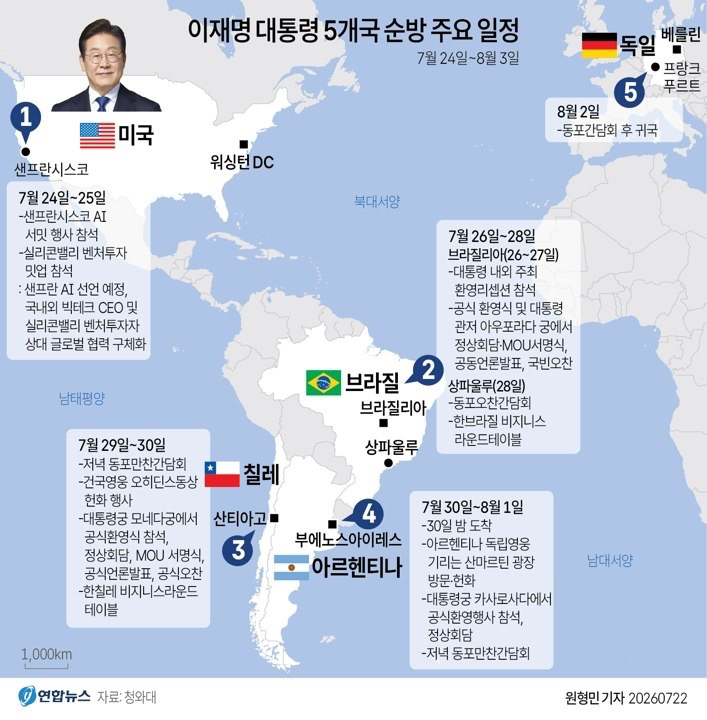 This San Francisco trip is where those blanks get filled in. Putting together Policy Chief Kim Yong-beom’s briefing with Bloomberg’s reporting, three things could emerge this time.
First, long-term memory supply contracts between Samsung Electronics/SK Hynix and America’s Big Tech. These are multi-year deals bundling HBM3 and DRAM, and Chief Kim went so far as to say the scale “could be bigger than the ₩4,700 trillion from last time.”
Second, joint investment in AI data centers. The observation is that more than half of the government’s planned 8GW Phase 1 capacity—meaning over 4GW worth of projects—could take shape during this visit.
Third—and this is the most important part. Bloomberg reports that, unlike previous announcements, these memoranda of understanding will spell out specific customers, sites, and Korean engineering partners. Instead of “we’ll invest heavily in AI,” what gets written down is “who is building what, where, and with whom.” Still, even when specifics are spelled out, an MOU doesn’t automatically become a binding, final contract.
This cooperation bundles together memory supply, data center investment, and securing sites and power. I see it as a deal where the two countries complement each other’s missing resources—not to say it’s cashless barter.
Why Korea Needs the Memory and America Needs the Sites and Power
To understand this partnership, you have to look at what each country’s companies actually lack when it comes to scaling up AI infrastructure.
The bottleneck in 2023-2024 was GPUs. How many Nvidia chips a company got allocated could make or break its fortunes. But starting in the second half of 2025, the bottleneck split into two.
One is memory. Last October, OpenAI signed a letter of intent with Samsung Electronics and SK Hynix for its Stargate project, covering D-RAM supply on the order of 900,000 wafers a month — that’s equivalent to 40% of global D-RAM production capacity. SK Hynix has effectively sold out its capacity through this year already. In the HBM market, SK Hynix holds 62%, and together with Samsung Electronics, the two Korean companies control roughly 80% of the market.
The other is power. The US has the GPUs and the capital, but in some regions it lacks the grid capacity to connect new data centers. The queue to interconnect new data centers to the power grid now stretches years, and sites that already have power secured have become scarce assets in their own right. That’s why the card the US can play is “sites with power available.” A site with secured power carries real negotiating value.
Here’s how the resources each side can offer break down.
What Korea brings: memory supply capacity representing roughly 80% of the global HBM market, long-term supply commitments, capital for joint investment in data centers, and engineering firms with a track record of building fast.
What the US brings: sites with secured power, GPU allocations (the 260,000 units Jensen Huang promised at APEC last October was an earlier instance of this), and status as the world’s largest AI demand market.
This is a partnership that ties together resources neither side could quickly secure with cash alone. Even with money, the US can’t accelerate HBM capacity expansion, and even with money, Korea can’t jump the queue for US grid interconnection. That’s why what matters isn’t just the contract value, but the supply volumes, the sites, and the power-connection terms.
The picture gets clearer when you set this alongside the China story we’ve covered all week. China is pouring state and Big Tech capital into DeepSeek, heading toward a self-contained ecosystem. The US, on the opposite side, is tying its allies’ physical assets into its own infrastructure. Korean memory and capital flowing into US data centers means Korea gets bound more deeply into the US camp within the supply chain.
Since the announcement hasn’t been made yet, let me flag three things worth watching in advance.
First, can power be secured for domestic and US data centers separately? Plenty of observers already note that the success of Korea’s own 15GW plan hinges on power infrastructure. One estimate suggests the Yongin cluster alone — a data center hub south of Seoul — will need power equivalent to 6-7 nuclear reactors. Now, on top of that, securing power for US data centers has landed on the negotiating table too. How the capital and power allocation between the domestic share and the US share gets designed is the real difficulty in this package.
Second, watch the pricing terms of the long-term supply contracts. Memory is one of the most volatile industries in history. Right now, near the peak of a supercycle, long-term contracts look like a safety net — but depending on how the pricing terms are structured, they could just as easily hand over the upside of the boom to customers in advance. If the announcement mentions volumes but not pricing terms, that’s not enough information to judge profitability. Whether that’s because the terms are confidential or still under negotiation is something that needs separate verification.
Third, the distance between an MOU and an actual contract. A good chunk of this announcement will likely take the form of memoranda of understanding. An MOU that names specific customers and sites carries far more weight than a blank MOU, but breaking ground and actually delivering product remain two different things. For this announcement, I plan to focus less on the size of the numbers and more on how much “implementation machinery” is attached to them.
Connecting the Two Announcements: Expectations for Asset Prices vs. the Actual Pace of Construction
Now let’s connect the two announcements.
There are several factors behind the asset price gains MGI tallied. Among them, I think U.S. Big Tech stock prices reflect a huge amount of expectation about AI. The Magnificent Seven’s share prices are essentially the price tag on that expectation. But for that expectation not to end up as mere paper, we need the real-world productivity gains that are the condition for Path 1. And that productivity can only be built on the physical substrate of data centers, fabs, and power grids.
 Everything being contracted in San Francisco — the South Korea-US data center package, the ₩4,700 trillion (~$3.4 trillion) megaproject, and DeepSeek’s ₩11 trillion (~$7.9 billion) that we covered last week — leads to real investment once this money is actually deployed into building factories, equipment, and data centers. That said, an investment concept or a company’s total fundraising doesn’t automatically get counted as net real investment.
To sum up, this is where the global economy stands right now. Asset prices are already priced as if Path 1 has been realized, but the real-world construction needed to back up that price is only just beginning. Whether investment actually translates into productivity gains is a crucial clue for judging how realistic Path 1 is. The pace of construction alone won’t determine the rest of the scenario. This is why the exchanges being made in San Francisco aren’t just diplomatic theater. They’re part of the investment that will decide whether rising asset prices actually turn into real productivity.
Oswarld’s Lens
In my data analysis lectures, I always tell students to ask, before anything else, “what is this number supposed to represent?” The original job of “wealth” as a metric is to stand in for real accumulation in the physical economy. But right now, global net worth has swollen to 5.1 times annual GDP. In my own data work, I often run into cases where an indicator has drifted away from the thing it was meant to measure — and when that happens, the indicator stops informing and starts misleading. The MGI report’s diagnosis is that the entire global economy has now entered exactly that state.
Keeping that diagnosis in mind, when I look at what’s happening in San Francisco, I read this deal less as an export achievement and more as an event that shifts Korea’s geopolitical position. In my GTM strategy consulting work, I’ve designed a lot of partnership negotiations, and I always apply the same test: if what each side puts on the table in a contract is “money,” it’s just a transaction; if what each side puts on the table is “something the other party can’t simply buy with money,” it’s an alliance. This package is clearly the latter.
The notable shift is that Korea’s leverage has changed. For decades, in US-Korea economic negotiations, Korea’s cards were mostly “market access” and “investment pledges” — cards the other side could take or leave without much cost. This time, though, Korea came to the table holding a physical asset whose supply cutoff would actually halt the other side’s production: memory chips. With OpenAI needing, for Stargate, a volume equivalent to 40% of global DRAM production capacity, Korea has moved from the position of asking to be bought to the position of setting the terms of supply. Negotiating power arises when you control a bottleneck the other side can’t easily substitute. At a moment when so much of the world’s wealth gain has come purely from rising prices, the MGI figures — read in reverse — show just how advantageous it is to hold a real, physical bottleneck like this.
Still, there’s a sober side to this. Locking specific resources and facilities into long-term contracts raises mutual dependence as well. If a large share of Korea’s memory production capacity ends up tied long-term to a handful of US customers, that’s stable revenue, but it’s also strategic dependency. And the illusion of paper wealth isn’t just a story about US stocks. Over 60% of Korean household assets are in real estate, and much of the growth in Korean household wealth over the past 20 years has come not from new homes but from rising price tags on homes people already owned. The moment you start treating asset price appreciation as if it were income — and plan your spending and debt around it — the risks of Paths 3 and 4 stop being someone else’s problem. Today’s theme, the gap between asset prices and real investment, applies just as directly to the composition of Korean household wealth.
Closing
Here’s the summary.
First, global net worth stands at roughly $600 trillion, or 5.1 times annual GDP. Separating out the components, nearly 60% of the increase in household wealth in 2025 came from real price appreciation of existing assets. Real investment accounted for only 20%.
Second, MGI lays out four scenarios: productivity acceleration, prolonged stagnation, inflation, and an asset price decline. The prolonged-stagnation scenario is the one where today’s imbalances simply persist. Current asset prices are a bet on the first path — an AI-driven productivity acceleration.
Third, in San Francisco, discussions are underway on linking Korea’s memory chips and capital with America’s power, land, and GPU supply. Whether this actually translates into real investment and productivity gains is something to watch. The point isn’t the size of the numbers announced, but three conditions: pricing structure, power allocation, and implementation mechanisms.
Once the announcement is finalized, I’ll follow up on where the actual terms match this structural analysis and where they diverge.
For the record, this piece is not investment advice, nor is it a basis for judgment about any specific company or asset. If you’re interested in related stocks, I’d recommend checking the original announcement, disclosures, and the MGI report yourself.
Take a moment to picture your own list of assets. Over the past 5 years, in the portion that’s grown, what’s the ratio between “what I newly created or earned” and “what I already owned that simply rose in price”? Share your rough ratio in the comments, along with how you’re treating that paper share. I’ll gather these responses for a follow-up issue on personal finance.
Keep the perspective, not the noise.
We choose one consequential shift and trace what sits beneath it, every other day.
Confirm once to finish subscribing.
Already a subscriber? Sign in to join the conversation


📨 If you have colleagues in asset markets or the semiconductor industry, please pass this issue along.
References & Further Reading
Primary sources
- McKinsey Global Institute, “Out of balance: What’s next for growth, wealth, and debt?”, 2025.10.9. ··· This research lays out four scenarios.
- McKinsey Global Institute, The global balance sheet 2026: Imbalance and divergence, 2026.7.23. ··· The composition of 2025’s total assets and household wealth growth is based on this update.
- The Economist, “The world’s balance-sheet is out of kilter with its economy”, 2026.7. ··· The most concise commentary on the MGI update. The chart breaking down 2025’s wealth growth composition is especially worth a look.
- AdvisorAnalyst, “The World’s Balance Sheet Is Bigger Than Ever. That’s Not Necessarily Good News.”, 2026.7.23. ··· A breakdown of detailed figures, including US equities at 3.7x GDP and corporate profits at 9.2%.
- Bloomberg, “Samsung, SK Hynix Set to Unveil Major US Deals During Lee’s Silicon Valley Visit”, 2026.7.24. ··· The breaking story that kicked off the latter half of this piece. It’s the source for key facts like more than half of the 8GW being finalized, with customers and sites specified.
- Financial News, “Kim Yong-beom: ‘At the US AI Summit, Samsung and SK Hynix chip deals to be announced… AIDC agreements with Big Tech too’”, 2026.7.24. ··· The full Korean transcript of the Policy Chief’s briefing. This is where the “could exceed ₩4,700 trillion (~$3.4 trillion)” remark appears.
- ZDNet Korea, “President makes his ‘San Francisco declaration’ before US Big Tech, homegrown AI players join in too”, 2026.7.24. ··· The most detailed account of the AI summit’s attendees and program structure.
Background
- Electronic Times, “Samsung, SK to invest ₩4,700 trillion in AI and semiconductors… three megaprojects launched”, 2026.6.29. ··· The content of the June national briefing that gave rise to this deal.
- eFocus, “Samsung, SK’s ₩4,755 trillion investment requires 15GW of data center power alone”, 2026.7. ··· An article examining the power implications of 15GW. This is the basis for the question “does electricity supply exist for both countries?”
- Tom’s Hardware, “OpenAI’s Stargate project to consume up to 40% of global DRAM output”, 2025.10. ··· The source of the key figure behind the claim that memory has become the bottleneck: 900,000 wafers a month.
- Hankook Ilbo, “Nvidia to supply 260,000 GPUs to Korean government, Samsung, SK, Hyundai Motor, and Naver”, 2025.10.31. ··· Last year’s APEC announcement, which served as a preview of this deal.
- Counterpoint Research, “Global DRAM and HBM Market Share” ··· The data source behind the HBM market share figures (SK Hynix at 62%, combined Korean share at roughly 80%).
- Fortune, “The world is awash in wealth but starved for productivity”, 2025.12.31. ··· MGI researchers themselves lay out the logic behind Scenario 1 — that AI productivity is the only way out.
Related past issues worth reading
- The Four-Hour Video Call That Raised DeepSeek ₩11 Trillion ··· A case worth reading alongside this issue to consider whether the capital raised here actually translates into real capex. Worth comparing against China’s capital structure, which differs entirely from the US and Korea.
- Contained by Sanctions, China Now Locks Its Own Door ··· A look at China moving toward a self-contained ecosystem, worth comparing against US-Korea cooperation. Read the two together and the map of the supply chain comes into view.

📝 Glossary
Footnotes
-
Paper wealth: Wealth that grows only on the books because the prices of existing assets rise faster than inflation, without any new assets being created. It’s the same principle as your house doubling in value while it’s still just one house. ↩
-
Cyclically Adjusted Price-to-Earnings ratio (CAPE): A valuation metric that divides share prices by the average earnings of the past 10 years to strip out the distortions of the business cycle. The higher the number, the more expensive shares are relative to earnings. ↩
-
HBM (High Bandwidth Memory): Memory that stacks DRAM vertically, like an apartment building, to drastically widen the channels through which data moves. It sits next to the GPU and resolves the bottleneck in AI computation, so it sells alongside every GPU sold. It’s currently the strongest card Korea holds in the AI infrastructure race. ↩
Related issues
DeepSeek's First Funding Round: The Founder Keeps Control
Liang Wenfeng answered 118 questions in four hours, insisting he wanted no more—yet control defined every deal term.
BusinessHuang Defends Chinese AI Models Hours After Bessent's Warning
The same day Bessent threatened sanctions, Nvidia's Huang praised China's open models—read why their stakes differ.
BusinessChina Completes 1GW Chip-Only Data Center, Weighs Export Ban
Beijing weighs blocking AI model and chip IP exports as a local firm powers a 1GW data center entirely on domestic chips.
Business
Your take shapes the next issue
What resonated most in this issue, or where has your experience been different?