

DeepSeek's First Funding Round: The Founder Keeps Control
Liang Wenfeng answered 118 questions in four hours, insisting he wanted no more—yet control defined every deal term.
Business4 Hours, 118 Questions, and “We Have No Interest in Taking More”
One day in mid-May, some of China’s busiest investors received a link to a Tencent Meeting call — think of it as China’s answer to Zoom. Each firm was allowed 2 attendees. On the other side of the screen was Liang Wenfeng, founder of DeepSeek. The call ran for 4 hours, and Liang answered 118 questions. As the story goes, one investor spent a good chunk of time on self-introduction before firing off 3 long questions in a row — and after finishing his answer to the 2nd one, Liang reportedly asked, “What was the 3rd question again?” and answered every single one anyway.
Details of that call surfaced this week in Chinese media. The funding round that followed reportedly closed at over ¥50 billion — roughly ₩11 trillion (~$8 billion). It’s the largest “first” external funding round ever raised by a Chinese AI startup.
But reading through the transcript, something strange stands out. In a room built for raising money, the one thing Liang Wenfeng repeated for 4 straight hours was: “We have no interest in taking more.” I don’t think this was mere rhetoric — I think it was the very mechanism through which the deal got done. Let’s look at how this restraint about expansion shaped the relationship with investors and the terms of the deal itself.
What We Know About the First Outside Funding Round
Let me lay out the confirmed facts first. DeepSeek closed its first-ever outside funding round last June, its first since founding in 2023. The raise topped ¥50 billion (roughly $7.4 billion; about ₩11 trillion), and the post-money valuation came in around ¥400 billion — roughly $59 billion. This is a company that, until now, hadn’t taken a single yuan from outside investors, running entirely on capital from its hedge fund parent, High-Flyer Quant. That’s the price tag it commanded in its very first round. Some analyses suggest the valuation jumped nearly 7x from its previous mark.
The investor list is star-studded too. Pooling the reporting together: Tencent put in around ¥10 billion, CATL about ¥5 billion, and JD.com, NetEase, and IDG Capital each contributed roughly ¥3 billion, with the National AI Industry Investment Fund adding around ¥1 billion. Among VCs, besides IDG, names like Monolith (a new fund founded by former Sequoia China partner Chao Xi) and Zhengxin Valley Capital (Royal Valley Capital) appeared on the list. According to Chinese venture-media analysis, while only around 10 institutions show up on the surface as participants, if you trace the money back to the limited partners behind each fund, close to 100 institutions and individuals — including local-government state capital, insurers, and listed companies — effectively took part in this round. It was, in every practical sense, a “national team round.”
But what’s genuinely fascinating about this list comes down to two things.
First, the single largest backer is Liang Wenfeng himself. The founder personally put in around ¥20 billion — roughly 40% of the entire round — and he did it through a limited partnership1 he manages himself. It’s a structure that offsets the dilution from outside investment with additional capital injected by the founder himself, and Forbes called this “the catch” of the whole deal. A founder who, in the very act of taking other people’s money, ends up contributing more of his own than anyone else — there’s no clearer picture of where the negotiating leverage actually sat.
Second, names that should have been there are missing. Sequoia China (HongShan) and Hillhouse — two names whose absence from a deal of this size would normally be the strange part in Chinese venture circles — don’t appear anywhere on the final list. Various theories about why they sat out, including something about offshore LP structures, are floating around in Chinese media, but none of it is confirmed. All that’s certain is the outcome: two firms that are practically synonymous with Chinese venture capital stood outside what may be the hottest deal in the industry’s history.
The Logic of “Whoever Wants Less Wins” — Pricing and Open-Source Policy
The most-quoted line from the transcript is this one.
“Let’s say AGI comes to account for 20% of GDP. Whoever wants 5% of that loses to whoever wants 1%, and whoever wants 1% loses to whoever wants 0.1%.”
He said this to investors who’d come to put up money — that whoever wants less, wins. And he doesn’t just say it; he backs it up with examples throughout the meeting.
Pricing is the clearest case. Liang Wenfeng said that when he launched one model, he initially set the price high out of fear that demand would overwhelm them — then later cut it to 1/4 of that. When he did, employees cheered in the company chat room. “We worked hard to build a model so that everyone could use it freely, and that goal was finally realized.” He’s lukewarm about the API business itself. “You just need a handful of people to maintain it — no sales, no customer support needed, users show up on their own. I don’t think it’s that attractive a business.”
He’s just as blunt about ambitions of becoming a super-app. “We have absolutely no intention of becoming the next ByteDance or the next Tencent.” Last year’s chatbot race and this year’s enterprise-revenue race are both outside DeepSeek’s interest. Compared to the goal of AGI, he says, that kind of competition is a minor matter. Open source rests on the same logic. The model used internally is the same one released publicly — nothing better is kept hidden. Liang Wenfeng’s calculation is this: “If you want 100x profit margins, open source gets in the way. But if you’re satisfied with reasonable margins, it makes no difference at all.”
There was one condition he emphasized especially to investors. “Don’t poach DeepSeek’s people, and don’t encourage them to leave and start their own companies.” Liang Wenfeng said team stability matters more than money or resources, and that it’s DeepSeek’s biggest risk and biggest challenge. In other words, in this ₩11 trillion (~$8 billion) round, what the founder most wanted to protect wasn’t capital — it was people.
Liang Wenfeng frames this kind of restraint as a business strategy. He himself says, “Restraint is strategy.” Give something up, he says, and you gain something else. Open source and low pricing generate a sense of accomplishment among employees, cohesion within the organization, and goodwill among peers and society at large. He’s even said he’d gladly help Alibaba, Zhipu, or Moonshot — as long as they don’t poach his people. Because DeepSeek isn’t hostile toward its competitors, other companies and developers feel free to adopt its models without hesitation, which widens the paths through which they spread. I think this policy has contributed to the spread of DeepSeek’s models. That said, the company’s influence can’t be explained by this attitude alone.
What ₩11 Trillion (~$7.9B) Secured: Compute and Team Stability
So why was this money needed? The answer lies in the roadmap laid out in the internal record.
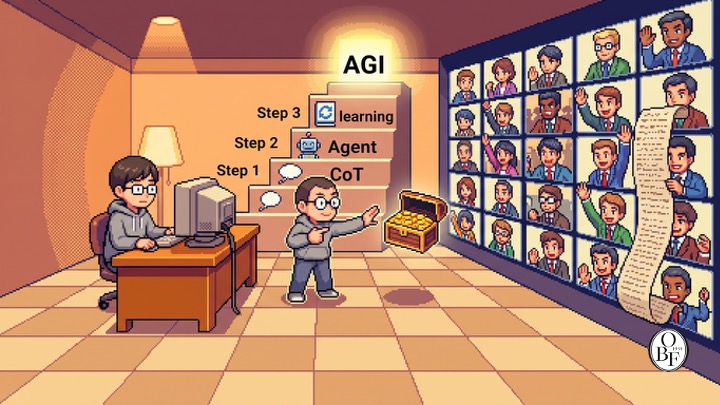 Liang Wenfeng compares the path to AGI to a staircase. Last year’s step was chain-of-thought (CoT)2, this year’s step is agents, and the next step is continual learning3. His diagnosis: “What today’s AI lacks isn’t taste or intuition — it’s the ability to keep learning.” People learn as they work, but AI has to be re-fed the entire context every single time it’s given the same task — which is why it can’t replace an employee. That’s why the first customer for the next-generation model isn’t an external user — it’s DeepSeek itself. “Our first goal isn’t a model that’s easy for everyone to use — it’s a model that’s easy for us to use. That’s the fastest path to AGI.” The step after that is a gradual singularity in which AI accelerates AI research, and at the end of that lies embodied intelligence4 moving out into the physical world. The immediate priority is clear: focus on general-purpose agents — coding agents above all — and push verticals like finance and healthcare down the list.
Climbing this staircase requires two things. One is compute. Of everything said in the meeting, I found this line the most honest: “We’re training a model of this size not because we think this size is enough, but because this is all the resources we have.” It’s an admission that the low-cost approach that became DeepSeek’s trademark was, before it was a virtue, a product of constraint. The internal record also reportedly contained optimism that the remaining challenges in the domestic chip ecosystem would be resolved before long.
The other is the team. The fact that Liang Wenfeng emphasized the condition “don’t poach our people” means DeepSeek sees talent outflow as a major risk. That doesn’t mean this represents every term of the investment deal, or that it’s the single biggest problem across China’s entire AI industry. In fact, DeepSeek’s researchers have consistently been named the hottest recruiting targets in China’s AI industry, and there have been multiple reports of big tech firms repeatedly trying to poach them. Liang Wenfeng says this funding round has “largely resolved the biggest risk, which was team stability.” The use of funds I’m focused on is securing the capacity to retain researchers and keep pushing into the next phase of research.
This round also connects to what we’ve covered this week. As we covered the day before yesterday, China has begun locking down AI models and chips as state assets, and as we covered yesterday, the US is internally divided over Chinese open models. Right in the middle of that, DeepSeek — one of China’s leading AI companies — has received a combination of strategic capital from firms like Tencent and CATL, state funds, and money from the founder himself. If the US channeled market capital into OpenAI, DeepSeek instead got a combination of state funds, big tech money, and the founder’s own capital. The two countries are fighting the same frontier race with entirely different capital structures.
Oswarld’s Lens
Through my work in GTM strategy consulting, I’ve had many chances to watch startups go through fundraising up close, and I’ve confirmed one principle every time: at the negotiating table, the strongest party isn’t the one making the most demands — it’s the one who doesn’t need the deal.
Viewed through this lens, Liang Wenfeng’s restrained rhetoric wasn’t simple modesty; it was a tool for maximizing negotiating leverage. The outcome bears this out. According to reported terms, the founder retained substantial control and even demanded provisions restricting other investors from poaching talent. That said, we can’t assume every undisclosed contract term necessarily favored the founder.
Still, I’d recommend reading two things with some skepticism. First, what we’re reading isn’t a full transcript of the meeting — it’s meeting content relayed through media. The fact that a 4-hour closed-door meeting emerged as such a polished, quotable narrative could itself be a communications strategy. The story arc of “ordinary people accomplishing extraordinary things” is compelling, but it’s worth remembering that the compellingness itself may have been deliberately crafted. Second, even the participating investors reportedly worried, “Isn’t this too much of a consensus trade?” A deal that many investors agree is promising doesn’t guarantee actual returns. But here’s the variable: this round isn’t purely about financial returns. A large portion of the money involved is aimed less at equity returns and more at securing a seat at the table in China’s AGI development. For capital like this, success or failure can’t be judged by the usual venture-return metrics alone.
One last note on organization. Whether the operating style DeepSeek used at roughly 200 people will hold up in a much larger organization of 2,000 remains to be seen separately. That’s what makes it interesting that Liang Wenfeng himself acknowledged, “Organizations are dynamic, and as the company grows, the structures it needs will emerge.” Whether a company that has built its identity on restraint can maintain this approach after scaling up — I think that’s the next thing to watch with DeepSeek.
Closing
Here’s the summary.
First, DeepSeek closed its first external funding round in the 50 billion yuan range, with Liang Wenfeng himself as the largest contributor. The founder’s additional investment served to reduce the equity dilution that would otherwise come from outside capital.
Second, the message running through the 4-hour meeting was restraint, and the condition Liang Wenfeng emphasized was “don’t poach people.” I read the posture of restraint as a strategy for securing trust and cooperative relationships, and in the restriction on recruiting talent, I saw the company’s concern about retaining its team.
Third, we need to keep watching whether this money is actually used to stabilize the team and fund the capacity for continued learning research.
From Monday’s export controls, to yesterday’s Jensen Huang, to today’s DeepSeek funding — that wraps up this week’s China AI trilogy. Looking at these three issues together, a pattern emerges: AI is shifting from being the business turf of individual companies to a domain where the state directly intervenes.
Have you, dear reader, ever had an experience in negotiation or business where wanting less actually got you more? Maybe you lowered your price and landed a bigger contract, or you chose different terms over equity and ended up winning anyway. Experiences where restraint cost you an opportunity are welcome too. Share them in the comments, and I’ll gather the examples for a follow-up issue on “the strategy of restraint.”
📨 If you have a colleague headed into fundraising or negotiations, pass this issue along to them.
Keep the perspective, not the noise.
We choose one consequential shift and trace what sits beneath it, every other day.
Confirm once to finish subscribing.
Already a subscriber? Sign in to join the conversation


References & Further Reading
Primary sources
- Tencent News, “Liang Wenfeng’s Four-Hour Investor Meeting Transcript”, 2026.7.22. ··· This is the primary source for this piece — the full meeting transcript. If you can read Chinese, I’d recommend checking the original nuances of his remarks directly.
- ChainCatcher, “Four Hours, 118 Answers: Liang Wenfeng’s Internal Talk Addresses Everything”, 2026.7. ··· This version organizes the 118 answers by topic. If the full transcript feels like too much, this is the easier read.
- Huxiu, “Liang Wenfeng’s Investor Meeting: DeepSeek’s Open-Source Restraint Is Driven by an AGI Vision”, 2026.7. ··· An article that interprets the meeting through the lens of a “vision-driven organization.” It lays out the context behind the team-stability conditions well.
- South China Morning Post, “How DeepSeek’s landmark funding secures Liang Wenfeng’s grip”, 2026.6. ··· Coverage of Liang’s self-led ¥20 billion round and the resulting control structure. I used this as the basis for the funding figures.
- Forbes (Anisha Sircar), “DeepSeek Just Raised $7.4 Billion. Here’s The Catch.”, 2026.6.17. ··· An analysis that identifies founder control via a limited partnership as the “catch.”
- Hankyung, “China’s DeepSeek Raises ₩11 Trillion (~$8B) — Liang Wenfeng Retains Control”, 2026.6. ··· The Korean-language report I used as the basis for the won-denominated figures.
Background
- Asia Financial, “China’s DeepSeek ‘Valued at Over $50 Billion’ After Funding Round”, 2026.6. ··· Lets you check the list of participating institutions and the valuation.
- Newspim, “China’s Hard-Tech IPO Big Bang Part 1: AI Frontrunner DeepSeek’s 7x Valuation Jump”, 2026.7.20. ··· Reads this funding round within the broader wave of Chinese hard-tech listings. Start here if you’re curious about IPO speculation.
Related past issues worth reading
- Issue 157: China’s review of AI export controls and reports on domestic-chip data centers
- Issue 158: Reading Jensen Huang’s defense of China models through Nvidia’s stakeholder interests

📝 Glossary
Footnotes
-
Limited Partnership (LP): A fund structure that separates the investors who provide capital (limited liability) from the manager who runs operations (unlimited liability). Liang Wenfeng structured the investment as a partnership in which he himself is the manager — so even as outside money flows in, voting rights and management control stay in his hands. ↩
-
Chain-of-Thought (CoT): A method that has AI work through reasoning step by step rather than simply spitting out an answer. This was the core technology behind the 2025 race for reasoning models, and DeepSeek R1 was the model that represented this leap. ↩
-
Continuous learning: The ability of a model to keep accumulating what it learns on the job even after deployment. Today’s AI, once training ends, has its knowledge frozen in place — closer to a state where you’d have to re-explain the job to the same employee every day as if it were their first day. ↩
-
Embodied intelligence: AI that goes beyond software on a screen to interact with the physical world through a body, like a robot. Liang Wenfeng argued that what ordinary people need isn’t a computer but human labor — and that this is where intelligence ultimately has to arrive. ↩
Related issues
Huang Defends Chinese AI Models Hours After Bessent's Warning
The same day Bessent threatened sanctions, Nvidia's Huang praised China's open models—read why their stakes differ.
BusinessChina Completes 1GW Chip-Only Data Center, Weighs Export Ban
Beijing weighs blocking AI model and chip IP exports as a local firm powers a 1GW data center entirely on domestic chips.
BusinessHow Aging Strains Pension Funding in Europe and Korea
As populations age, the ratio of contributors to retirees is shifting fast—here's how Europe's and Korea's pension systems differ.
Business
Your take shapes the next issue
What resonated most in this issue, or where has your experience been different?