

Google Applies to Release 64 Million Mosquitoes in the US
Google filed a US permit to release up to 64 million male mosquitoes over two years, using Wolbachia-based sterile insect technology.
AI & TechGoogle Applies to Release Up to 64 Million Mosquitoes in the US
Malaria and dengue fever, both spread by mosquitoes, are major public health problems. The species of mosquito that carries disease and the environment it lives in differ by region, so no single control method can solve the problem everywhere.
Google’s Debug project studies a method of breeding mosquitoes and releasing them into the wild. Wild females that mate with the released males fail to reproduce, which reduces the population of the target mosquito species. In a permit application that the US Environmental Protection Agency (EPA) made public in May 2026, Google laid out a plan to release up to 64 million mosquitoes total across California and Florida over two years.
Ways to Supplement Existing Mosquito Control
Disease transmission through mosquitoes involves both the pathogen and the mosquito species. The mosquitoes that carry malaria differ from the ones that mainly transmit dengue fever and West Nile virus. Existing control methods have combined insecticide use with eliminating breeding sites like standing water.
As more mosquitoes develop resistance to insecticides, the same chemicals can become less effective. Depending on the chemical and how it’s applied, other insects can be affected too. The Aedes aegypti mosquito1 breeds even in small containers of water, like flowerpot saucers or discarded tires. Because it’s hard to manage every single one of these spots, we need methods that can supplement existing control efforts.
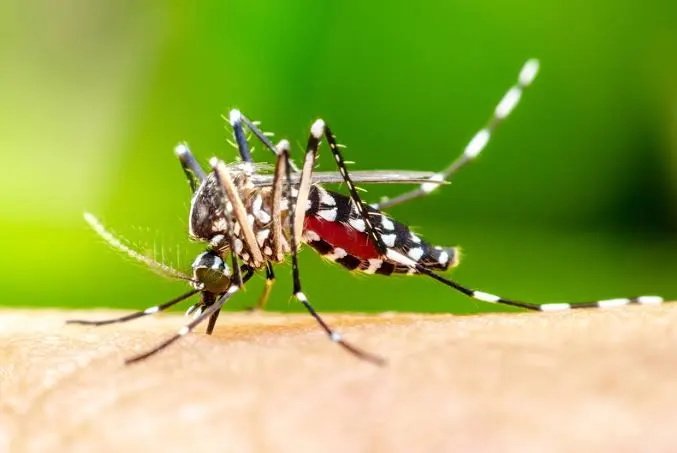
In Korea, too, mosquitoes keep arriving through channels like overseas travel. According to the Korea Disease Control and Prevention Agency’s 2024 infectious disease report, there were 196 reported cases of dengue fever, all of which were cases brought in from abroad. The Asian tiger mosquito, which can carry dengue fever, does live in Korea. But we need to look separately at the number of imported cases versus whether transmission is actually spreading domestically.
That’s why scientists have spent decades researching a different approach: finding ways to stop mosquitoes from reproducing.

How Wolbachia Suppresses Wild Mosquito Reproduction
Debug’s approach involves breeding a mosquito lineage carrying the bacterium Wolbachia2 and releasing the males. When a released male mates with a wild female that’s reproductively incompatible with it, the resulting eggs fail to develop normally. In Aedes aegypti, this incompatibility shows up specifically when a Wolbachia-carrying male mates with a female that lacks it. By releasing such males repeatedly, the technique suppresses the wild population.
The mosquitoes released are exclusively male. Males don’t bite humans, so they don’t transmit disease through blood-feeding. This makes precise sex-sorting during mass rearing critical.
The idea of mass-releasing reproduction-disrupting males isn’t new. Starting in the 1950s, the United States used radiation to sterilize screwworm flies, and declared the native population eradicated in 1966. That’s a classic case of the Sterile Insect Technique (SIT)3. Debug’s Wolbachia-based approach differs in that it exploits bacterially induced reproductive incompatibility rather than radiation-induced sterility, which is why it’s called the Incompatible Insect Technique (IIT).
What Debug has contributed is the engineering to run this method at scale. Rearing, sex-sorting, and release all have to work reliably.
First, millions of mosquitoes need to be raised to consistent quality. Debug has automated processes like feeding and larval rearing. Software engineers, hardware engineers, and biologists work together to develop the equipment and workflows.
Next comes sex-sorting. If Wolbachia-carrying females slip into the mix and reproduce, their offspring will carry the same bacterium, weakening the suppression effect. Debug combines mechanical sorting by size with image analysis, among other methods, to minimize the chance of females getting mixed in.
Release location and volume also need to be precisely calibrated. Debug has developed GPS-guided automated release vehicles, among other tools, aiming to cover wider areas with the same workforce while releasing at the planned locations and quantities.
In the field, excelling at just one of these isn’t enough. If rearing volume falls short or sorting is inaccurate, planned trials become difficult to sustain — and if release location and frequency aren’t right, the suppression effect will vary accordingly.
The English draft matches the Korean source accurately with no meaning distortions, omissions, number mismatches, or glossary violations. No corrections needed.
What the Fresno and Singapore data show
Debug launched in 2016 as research under Verily, and Google now runs the program. It has expanded its reach through US field trials and a partnership with Singapore’s National Environment Agency (NEA).
In Fresno, field releases began in 2017. A study published in Nature Biotechnology in 2020 covered results from releasing 14.4 million males across three sites totaling 293 hectares in 2018. At peak mosquito season, female counts in release areas were 95.5% lower than in non-release areas. That’s a comparison of mosquito populations in the area — not a measurement of reduced human infection rates.
In Singapore, NEA launched Project Wolbachia in 2016, and Debug has partnered on it since 2018. According to Debug’s announcement in May 2026, more than 10 million males are being released weekly. The NEA field study results cited in that announcement were as follows:
- Aedes aegypti population in release areas: suppressed by roughly 80-90%
- Dengue risk in areas with 6-12 months of releases: reduced by more than 70%
The economics have also been studied. Researchers from NEA, the National University of Singapore, and other institutions used 2010-2020 data to calculate cost-effectiveness under an assumed nationwide release program. Assuming a 40% prevention effect, the estimate showed disease-related economic costs could be reduced by roughly $329.4 million. That’s based on 2010 prices — it doesn’t represent money actually saved during that period. It’s a modeling result based on assumed operating costs and effectiveness.
The target of this US trial application isn’t Aedes aegypti but the southern house mosquito (Culex quinquefasciatus)4, the species that transmits West Nile virus and St. Louis encephalitis. Since this trial is testing whether the approach works with a different mosquito species and environment, Singapore’s dengue results can’t simply be applied here.
Per the EPA notice, the requested quantities are up to 16 million per year in each of two states. Combined, that’s 32 million per year, or up to 64 million over two years. The public comment period ended on June 5, 2026. This notice is simply an alert that a trial permit application has been filed — it doesn’t mean the permit has been approved or that releases have actually taken place.
Oswarld’s Lens
What struck me most about this case is that Google chose a level of technology suited to the problem — not the flashiest one available.
In my work doing GTM strategy consulting, I’ve seen plenty of cases where using cutting-edge technology alone doesn’t solve the problem. At Debug, what matters is computer vision for mosquito classification, rearing facilities, sensors, and automated processes. That’s a fundamentally different kind of problem than competing on general-purpose language model performance.
This is exactly why the case caught my attention. When choosing a technology, you first need to define precisely what must be classified or processed, then build the equipment and operational systems capable of repeating that task at scale. Debug’s results are better understood as the outcome of running biology together with rearing, sorting, and release processes in concert — not the product of a single image-recognition model.
Going forward, what matters is how long the effect lasts and whether the operation can be sustained cost-effectively in other regions. It’s also worth watching whether reducing one mosquito species shifts the distribution of others. That doesn’t mean ecological damage has already been confirmed — it’s something to observe as the program scales. I read NEA’s point about needing to keep existing habitat management and pest control running alongside this effort in the same light.
Closing
Debug combines Wolbachia-based biological control with automated rearing, video-based sex sorting, and release equipment. In Fresno, it confirmed a reduction in the target mosquito population; in Singapore, it confirmed both mosquito suppression and reduced dengue risk. The new trial application in the US targets a different mosquito species, so it will need separate verification.
I think this is where AI’s practical value shows up too — in fieldwork like this. Regardless of how much a model can explain in words, there’s real value in a system that can handle classification tasks accurately and consistently, at a scale humans struggle to repeat.
Is there work in your own job that’s hard to scale because it involves repetitive classification or inspection? If so, share in the comments what technology actually helped.
Keep the perspective, not the noise.
We choose one consequential shift and trace what sits beneath it, every other day.
Confirm once to finish subscribing.
Already a subscriber? Sign in to join the conversation


References & Further Reading
Primary sources
- CDC, “Fighting the World’s Deadliest Animal”, 2026. : The official source for grasping the full scale of mosquito-borne disease.
- US EPA Federal Register Notice, “Experimental Use Permit for Debug (Google)”, Docket No. EPA-HQ-OPP-2025-3951, 2026. : The original text of this EPA permit application. The public comment deadline was June 5, 2026.
- Crawford et al., “Efficient production of male Wolbachia-infected Aedes aegypti mosquitoes enables large-scale suppression of wild populations”, Nature Biotechnology, 2020. : The key paper detailing the results of Debug’s Fresno field trials.
Background
-
Korea Disease Control and Prevention Agency (KDCA), 2024 Annual Report on Notifiable Infectious Disease Statistics, 2025.06.26.
-
USDA National Agricultural Library, Records of the Screwworm Eradication Program: 1958–1969.
-
Our World in Data, “What are the world’s deadliest animals?”, 2026. : A well-made data visualization comparing human deaths by animal.
-
Soh et al., Economic impact of dengue in Singapore from 2010 to 2020 and the cost-effectiveness of Wolbachia interventions, PLOS Global Public Health, 2021.10.13. : A cost-effectiveness analysis assuming a nationwide release program.
-
Agarwal et al., “Buzzworthy Solutions: Dengue Control and Energy Consumption”, NUS, 2026. : An interesting study on the side effect of mosquito control reducing household electricity consumption.
-
Debug Project official blog, “Debug expands in Singapore”, May 2026. : The primary source for news of the Singapore expansion.

Footnotes
-
Aedes aegypti (yellow fever mosquito): The mosquito species most responsible for transmitting dengue, Zika, chikungunya, and yellow fever. It lives close to humans, bites during the day, and can breed in even the tiniest pools of standing water, making it notoriously hard to eradicate. ↩
-
Wolbachia: A bacterium found in roughly 60% of insects in nature. When a male mosquito infected with a specific Wolbachia strain mates with an uninfected female, her eggs fail to hatch. This phenomenon is known as “cytoplasmic incompatibility.” ↩
-
Sterile Insect Technique (SIT): A method that typically involves releasing large numbers of radiation-sterilized males to reduce reproduction in wild populations. It’s distinguished from IIT, which exploits Wolbachia-induced reproductive incompatibility, though the two are sometimes combined. ↩
-
Culex quinquefasciatus, also known as the southern house mosquito: A major vector for West Nile virus and St. Louis encephalitis, widely distributed across the southern United States. It’s the target species of this Google EPA application. ↩
Related issues
Nature Launches a TikTok Account to Explain Science
Short videos force tough choices about what context and caveats survive when research meets a 15-second format.
AI & TechSpaceX's $135 IPO Price vs. Morningstar's $63 Estimate
One company, two valuations — the gap comes down to bets on orbital AI data centers.
AI & TechWhat Jensen Huang Said in Taiwan After Visiting Beijing
Nvidia's China sales still hinge on approvals from both Washington and Beijing, even after Jensen Huang's high-profile Asia tour.
AI & Tech
Your take shapes the next issue
What resonated most in this issue, or where has your experience been different?