

The Real Story Behind Italy's 'Pet Sick Leave' Case
One Italian case got mistaken for law—here's what it actually shows, plus Japan's pet leave policies and Korea's numbers.
AI & TechWhen a pet needs surgery or falls suddenly ill, its owner has to make time to take it to the vet and watch over its recovery. If you live alone, even finding someone to look after the animal in your place can be a challenge.
At work, you have to check whether you can use annual leave or adjust your hours. Some companies have set up separate leave specifically for pet care, but the same policy doesn’t apply to everyone.
I want to look at the case of one employee in Italy who was granted such leave, along with the benefits offered by a Japanese company. I also thought about how many pet-owning households there are in Korea, and what companies would need to define if they wanted to build a policy like this.
What Italy Actually Recognized Was One Employee’s Pet Care Leave
What the Italian case actually confirms is that in 2017, an employee at La Sapienza University in Rome was granted two days of paid leave to care for a sick dog. LAV, the animal welfare organization that supported the case, describes it as an instance where the employer recognized the leave under its existing personal-and-family-reasons provision.
A single company approving leave for one employee is not the same as legislation granting a new statutory leave to every worker. This case cannot be cited as the basis for a claim that, starting in March 2026, 3 days of paid pet leave per year became law nationwide. Nor is there any confirmed requirement that anyone with a microchip and a digital veterinary certificate can simply take this leave.
The Two Days Off Requested to Care for Cucciola in 2017
University employee Anna Calabro requested two days of paid leave for a serious personal and family matter when her dog Cucciola fell ill. According to LAV’s 2017 activity report, her employer initially refused verbally. The leave was later granted after LAV helped with a legal review and a veterinarian’s diagnosis was submitted.
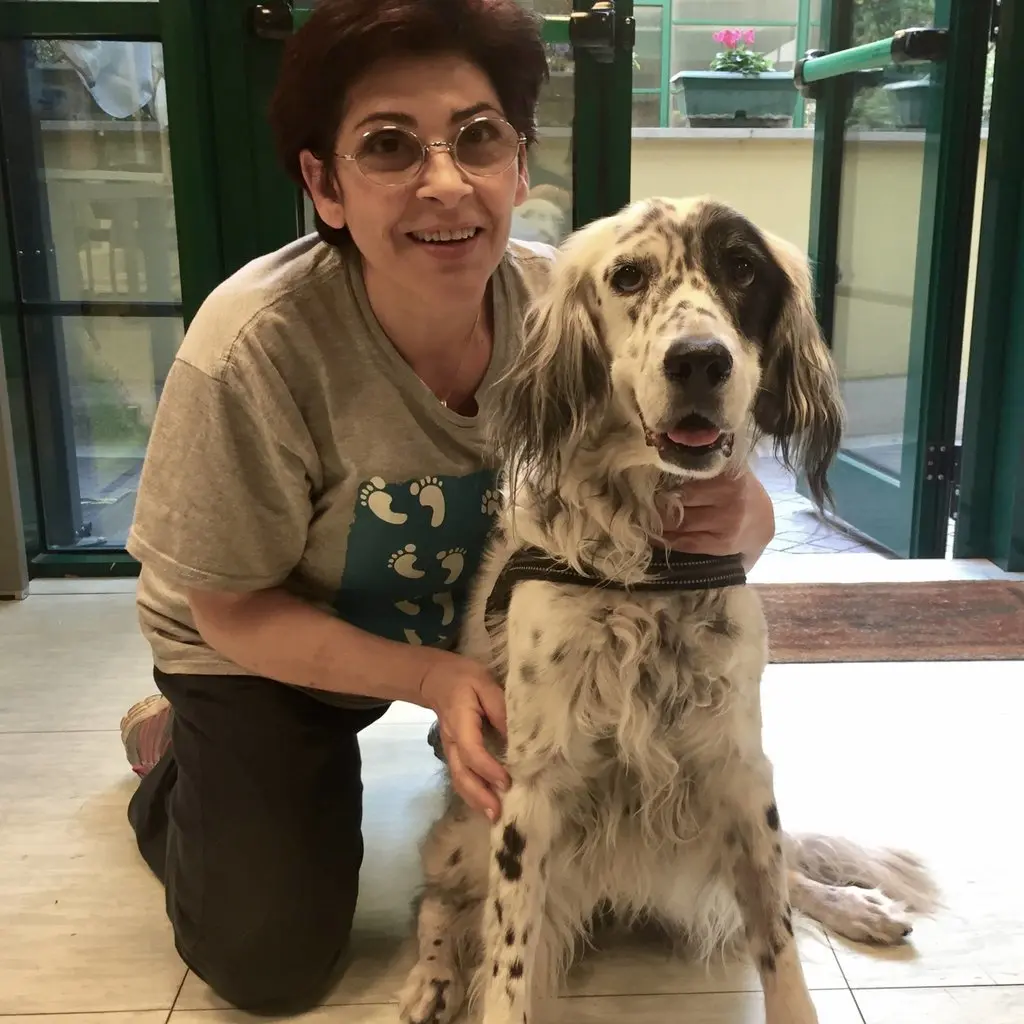
LAV grounded its argument in existing law and precedent holding that failing to provide necessary care could constitute animal abuse or abandonment. In other words, the caregiver’s duty of care was cited as the basis for the leave request. It would be inaccurate to describe this as a case where the employee won a “Cucciola ruling” in court that created a new right.
LAV has since continued to push for the introduction of leave for pet care and pet death. In December 2025, it introduced an amendment to the budget bill proposing two days of paid leave in the event of a pet’s serious illness or death. This document is evidence that the organization pursued institutionalization — it does not mean the proposal was enacted as-is.
The question this case raises is clear: when an employee responsible for a pet’s care needs urgent time off, on what basis should a company grant leave? Relying on an individual manager’s understanding feels very different to an employee than having a predetermined policy in place.
Korea’s pet-owning households number an estimated 5.91 million
In Korea too, caring for a pet is part of daily life for many households. Still, the fact that pet-owning households are numerous and social agreement on a specific paid leave are two separate things worth examining separately.
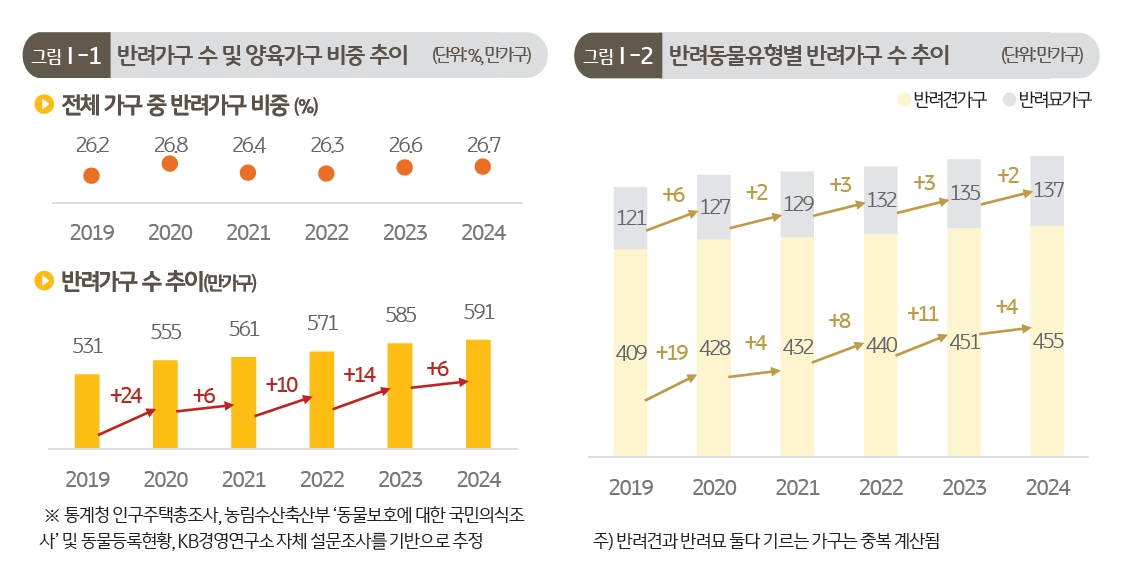
KB Financial Group Management Research Institute’s “2025 Korea Companion Animal Report” estimated that, as of the end of 2024, pet-owning households numbered about 5.91 million, or 26.7% of all households. It estimated the number of pet owners at about 15.46 million, or 29.9% of the total population. This figure combines government statistics, animal registration data, and the institute’s own survey.
Perceptions of pets have also shifted. The response “a pet is a family member” was given by 87.2% of pet-owning households and 68.2% of non-pet-owning households1. That 68.2% agreement rate among non-pet-owners is up from 50.6% in 2018. It suggests that even among people who don’t keep pets, many now understand relationships in which a pet is treated like family.
Caring for a pet also costs money. In KB’s 2025 survey, average monthly pet-care spending was ₩194,000 (~$140) per household, up ₩40,000 from the 2023 survey. Veterinary costs were tallied separately: including households that spent nothing on treatment over the past two years, the average came to ₩1,027,000 (~$740). Alongside cost, how to find time to accompany a pet to the vet or otherwise care for it is an important question too.
Japan offers examples of companies building their own such benefits. A 2017 report by the Kyunghyang Shinmun, a Korean daily newspaper, citing Nikkei, described how the app developer Eureka granted employees 3 half-day leaves a year to take pets to the vet. Unicharm was reported to have introduced a policy giving 1 paid day off if an employee’s dog or cat died. These were individual corporate practices at the time, not a statutory leave common across Japan.
There’s no need to frame these cases as a competition between the number of pets and the number of children. It can instead be approached from the fact that family composition and objects of care differ from person to person. The term “multispecies family”2 — describing a family formed jointly by people and pets — is used to capture exactly this kind of relationship.
Still, it’s hard to predict that leave systems will shift in the same direction just because these three countries’ demographic structures are similar. Laws, labor contracts, and company-specific benefit rules all differ.
What Companies Need to Decide When Creating This Leave
If Korean companies are going to discuss pet care leave, they first need to separate statutory leave from company-provided benefits on top of it. And they need to spell out concretely what qualifies as a valid reason for taking leave and how to handle the resulting work gaps.
First, check which system actually lets you take time off. Korea’s family care leave law defines eligible family members as grandparents, parents, spouses, spouses’ parents, children, and grandchildren. Caring for a pet isn’t automatically included here. A company offering leave as a separate benefit is something distinct from statutory family care leave, and the two need to be considered separately.
Second, the policy needs to be something employees can actually use. Companies need to decide whether emergency surgery and routine checkups count as the same qualifying reason, whether leave can be taken in half-days or hourly increments, and who covers the work when someone is suddenly out. If the leave exists in name only, and employees have to read the room every time they apply for it, the whole point gets lost.
Third, you need standards that colleagues can actually accept as fair. Agreeing that pets are family doesn’t automatically mean agreeing to paid leave for them. Companies also need to talk about the care needs of employees who don’t have pets, and the burden placed on whoever picks up the slack. That’s exactly why eligibility, documentation, and the number of days allowed all need to be spelled out clearly.
Oswarld’s Lens

Looking at this issue, I kept coming back to a question I used to ask when mapping out GTM strategy: has our customer’s life changed, and does what we offer actually reflect that new reality? Corporate benefits work the same way. You can’t design a policy that actually helps unless you understand what employees are really struggling with.
What caught my attention in the case of the Italian university employee was that the necessary care was explained and recognized within the existing leave policy — no new rule required. Even before any nationwide law existed, it showed that employers and employees could work through specific circumstances together.
Not everyone who lives with a pet needs the same kind of leave. What support is actually needed depends on whether there’s someone else who can help with care, what condition the animal is in, and how flexible the person’s working hours can be. Rather than setting policy based purely on the number of pet-owning households, I think the first step should be listening to the actual situations that caused people difficulty.
Companies could also introduce this as their own internal benefit and study how it’s actually used — whether it helped employees, whether the application process worked well, whether it ended up dumping extra work on other staff. What matters more than a name to use in recruiting materials is how the policy performs once it’s actually running.
Closing
When discussing pet care leave, we need to distinguish between individual company cases, corporate benefits, and statutory leave. Presenting a single case as if it were every worker’s legal right can leave people who actually need such leave with the wrong expectations.
In Korea, too, more and more people now think of their pets as family. But translating that sentiment into actual workplace benefits requires working out the details—who’s eligible, under what conditions, and how the extra workload gets distributed among coworkers.
If you live with a pet, it’s worth checking what leave or flexible-work options are available to you for those sudden trips to the vet. And if you’ve run into difficulties with this yourself, I’d love to hear about it in the comments.
Keep the perspective, not the noise.
We choose one consequential shift and trace what sits beneath it, every other day.
Confirm once to finish subscribing.
Already a subscriber? Sign in to join the conversation


References & Further Reading
Primary sources
- KB Financial Group Research Institute, 2025 Korea Companion Animal Report, June 29, 2025. Includes household and population estimates, pet-care spending, and perception surveys.
- LAV, 2017 Activity Report, p. 12. Describes how Anna Calabrò was granted two days of paid leave to care for her dog, Cuccola.
Background
- LAV, Proposed animal-related amendment to the 2026 budget law, December 8, 2025. Documents the proposal to introduce leave for a pet’s serious illness or death.
- Korea Law Information Center, Article 22-2 of the Act on Equal Employment and Support for Work-Family Reconciliation. The provision that sets out the eligibility and conditions for family care leave.
- Kyunghyang Shinmun (a major South Korean daily newspaper), “Leave on your pet’s birthday, bringing pets to the office”—Japan’s “pet-friendly” companies expand, July 23, 2017. Citing reporting from Nihon Keizai Shimbun, this piece surveys workplace benefits at Japanese companies at the time.

Footnotes
Related issues
Qwen's Chief Departs as Alibaba Restructures Its AI Unit
Alibaba's Qwen tech lead resigned days before the company launched a new AI business group, Token Hub.
AI & TechGemma 4, GLM-5, and the Real Cost of Running Agents
Google's Gemma 4 and a fresh GLM-5 benchmark reopen the question of what an agent model should actually cost to run.
AI & TechAnthropic's $14B ARR vs. $5B Cumulative Revenue
Run-rate and cumulative revenue mean different things—AI growth figures need cost and retention context too.
AI & Tech
Your take shapes the next issue
What resonated most in this issue, or where has your experience been different?