

SK Hynix Pre-Market Crash Traces to a $45B Hedge Fund Blowup
I trace SK Hynix's brief 30% pre-market plunge and KOSPI's record 17.91% rally to a 30-hour forced unwind of a $45B hedge fund bet.
BusinessJuly 28 Pre-Market: SK Hynix Trades at ₩1,272,000 (~$920)
At 8:00 a.m. on July 28, the moment Nextrade’s pre-market session opened, one share of SK Hynix traded at ₩1,272,000 (~$920), 29.99% below the previous day’s close. The price snapped back into the ₩1,700,000 range within minutes, but that single print was enough to set off the forced liquidation of an overseas derivatives position. That same Friday, the KOSPI surged 1,001.89 points—17.91%—setting new all-time records for both the largest single-day point gain and the steepest percentage rise. SK Hynix itself closed at its daily upper limit, up 29.95%.
The same stock printed minus 30% and closed at plus 30% in the same week. What happened?
I think the only way to make sense of this whiplash is to look at the forced unwind of a hedge fund in San Francisco. A position built on borrowed money by a 25-year-old trader—one that had swelled to $45 billion at its peak—collapsed and was liquidated over roughly 30 hours, and the shockwaves reached all the way into Korean investors’ account statements. Being right about where the market is headed and surviving long enough not to get liquidated are two entirely different things—and that’s the crux of this whole episode.
From a 165-Page Essay to a $45 Billion Fund
Let’s start with the protagonist: Leopold Aschenbrenner. Born in Berlin, he entered Columbia University at 15 and graduated first in his class at 19. He turned down a spot at Yale Law School to work at FTX’s philanthropic arm—and then FTX collapsed. His next job was at OpenAI. In April 2024, the company fired him, citing a leak of confidential information; he countered that the documents he’d shared contained nothing confidential, and that the real reason was a memo he’d sent the board raising security concerns.
Two months later, he posted a 165-page essay titled “Situational Awareness.” It predicted the arrival of superintelligence around 2027, and even proposed launching an investment fund to bet on this trajectory. The essay became required reading across Silicon Valley, and when strangers started reaching out with money in hand, he actually founded a hedge fund with the same name as the essay. That November he raised $100 million from tech industry heavyweights—early investors reportedly included the Collison brothers, founders of Stripe, and Nat Friedman.
Investor documents reviewed by The New York Times contain an intriguing line: the fund places “no limits” on investment type, position concentration, or use of leverage1. New York’s big money was split on this. Blackstone, the world’s largest hedge fund investor, passed on the opportunity, and one investor said that when he asked what the contingency plan was if AI didn’t develop as expected, he got no concrete answer. The impression was that Aschenbrenner genuinely believed everything would simply work out.
Still, the returns were strong enough that these concerns didn’t matter much. One investor account puts 2025 full-year returns at over 200% after fees, with 439% in the first half of this year alone, and The Wall Street Journal’s tally puts cumulative returns since inception above 1,000%. Reports say assets swelled to as much as $45 billion earlier this month. The New York Times, by contrast, counted roughly $30 billion as of early July—I’ll come back to why these numbers diverge later.
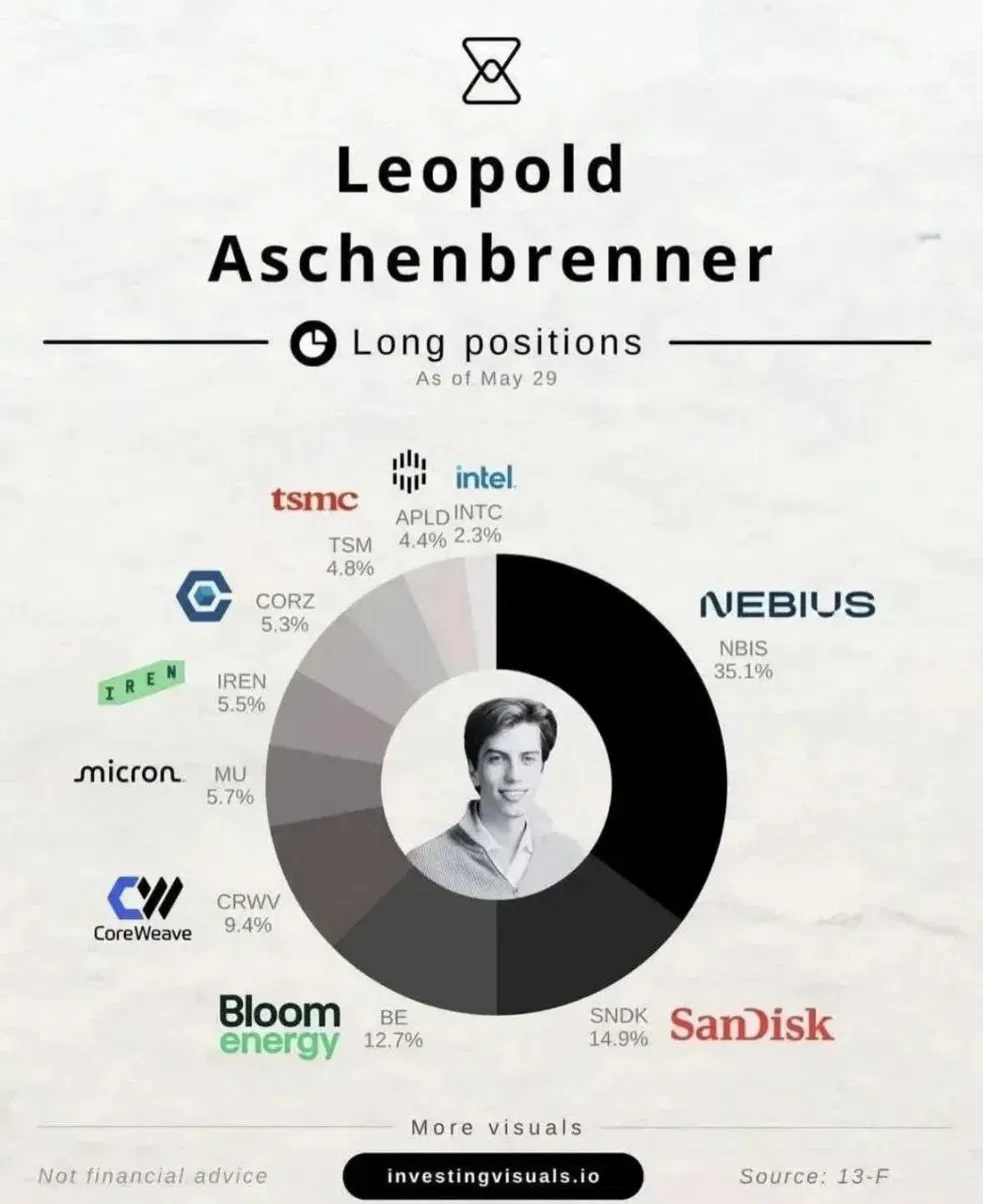 The portfolio was fully tilted toward a bet that AI would succeed. Per an end-of-May disclosure, the fund’s long positions in public equities broke down as: Nebius 35.1%, SanDisk 14.9%, Bloom Energy 12.7%, CoreWeave 9.4%, and Micron 5.7%. On the side that doesn’t show up in disclosures, the fund was a cornerstone investor2 in SK Hynix’s ADR, which listed on the Nasdaq this month. According to the Financial Times, alongside Baillie Gifford and Coatue, it expressed intent to invest as much as $7 billion. On the flip side, it held short positions against software companies like Adobe, betting they’d be displaced by AI. In other words, this fund amplified a single worldview on AI—both long and short—using leverage reported to reach as high as 400%.
The 30-Hour Forced Liquidation and the Math of 4x Leverage
July was the problem. This month, the fund’s major holdings listed above fell more than 35% in a single month, as skepticism spread that AI infrastructure spending wasn’t translating into near-term revenue. But the real problem was on the other side of the book. Software stocks like Adobe — supposedly the ones AI would crush — rallied instead, so both the longs and the shorts moved the wrong way at once. The short positions that were meant to cushion the risk ended up amplifying the losses.
This is where the math of 4x leverage comes in. Put in ₩100 million (~$74,000) of your own money, borrow ₩300 million, and buy ₩400 million worth of stock — a mere 25% price drop wipes out ₩100 million, every cent of your own capital. This is exactly the point that former hedge fund manager Martin Shkreli made about the episode: at 4x leverage, a 25% correction means you’re out, and market prices are often set not by investors as a whole but by the marginal 5% who are running high leverage.
This month’s decline pulled that trigger. Goldman Sachs called in part of its loans, and prime brokers3 like Bank of America and JPMorgan pressed for margin requirements to be met. Aschenbrenner himself described the situation at the time in a letter to investors.
“This was, in essence, a phenomenon similar to a bank run. It was a structure in which one vulnerability gave birth to another.”
Once the market knows exactly what a fund holds and how much, that fund is in trouble. The moment everyone knows a fund has no choice but to sell, selling that stock first becomes the rational move for everybody else. That’s how the 30-hour selling battle began. According to The New York Times, the fund needed to unload roughly $20 billion worth of stock; it initially pitched the position to buyers as a risk-hedging asset, but what was actually inside turned out to be a massive directional bet. Spooked prospective buyers backed away, and in the early hours of Thursday, a phone call between Aschenbrenner and Ken Griffin sealed a deal for Citadel to buy the position at a discount. The FT put the size of this block trade4 at roughly $16 billion — the largest emergency block trade in Wall Street history.
$45 billion and $30 billion, $20 billion and $16 billion — why do the numbers differ so much? I think that gap itself captures what a leveraged fund is. The total position, including borrowed money, and the actual equity behind it can differ by several multiples, and the reported size shifts depending on when you measure it and by what yardstick. That’s why the size of a fund like this is hard to pin down with a single number.
This deal was a factor easing fears of forced selling in last Friday’s rally. When a forced liquidation plays out in the open market, the sell orders flood the order book and trigger a chain reaction of further declines; but when only ownership changes hands through an off-market block trade, that entire process gets skipped. On news that the forced-selling overhang weighing on the market had lifted, the Nasdaq 100 jumped more than 3%, and the next day, South Korea’s KOSPI rose 17.91%. The second-largest gain on record was 11.95%, recorded on October 30, 2008, the day the Korea-US currency swap was announced. Korea’s top two single-day stock market gains weren’t recorded on days when corporate earnings or the economy improved — they came on days when some external measure or deal stepped in to head off a crisis.
Last week’s decline was driven both by concerns over AI profitability and by this fund’s debt burden. We also need to recognize that the timing of the loan calls and margin demands, all converging at once, is what amplified the selling pressure.
Echoes of LTCM in 1998, and What’s Left in the Fund
On the Thursday the sale news broke, Daniel Loeb of the hedge fund Third Point didn’t post a long commentary on X. He posted a purchase link for a book: When Genius Failed, the account of the 1998 collapse of the hedge fund Long-Term Capital Management (LTCM).
LTCM was, in its day, considered the smartest fund around — two Nobel laureates in economics and some of Wall Street’s best traders. It ran sophisticated models at dozens of times its equity in leverage, and the models weren’t, broadly speaking, wrong about direction. The problem was that when Russia defaulted in 1998, markets moved further and more irrationally than the models had anticipated, and for longer. Margin ran out before positions could find their footing, and only after the Fed brokered an intervention — with 14 banks putting up capital — was a market-wide spread averted. In fact, many of LTCM’s bets did eventually converge as expected, after liquidation. The direction was right. The fund simply didn’t survive long enough to see it.
There’s an old market saying — often attributed to Keynes, though the source is unverified — that markets can stay irrational longer than you can stay solvent. At 4x leverage, a single 25% drawdown wipes out your equity. There’s almost no room to wait it out.
That’s the line that jumped out at me most in Aschenbrenner’s letter.
“If AI stocks fell sharply even as the technical and business fundamentals of AI companies were actually improving, it’s naturally expected that our fund would also record substantial losses.”
This is probably true. His outlook on AI may well end up being correct. But what this episode actually proved is the opposite proposition: whether a forecast is correct and whether a fund survives are two separate variables. By the letter’s own unaudited estimates, the fund is down 67% in July alone this year, while still up 80% year-to-date. Same strategy, same person, two very different numbers.
The winner’s seat is a familiar one, too. Citadel’s Ken Griffin played white knight during the 2006 Amaranth collapse as well, scooping up distressed assets on the cheap. But it’s hard to read this acquisition as a simple bargain buy on AI stocks. Some in the market are reading it differently: Citadel likely took the entire portfolio at more than 10% below market price while simultaneously shorting the index and related names to strip out directional risk. Indeed, once the forced liquidation ended and short-covering kicked in, names like SanDisk and Nebius rebounded 15–35% off their lows — and if this reading is correct, Citadel was pursuing a discount purchase and a risk hedge at once. If it then unwinds the position gradually as volume recovers, it can convert the gap between the forced-sale price and the market price into profit regardless of whether AI stocks rise or fall. Aschenbrenner borrowed money to bet on the direction of AI stocks; Griffin used his own money to buy at a discount by exploiting a counterparty’s obligation to sell. The point of this reading isn’t just about who called the direction of AI stocks correctly — it’s that there’s a separate strategy built entirely around the gap between the forced-sale price and the market price. The actual profit won’t be clear until we see the eventual disposal prices and hedging costs.
 Roughly $8 billion to $10 billion remains in the fund. Most of it sits in private, unlisted assets, including its Anthropic stake (valued by the FT at roughly $5 billion). Private equity valuations carry wide discretion, so whether the number on the books is the real price won’t be confirmed until the next market correction. The “paper wealth” problem I covered in the last issue applies directly to what’s left in this fund. The fund hasn’t been liquidated — it says it will rebuild its public-equity book entirely with its own capital.
And this fund isn’t the only leverage left standing in the market. By Citadel Securities’ own count, global leveraged ETF assets grew 4.6x, from $47 billion in June 2020 to $218 billion this June, with two-thirds of that — $147 billion — concentrated in semiconductor and tech names. Leveraged ETFs buy when the underlying rises and sell when it falls, every day at the close, to hit their target multiple — which means in a downturn, they mechanically dump the same names at the same time, regardless of any fund manager’s judgment. Aschenbrenner’s margin call has been resolved, but the automatic sell machines that all move in the same direction are still sitting there. It’s also worth noting that it was Citadel itself that tallied up this leverage figure.
Meanwhile, according to The New York Times, he was handling the margin call5 and wedding preparations in the same week — and said the wedding would go ahead as planned. The only thing that changed in the office, apparently, was one newly hired security guard.
Oswarld’s Lens
In my GTM strategy consulting work, I’ve seen it happen more than once: the market call was right, but the company shut its doors first. A founder nails the exact moment the market will open, only to run out of cash six months before that moment arrives. Every time, the same principle held up: conviction about direction and the size of your bet have to be decided separately. The stronger your conviction, the more you want to scale up your exposure—but survival isn’t determined by how strong your conviction is, it’s determined by whether you can survive your worst single month. This hedge fund incident proves the same point. Aschenbrenner may have been winning on the forecast, but he lost on position design.
As someone who works with data, I’d add one more thing: whenever you look at a return, always ask what actually produced this number. A 1,000% return since inception and a -67% month in July are two numbers from the same strategy. Without looking at volatility alongside the return, you can’t tell whether the gain came from skill or from simply taking on outsized risk. The next time you hear someone claim they made several hundred percent using AI, ask about the leverage multiple before you ask about the return.
To be fair, there’s something worth crediting here too. Unwinding all leverage within two days and owning the mistake is actually the kind of response speed worth learning from. But as he wrote in his own letter, the real discipline in fund management is not creating that situation in the first place. I think that sentence is the most accurate summary of this entire episode.
And this isn’t just a hedge-fund story. Last month, there were reports that daily trading volume in Korea’s single-stock leveraged and inverse ETFs reached ₩15 trillion (~$11 billion). Borrowing against conviction carries the same leverage risk regardless of the asset. Betting your career on a single company, or your business on a single client, concentrates risk in a similar way—though that’s worth distinguishing from financial leverage proper. The stronger your conviction that you’re right, the more you need to design first for surviving the stretch where that conviction looks wrong. That’s the conclusion this episode reconfirmed for me.
Closing
First, last week’s wild swings in the domestic stock market were also driven by an AI hedge fund’s forced liquidation and a block deal. Even the largest single-day gain on record came on the day an acquisition deal closed, removing fears of forced selling.
Second, his AI outlook may not have been wrong. But at leverage of up to 4x by press reports, being right about the outlook and surviving without being liquidated were two different things — if you can’t hold the position, being right doesn’t translate into profit.
Third, what’s left in the fund is unlisted equity with wide latitude for valuation, while the market still has $147 billion in leveraged ETFs concentrated in semiconductor and tech stocks sitting exactly where they were. Worth watching: if a downturn hits, these products are structured to mechanically sell the same stocks at the same time.
For the record, this piece is not investment advice, nor is it a basis for judging any specific stock or fund. Please keep in mind that the figures in this piece are based on reporting and unaudited estimates as of publication.
Reader, have you ever been right about the direction of something but couldn’t hold on? Investing, business, career — any of it counts. I’d also love to hear the opposite: times when deliberately dialing down your conviction is what let you survive. Share your story in the comments, and I’ll gather the examples for a follow-up issue on the art of position sizing.
📨 If you have a colleague who trades on leverage, send them this piece.
Keep the perspective, not the noise.
We choose one consequential shift and trace what sits beneath it, every other day.
Confirm once to finish subscribing.
Already a subscriber? Sign in to join the conversation


References & Further Reading
Primary sources
- The New York Times, “Inside the Meltdown of a Wunderkind’s A.I. Hedge Fund”, 2026.8. ··· This is the deep investigative piece that forms the backbone of this issue — the 30-hour sale process and the “no limits” investment memo both come from here. I’d recommend reading it alongside the report on the Citadel acquisition deal.
- CNBC, “Leopold Aschenbrenner Situational Awareness fund: $45B to fire sale”, 2026.7.31. ··· A comprehensive rundown of the fund’s peak $45 billion valuation and how the sale unfolded.
- Quartz, “Situational Awareness hedge fund margin call”, 2026.7.31. ··· Lays out the up-to-400% leverage, the drawdowns in key holdings, and the list of prime brokers involved.
- Newspim, “Citadel’s ‘AI Chip Stock Rescue’”, 2026.7.31. ··· Provides context that SK Hynix ADRs were the epicenter of the losses, plus details on cornerstone investor participation.
- Nate News, “SK Hynix-Driven Derivatives Unwind and the FT Tally”, 2026.7.31. ··· The source for the pre-market execution scene on July 28, the FT’s $16 billion figure, and the description of it as Wall Street’s largest emergency block deal.
- Capital Market News (Jabon), “Citadel Acquires Aschenbrenner Fund’s Holdings”, 2026.8.1. ··· Explains why the block deal triggered a rebound, framed as a shift in how the overhang of shares was absorbed.
- Hankyung (Korea Economic Daily), “Market Wrap: KOSPI Closes at Record-Largest Surge”, 2026.7.31. ··· The KOSPI, Korea’s benchmark stock index — source for the 17.91% figure, the stocks that hit their daily upper limit, and the scale of foreign net buying.
Background
- Roger Lowenstein, When Genius Failed, Random House, 2000. (Published in Korean translation as The Failure of Geniuses) ··· This is the very book Daniel Loeb linked to. Reading it alongside this episode makes for an illuminating parallel with LTCM in 1998.
- Leopold Aschenbrenner, “Situational Awareness: The Decade Ahead”, 2024.6. ··· The original 165-page essay where all of this began.
- Aschenbrenner’s investor letter, 2026.7.30. ··· The letter as disclosed through media reports. It’s the source of the quotations in this issue, and also worth reading as a document of crisis communication.
- Wall Street CN (華爾街見聞), “Leveraged ETF Assets Chart”, 2026.8. ··· The source of the leveraged-ETF data compiled by Citadel Securities. It also offers a glimpse of how Chinese-language markets are reading this acquisition as a liquidity arbitrage play.
- Seoul Shinmun, “Leveraged ETF Trading Volume Plunges”, 2026.7.31. ··· On the domestic single-stock leveraged ETFs that had been trading ₩12-15 trillion (~$8.7-10.9B) a day. This is exactly why this episode isn’t someone else’s problem.
Issues worth reading alongside this one
- Issue 158: Reading Jensen Huang’s Defense of China Models Through Nvidia’s Self-Interest
- Issue 162: The Real-Asset Investments Behind 20% of Global Household Wealth Growth, and US-Korea AI Cooperation

📝 Glossary
Footnotes
-
Leverage: Borrowing money to add to your own capital and enlarge the size of an investment. Both gains and losses scale up accordingly — at 4x leverage, a 25% drop in the stock price wipes out all of your own equity. ↩
-
Cornerstone investor: An anchor investor who commits in advance to taking a large allocation before an IPO. In exchange for effectively guaranteeing the offering’s success, they also absorb outsized losses if the stock falls right after listing. ↩
-
Prime broker: A division within a large financial institution that lends cash and securities to hedge funds and settles their trades. Because it can demand additional collateral when the value of that collateral falls, it holds the fund’s fate in its hands during a crisis. ↩
-
Block deal: A transaction in which a large volume of shares changes hands off-exchange, bypassing the public order book. It allows ownership to change without shocking the market with a sudden supply of shares. ↩
-
Margin call: A demand from a lender for additional collateral when the value of an asset purchased with borrowed money falls. If the borrower fails to post more collateral in time, the asset gets sold off by force. ↩
Related issues
Stock Down 14%, Musk Still Promised Abundance
Comparing three AI safety proposals from Musk, Hassabis, and Zuckerberg against their July earnings and market positions.
BusinessHow a $145M Fine Opened X's Researcher Data
Even with a legal right to it, a professor couldn't get TikTok's data—until a massive fine cracked open X's instead.
BusinessSix AIs Claimed Perfect IMO Scores, Only Two Were Graded
When six AI systems claimed top marks at the same math olympiad, only two submissions actually went through official grading.
Business
Your take shapes the next issue
What resonated most in this issue, or where has your experience been different?