

Takara Tomy's Stock Doubled Selling Spinning Tops to Adults
At a Beyblade tournament, employees swapped business cards instead of after-work drinks.
BusinessBefore They Could Spin Tops in Akihabara, They Had to Swap Business Cards
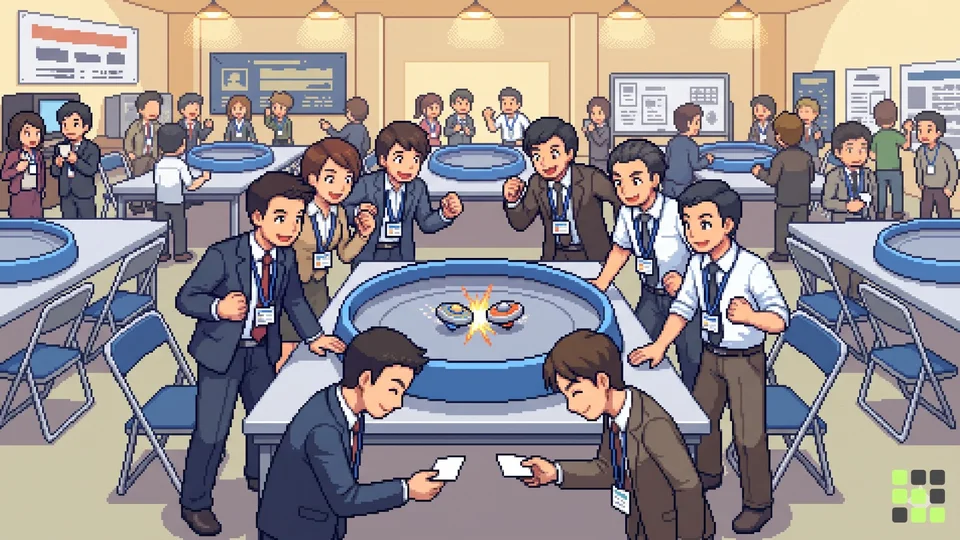
On August 11, 2026, 192 office workers gathered at Akiba Square, an event hall in Tokyo’s Akihabara district. It was the first-ever “BEYBLADE X Corporate Battle,” hosted by Japanese toy maker Takara Tomy. The spinning top known in Korea as “Top Blade” — Beyblade — became the pretext for companies to compete against each other.
The unit of entry wasn’t individuals but organizations. Teams of three from the same company, corporate group, or institution formed 64 squads. Alongside names like Accenture, TOPPAN, Sega, Toys “R” Us Japan, Toei Animation, and Suzuki, there were teams from the Katsushika Ward Office, Koshigaya City Hall, and even a public elementary school in Numazu.
One rule stands out: before every match, opposing teams had to exchange business cards. There was also a separate “Business Card Exchange Matching Battle” corner, where participants could challenge companies they’d just met that day to a rematch.
The championship went to Hokuriku Computer Service, a systems developer headquartered in Toyama Prefecture. Their final opponent was broadcaster BS Fuji. Inspired by the tournament, the winning team started wrapping up work early once a week to gather and spin Beyblades together — and they said that time had become a source of motivation at work.
Nikkei Asia covered the tournament as an example of gaming emerging as a new business networking tool in Japan. But there’s another reason I latched onto this story: the stock price of the company that hosted it. While AI stocks monopolized market attention this year, shares of this toy company — which never pitched itself as an AI growth story — more than doubled.
The “doubling” is measured from May’s low point
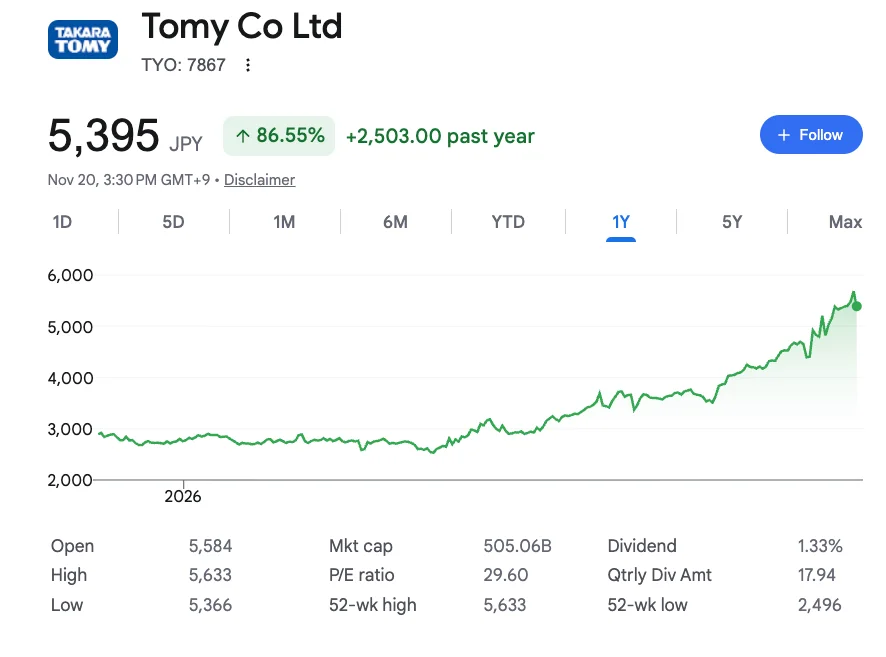
Let’s get the numbers right first. Takara Tomy (Tokyo Stock Exchange: 7867) hit its yearly low of ¥2,496 on May 1, 2026. The closing price on November 13 was ¥5,353 — roughly 2.14 times the low. On November 11, the stock climbed to an intraday high of ¥5,577, surpassing the previous record of ¥5,119 set in February 2025. That’s the highest price since the company went public.
There’s a related fact worth noting here. This same stock had already crossed ¥5,000 back in February 2025, then fell to less than half that within a little over a year. A large share of this “doubling” is simply the stock clawing back ground it had already lost. If you set the baseline at late January instead (the January 30 close of ¥2,725), the gain comes to about 96% — just short of doubling. So when I say “doubled” in this piece, read it as “doubled from the yearly low,” not from some earlier peak.
Here’s what the fundamentals looked like while the stock was at bottom. For the fiscal year ending March 2026, revenue hit an all-time high of ¥270.4 billion, but operating profit fell 2.5% to ¥24.2 billion, and net profit dropped 28.6%. The culprits were goodwill impairment at the U.S. subsidiary and the impact of U.S. tariffs. In short: a company where sales kept growing while profits got squeezed.
The mood shifted after markets closed on October 29. The company raised its guidance for the current fiscal year (ending March 2027) — revenue from ¥285.0 billion to ¥300.0 billion, and operating profit from ¥26.0 billion to ¥30.0 billion. The stock jumped 11.66% the next day, closing at ¥4,922. First-half (April–September) results released on November 10 backed this up: operating profit came in at ¥16.3 billion, up 39.1% year-on-year.
Even this strong result comes with a footnote. First-quarter operating profit included roughly ¥1.0 billion in U.S. tariff refunds — meaning part of the gain was a one-time item. That said, the first-half growth in Japan sales (¥129.2 billion, up 17.3%) and Asia sales (¥44.5 billion, up 30.1%) reflects genuine sales growth, unrelated to any refund.
 Toys adults buy drove the profit
The reasons for growth the company points to are found in its product lineup: Beyblade X, the trading card game “Duel Masters,” the “Tomica” line of miniature cars, capsule toys (gacha), character merchandise from the toy and variety store chain “Kiddy Land,” and sales across Asia. Pokémon-related products, marking their 30th anniversary this year, also contributed. AI appears nowhere on this list.
The word running through this list is kidult1. Takara Tomy has set two pillars for its growth strategy: “expanding the age axis” and “expanding the regional axis.” In other words, get adults buying the toys children used to buy, and expand sales from Japan into the rest of Asia.
The numbers show how far this has already progressed. According to company data compiled by the Japanese financial media outlet Money Plus, about 30% of Beyblade users in Japan are adults. The premium “Tomica Premium” line, launched in 2015, prices its base model at ¥990 — about 1.7 times the ¥594 price of a regular Tomica car — and about 60% of its buyers are adults. The company explains that Beyblade X is spreading as a toy parents and children enjoy together, or that twenty- and thirty-somethings enjoy on their own, since the generation that played with Beyblade as kids has now grown up and had children of its own. There’s good news for Korean readers too: in the first half of this year, Tomica opened its sixth Asian brand store in Korea.
So it would be a mistake to read the corporate tournament as the cause of the stock’s rise. The tournament is simply one scene within the same strategy of growing the adult customer base. A spinning-top company that used to hold tournaments for kids has now created one more reason for adults to bring their tops out, too.
Can a Spinning Top Do What Drinking Did?
The vacancy Takara Tomy is targeting is the drinking session. Japan even has a word for it — “nominication” 2, a blend of “nomu” (to drink) and “communication” — because company dinners and client entertaining were the channel through which workplace relationships got built. That channel is narrowing. In a 2024 survey by Tokyo Shoko Research, only 59.6% of companies held a year-end or New Year party, nearly 20 percentage points fewer than in 2019, before Covid.
What stands out in the survey Nikkei cited is age. The share saying they’d rather avoid drinking sessions was 39% among 46–61-year-olds, 35% among 31–45-year-olds, and 28% among 20–30-year-olds — the older the respondent, the more reluctant. Other surveys point the same way. In a 2023 survey by the Japanese company Daikokuya, the share who said they liked company drinking sessions was 46% in their 20s, 44% in their 30s, 37.6% in their 40s, and 27.6% in their 50s. Contrary to the assumption that it’s young people who hate company dinners, it’s the manager-age cohort that’s actually more worn out by them.
In Issue 226, covering the decline of company dinners in Korea, I wrote that when you abolish an institution, you also lose whatever quiet work that institution was secretly doing. Company dinners were a coercive device, but they were also a channel through which strangers broke the ice and learned what kind of people each other were. Cutting back on forced drinking sessions was the right call — but what would replace the function those sessions served was left blank.
The Beyblade tournament reads as one answer written into that blank. Pull apart its structure and it reproduces, quite precisely, what the drinking session used to do. By folding business-card exchanges into the match’s opening procedure, the rules handle the awkwardness of the first word for you. The match that just ended supplies the conversation topic. When the match ends, so does the occasion — the time doesn’t stretch on indefinitely. People who can’t drink participate exactly the same way, and rank differences show up less on the competition floor. Takara Tomy itself named the tournament’s purpose as giving adults a place to meet directly and build new relationships, regardless of age, title, gender, or language.
Oswarld’s Lens
I think reading this company as merely “a company that rose without AI” misses half the picture. The other half is that it turned a reason for people to meet in person into an actual product.
In Issue #24, writing about why most corporate communities quietly fizzle out, I argued that communities move toward a purpose, and that early on, they need to be nurtured by having a handful of people meet offline, in person. The Beyblade tournament checks that box. Participants have a clear purpose — winning — and business cards and conversation are just byproducts that come along for the ride. People who wouldn’t show up for “come network with us” might well show up for “come spin a top under your company’s name.” The detail that the winning team started meeting every week after the tournament reads to me as a signal worth watching longer than the stock price.
I think the more AI takes over writing documents, emails, and meeting notes, the more precious an excuse for people to gather in the same physical space will become. It’s a stretch to claim Takara Tomy’s earnings prove that outright. But the fact that the company whose profits were lifted by adult customers is also the one building spaces for adults to gather — that’s two numbers pointing in the same direction.
Closing checks out—no issues found.
Closing
Takara Tomy’s “stock price doubled” figure is measured from the yearly low, and behind it lies a track record built by adult customers and sales across Asia. The corporate tournament is one scene that strategy produced. The toy company has put forward its own answer to what might replace what the drinking party used to do. Whether that answer is right depends on whether this tournament is held again — and whether the participants come back.
💬 At your company, has there been a gathering — besides a drinking party — that first got you talking to a colleague or someone from another company? Sports, games, study groups, anything — let us know in the comments.
📨 If you have a colleague or team lead wrestling with drinking-culture questions, pass this piece along.


References & Further Reading
Primary sources
- Takara Tomy Co., Ltd., “Report on the ‘BEYBLADE X Corporate Tournament,’ an Official Event for Working Adults,” PR TIMES, August 12, 2026. Link ··· the source for the 64 organizations/192 participants, the pre-match business-card exchange rule, and the winning team’s comments.
- On-site report on the “BEYBLADE X Corporate Tournament,” Mynavi News, August 2026. Link ··· covers the makeup of participating organizations and the background behind Beyblade X’s user base widening to people in their 20s and 30s.
- Rie Fujikawa, Takara Tomy stock analysis article, MONEY PLUS, November 5, 2026. Link ··· the source for the doubling from the May low, the share of adult users, and the Tomica premium-line figures.
- Takara Tomy FY2027 (fiscal year ending March 2027) interim earnings report article, GameBusiness.jp, November 11, 2026. Link ··· lays out regional sales, growth drivers by product line, and the opening of Tomica stores in Korea.
- Takara Tomy FY2027 (fiscal year ending March 2027) Q1 earnings report article, gamebiz, August 4, 2026. Link ··· includes the roughly ¥1 billion tariff refund and the prior year’s results.
- Article on Takara Tomy’s upward earnings revision (Kabutan), Matsui Securities, October 29, 2026. Link ··· confirms the figures behind the October 29 upward forecast revision.
- Takara Tomy stock price time series, Traders Web. Link ··· the source for the intraday high and closing price in November.
Background
- “Nominication: Japan’s Changing Culture of Company Drinking,” nippon.com. Link ··· compiles data on year-end party attendance rates and drinking preferences by age group.
- “Gaming emerges as a new corporate networking tool in Japan,” Nikkei Asia. Link ··· the article that sparked this piece.
Past issues worth reading alongside this one
- INLEVEL9 Letter Issue 226, “Sober Chimps and Korea’s Drinking Statistics”
- INLEVEL9 Letter Issue 24, “Why Only the Community Manager Ever Posts in Brand Communities”
- INLEVEL9 Letter Issue 105, “The ‘Weak Ties’ Happiness Study That Started at a Hot Dog Stand”

📝 Glossary
Footnotes
-
Kidult: a blend of “kid” and “adult.” It refers to adults who enjoy toys and character merchandise once considered the domain of children, or to the market built around them. Takara Tomy itself calls out this demographic separately in its earnings materials. ↩
-
Nominication (飲みニケーション): a blend of the Japanese word nomu (“to drink”) and the English word “communication.” It refers to the culture of building relationships with coworkers or business partners through drinking sessions. The term is said to have first appeared in the media in the 1980s. ↩
Related issues
Job Ads Now Must Say Whether They're Really Hiring
Ghost job postings serve four hidden purposes—and labeling laws expose which ones survive disclosure.
BusinessA 28-Year-Old Who Calls $248 a Month 'Investment'
A Philippine freelancer's $248 AI subscription equals 29 days of his city's minimum wage.
BusinessAnthropic's IPO Meets a $2 Trillion Private Price
Peter Thiel's longtime partner Jack Selby explains why private valuations keep outrunning the market—and who's left holding the bag.
Business
Your take shapes the next issue
What resonated most in this issue, or where has your experience been different?