

Anthropic's IPO Meets a $2 Trillion Private Price
Peter Thiel's longtime partner Jack Selby explains why private valuations keep outrunning the market—and who's left holding the bag.
BusinessThis week, a private price finally meets the market
Episode 451 of the podcast “How I Invest,” released on November 4, featured Jack Selby. He joined PayPal in its early days, took charge of the company’s international business at 25, and after PayPal was sold to eBay, co-founded the hedge fund Clarium with Peter Thiel. He’s still a managing director at Thiel Capital, Thiel’s family office. By his own account, he’s known Thiel for 28 years and worked alongside him for 27. He also runs Copper Sky (formerly AZ-VC), an Arizona-based venture fund, and is currently raising its second fund.
What this man said over nearly an hour was quite unequivocal. The AI bubble is beyond debate, he says — the only question is not “if” it bursts, but “when.” He even goes so far as to say that anyone who genuinely believes there’s no AI bubble right now is the real contrarian investor. He warns that once the cycle turns, tens of billions of dollars — potentially hundreds of billions — will go to zero.
There’s a reason to read this warning this week. Anthropic, the company Selby held up as his prime example, is going public this week. Per the amended registration statement filed on November 10, the targeted IPO price range is $70–78 per share, and the fully diluted1 valuation at the midpoint runs anywhere from $1.2 trillion to $1.4 trillion, depending on which tracker you check. The figure that had been circulating among investors all summer was $2 trillion. Pricing is set for the 18th, U.S. time, with trading on Nasdaq expected to begin on the 19th.
Rather than dwell on the prophecy that “the bubble will burst,” this issue follows a single line Selby draws. He calls himself an investor, and calls the venture market of the past few years a trading market. Follow that distinction, and it becomes clear why these prices don’t easily deflate — and who ends up holding what in the meantime.
A Price You Can’t Pull Out a Pencil For
The difference between an investor and a trader, as Selby puts it, is simple. An investor pulls out a pencil, writes down assumptions, and calculates whether this price makes sense given those assumptions. The industry calls this underwriting2. A trader just checks whether there’s a next buyer willing to pay this price.
He states flatly that no one can underwrite Anthropic at $2 trillion. That’s not a claim that the company is bad. It means there’s no way to pencil out cash-flow assumptions that justify that price — which is why, in his view, today’s venture market is a trading market.
The case gets more concrete once you trace where the $2 trillion figure actually came from. The last price at which Anthropic actually raised new money was $965 billion in May. In July, secondary trades on private-share platforms were reported changing hands around $1.2 trillion. In August, the Financial Times reported that six Anthropic investors were expecting a listing above $2 trillion — and in that same report, company management said no target price had ever been set. The $2 trillion figure, in other words, was the expectation of shareholders, not the valuation of the company.
Selby also names exactly who profits in this window. People selling stakes through SPVs3 at a $2 trillion price tag — when the last actual trade was at $1 trillion or $1.5 trillion — are making real money right now, he says. And whoever buys in at the top, once the music stops, stands to lose big.
This week’s IPO price is one of those moments when the music briefly stops. Just looking at the indicative price range, it opened below where summer expectations had set it. That doesn’t mean demand is weak, either — Bloomberg reported on the 11th that order books were already several times oversubscribed relative to the offering size. The final price could still land above the range.
So this IPO price isn’t a verdict that proves Selby right. It’s one data point showing that there’s a gap between the price set by expectations in the private market and the price the public market first puts on the table — and that someone, somewhere, has to absorb that gap.
 Why Zombie VCs Throw One Last Pass
Why does money keep flowing toward prices that don’t pencil out? Selby’s explanation traces back to the 2008 financial crisis.
With interest rates pinned near zero for more than 13 years, investors went hunting for yield, treating tech as a proxy for growth and growth as a proxy for returns. The result: too much money flowed into venture capital — a small asset class compared to private equity — and that money minted a wave of what Selby calls “B-minus or worse” fund managers.
The problem surfaced in 2021. Many firms rode all the way to the top of the cycle without realizing a single gain, then rode right back down. Paper profits simply evaporated. Selby is careful to note this isn’t about calling the market top. The fiduciary duty of a fund manager is to return capital to investors — and that’s exactly what didn’t happen.
The numbers back this up. By PitchBook’s count, since 2022 U.S. venture funds have returned $202 billion less to LPs4 than they’ve collected from them. The average year-five DPI5 for funds raised in 2021 is the lowest this century. Carta’s data shows fewer than one in five 2017-vintage funds has returned even their original principal in cash — and these funds are nearly 9 years old.
So what happens when these firms can’t raise a new fund? Venture funds typically run on 10-year structures, so even without fresh capital, management fees6 from existing funds keep flowing in. Selby calls these firms zombies. The company keeps operating, even as LPs are effectively saying: “We haven’t seen a dollar back in over 10 years, and you haven’t closed a new fund in 3-4 years — go find something else to do.”
This is where Selby’s observation gets sharp. Five years ago, you’d have struggled to find the word “AI” anywhere in these firms’ portfolios. Now every single company gets pitched as an AI company. Because if even one of them gets acquired or goes public, that’s a shot at raising another fund. It’s the venture equivalent of a Hail Mary7 — the long desperation throw at the end of a football game, hoping for a last-second reversal.
Selby traces the durability of this holdout strategy to the structure of the career itself. An investment banker who stumbles at one bank can slide over to another. Venture fund managers have no such ladder. If the fund collapses, it’s not an abstract problem — it’s their kids’ tuition and their mortgage on the line, so they stay on the ship until the end. That’s why the market takes so long to clear. Selby admits he expected this shakeout to be somewhere around innings 5 through 7 of a baseball game by now. In reality, he corrects himself, we’re at best in the 2nd inning.
Megafunds at the Top, Empty Space at the Bottom
The remaining money has piled up at the opposite extreme. Selby says she spent the entire first half of this year traveling every week to meet LPs, and she sums up what she heard in three points: the industry hasn’t returned money properly over the past decade, what venture-friendly capital remains has gone to a handful of megafunds, and whatever’s left after that has poured into glittering late-stage AI deals.
Selby said eight firms took in roughly $70 billion, though PitchBook’s tally differs slightly. US venture fund closings totaled $74.8 billion in the first half of this year, and twelve firms accounted for three-quarters of that. Andreessen Horowitz, Thrive Capital, and Founders Fund alone made up 48.1%. The number of firms raising a first-time fund is on track for its lowest count since 2016. The figures don’t match Selby’s recollection exactly, but the direction is the same.
The question Selby raises here is about that empty space. As megafunds grow larger, so does the minimum check size they need to write in one go — so who’s writing the checks under $20 million? Her argument is that even though they share the same “venture” label, a firm managing tens of billions of dollars and a small early-stage fund are effectively different asset classes. We’ve already dissected, using California numbers, how first-half US venture investment was in fact concentrated in just a handful of entities, in Issue 255.
One More Difference From the Dot-Com Era: Capex
The biggest difference Selby points to between the PayPal era and now is capital expenditure. Back in the dot-com days, you didn’t need power, chips, or data centers at anything like today’s scale. Now you need all of it — and raising that much money requires a story that’s just as big, by his diagnosis.
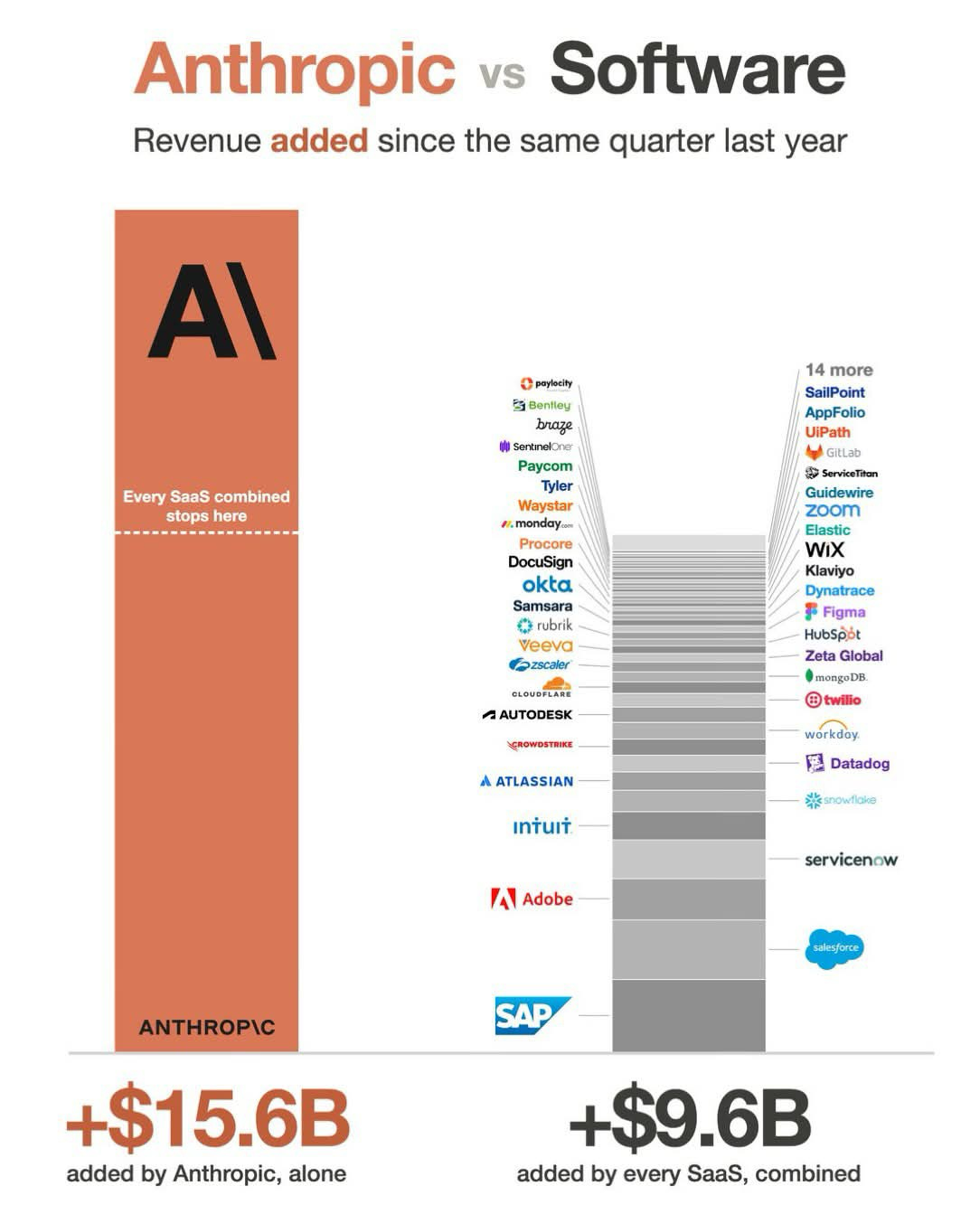
Anthropic’s IPO filings show that scale. According to a draft prospectus obtained and reported by Reuters, Anthropic has locked in at least $518 billion in computing commitments with six infrastructure partners over roughly the next decade. About 80% of that is non-cancelable or structured as pay-whether-you-use-it-or-not. Its 2025 net loss was $42 billion, of which roughly $34 billion was an accounting charge.
Revenue has climbed sharply. A company that made about $4.6 billion in revenue for all of 2025 brought in $35.3 billion over the 12 months through September 2026. At the same time, commitments worth more than 14 times that 12-month revenue are locked in, mostly non-cancelable. That means there isn’t much cost to cut if the story wobbles — which is exactly why the same numbers get cited both for and against the bubble thesis.
Host David Weisburd pushes back, too. Even if 90% of companies are overvalued, if the same vintage produces a handful of trillion-dollar companies, the expected value across that whole cohort can still be high. Selby disagrees. Companies like SpaceX or Anthropic come along maybe once a generation, he says, and betting on finding one early means low odds and a far-too-long road to any payout.
Oswarld’s Lens
I’m an AI optimist, and I’m generally in favor of building data centers. Lately I’ve been traveling to various regions, advising on, designing, and reviewing AI data center projects. When a review request comes in, before I even look at the site or the GPU count, I check whether there’s a confirmed tenant — and whether the lending syndicate is moving on the strength of that tenant’s credit.
Looking at Selby’s distinction through that lens, AI itself contains both a layer calculated with pencil-and-paper arithmetic and a layer that’s watching for the next buyer. Those lending money to data centers calculate based on the tenant’s credit and on non-cancelable commitments. The equity price stacked on top of that, however, leans heavily on the next funding round and the next buyer. Even when the same company name is attached to both, the two numbers are built in entirely different ways.
That’s why the claim that 80% of the $518 billion is non-cancelable reads differently depending on which side of the table you’re sitting at. For those supplying chips, cloud, and data centers, it’s evidence that demand has been locked in by contract. For those lending the money, it becomes a question of how concentrated that credit is in a single company. When I see a big number in AI company news, I find it more useful for judgment to first ask whether that figure came from a contract or from the next buyer’s expectations — rather than simply asking “is this a bubble or not.”
Closing
When I asked him, at the end of the interview, to look back on his career and name a regret, Selby said it was missing the momentum trades. He’d stayed too much the boy scout, maybe too much the cynic, and left money on the table. Even someone convinced a bubble is a bubble doesn’t deny that real money gets made inside one.
Anthropic’s IPO price is the moment when private-market expectations get their first public verdict. Whether it comes in high or low, it won’t settle the bubble debate. But it should make a little clearer how much of that number comes from the pencil — and how much from the next buyer.
💬 Reader, do you think AI company valuations are closer to “expensive, but calculated,” or closer to “betting the next buyer will pay more”? Let me know in the comments.
📨 If you know someone interested in AI investing or this IPO, pass this piece along.


References & Further Reading
E451: Peter Thiel’s 27-Year Partner on the AI Bubble, the Venture Capital Crisis, and the PayPal Mafia (How I Invest with David Weisburd)
📝 Glossary
Footnotes
-
Fully diluted valuation: A company’s valuation calculated as if every stock option, convertible security, and other instrument that could eventually become equity has already converted into shares, on top of shares already issued. Because institutions differ on what they include, the resulting figure varies from one source to another. ↩
-
Underwriting: The work of building your own assumptions about revenue, margins, and growth to judge whether today’s price is actually justifiable. This is what Selby means by “pulling out a pencil.” ↩
-
SPV (special purpose vehicle): A separate legal entity created solely to hold a stake in one specific company. Multiple investors pool money into the SPV, which in turn holds the equity — a structure commonly used to slice up and sell private shares in smaller pieces. ↩
-
LP (limited partner): The pension funds, university endowments, family offices, and similar investors that commit capital to a venture fund. The side that actually manages the fund is called the GP. ↩
-
DPI (distributions to paid-in capital): The ratio of actual cash returned to an LP versus the cash they put in. A DPI of 1x means the principal has been recovered in cash — it does not include paper gains. ↩
-
Management fee: An annual fee the fund manager collects in proportion to fund size, regardless of performance. It keeps flowing in for as long as the fund exists, even if returns are poor. ↩
-
Hail Mary pass: In American football, a long pass thrown toward the end zone in the final moments of a game in a bid to pull off a comeback. The odds of success are low, but you throw it when you’re out of other options. ↩
Related issues
What Happened to Farriers in the 20 Years Cars Replaced Horses
I lined up a 130-year-old newspaper archive against today's AI headlines—and the parallels are uncanny.
BusinessKorea's Midlife Job Programs Define 'Midlife' Differently
35, 40, or 50—the same word points to different people depending on which program you ask.
BusinessAn 18-Year-Old Cosmetics Brand's Adobe Platform Collapse
A quarter of Adobe's revenue comes from its marketing and commerce business, not Photoshop.
Business
Your take shapes the next issue
What resonated most in this issue, or where has your experience been different?