

Why Civilization Has Only Changed One-Third in 35 Years
Sid Meier and his team explain the rule for sequels—and what happened when Civilization 7 crossed it.
BusinessA 43-Minute Making-Of Film for the 35th Anniversary
I’ve been playing the Civilization series regularly since the fourth installment. So I wanted to share a video that went up this week. It’s a 43-minute documentary the gaming outlet Polygon posted on YouTube on October 22nd, titled “The Complete History of Civilization, as Told by Sid Meier and More.” The first game came out in September 1991, making this its 35th anniversary, and Polygon visited Firaxis Games to interview the people who made every installment from the first to the seventh.
The video follows the game’s history in chronological order. But what stuck with me wasn’t the timeline. It was how, with each new installment, the team decided what to change and what to keep—and whose voice they listened to when making that call. Few products keep selling under the same name for 35 years, and this one changed lead designers with every installment, overturning something fairly significant each time. Yet it preserved the “just one more turn” feeling throughout. Today I want to pull out the parts of the interview that explain how they pulled that off.
It Was Done When the Memory Was Full
Sid Meier names 1990’s Railroad Tycoon as his first “god game”1. It was a game that started from a small seed and grew into something bigger. While brainstorming the next project with co-designer Bruce Shelley, the two agreed that what made the game fun was building things up rather than blowing them up, and someone floated the idea of making the subject all of human history. As Meier remembers it, the thought was, “Can we do this? Probably not, but let’s try.”
The first version they built was closer to SimCity. You’d zone an area, watch it grow, and occasionally tweak something—but it wasn’t fun. So they shelved it for a while, made another game, and came back to switch it to a turn-based2 format. Meier says this switch is what saved the game. Once it became turn-based, players’ minds were always somewhere in the future. They’d imagine what would happen once a wonder was finished, once a library was built, once that whole continent was explored. Every playthrough turned out differently, and because your own decisions piled up into your own story, a sense of ownership emerged. Feeling a bit smarter at the end than you were at the start was also part of the fun, he says.
Shelley played a role in this process. Meier would leave a floppy disk on his desk when he went home, Shelley would play it all night, and the next morning he’d report what worked and what didn’t. Meier calls having someone willing to stick with a deeply flawed game and keep playing it the most valuable resource he had.
The technical side is interesting too. The IBM PC of the time had a 640KB memory limit, and the MicroProse team—before Firaxis existed—got around it with a technique called overlaying: swapping out code you didn’t need and pulling in the code for, say, the city screen or the tech screen as needed. To squeeze more information onto the screen, they hand-drew a 3-by-5 pixel font covering letters and numbers, and in 256-color mode they cycled colors to make rivers look like they were flowing. Asked when they knew to stop working, Meier’s answer was: “It was done when the memory was full.”
The launch was quiet. There was almost no marketing budget, and even by the standards of the time, the game was too different from everything else out there. A few months later, co-founder Bill Stealey called from some event to say people were talking about Civilization, and from there it spread as word of mouth, player to player. Meier is emphatic that this part “wasn’t something we designed.”
The One-Third Rule
Asked how he approaches building a sequel, Meier talks about his one-third rule. One-third is proven — the elements that made the previous installment a hit, the kind players would be disappointed to lose. One-third is improvement — things the team could have done better but didn’t know how to at the time, and now, with experience and feedback in hand, can finally fix. The remaining third is new, but with a condition attached: it has to work within the existing system.
The documentary shows how this rule played out, installment by installment. Civilization II was made by Brian Reynolds. When his wife landed a great job in the UK, he packed a hulking portable computer and moved across the Atlantic, returning a year later with Civilization II — complete with Windows 95 support, modding3, and cheat codes. Meier admits he thought most of those additions were bad ideas. Cheat codes especially — until he saw his son summon ten tanks through a cheat and go steamrolling across the screen, grinning from ear to ear, and changed his mind. He decided to just let people play the way they wanted.
In Civilization III, the story centers on Soren Johnson. He joined as an AI programmer, and when studio head Jeff Briggs handed down nothing more than a vague directive — “I want culture to matter” — the job of turning that into an actual working system fell to him. Building a temple could raise your culture score, sure, but that score meant nothing unless it actually changed something. So he made it so that accumulating culture expanded your borders, and once it rose high enough, a neighboring civilization’s border city could flip over to your side. Soft power — claiming territory through influence rather than the sword. Strategic resources followed the same logic. When the team added a rule that you couldn’t build swordsmen without iron, they worried players would hate it. But Johnson believed that constraint was exactly what gave war a reason to exist: “my neighbor has iron and I don’t.” A new system, in his view, needs something at stake.
Civilization V changed the grid. Even back on the first game, the team had seriously discussed hexes4, but settled on squares so as not to rattle players too much. By the fifth installment, they judged that players were ready — and trusted the team enough to go along with it. The one-unit-per-tile rule arrived here too. Before, you could pile units onto a single tile without limit, and fans dubbed it the “stack of doom.” After the change, with units spread across every tile instead, they renamed it the “carpet of doom.”
Civilization VI began with an idea shelved while making the fifth. Tiles outside a city could show what was happening inside it — except that through the fifth game, every city still occupied just a single hex. The team went to Jon Shafer, lead on the fifth installment, twice, proposing that Wonders at least get their own tile. Shafer said no — not yet, it didn’t fit where the fifth game was headed. Ed Beach, on the sixth, finally unlocked that “not yet,” spreading cities across multiple tiles — building a science district beside a mountain, say — and making terrain a central character in the game. The sixth was supposed to wrap up after two expansions, but content kept piling on even past the second one, which added a climate change model, and by the team’s own admission, things got a little excessive by the end — down to a zombie mode.
There’s one precondition that makes this whole rule work: the fact that the team does its research in the children’s section of the library. The point is to let players draw on history they already know and feel smart doing it, so no matter how new an addition is, it has to stay within reach of what a player can pull out of their own head. When Poland was first added in the fifth game, the reaction there was reportedly so strong that the expansion got its own special cover just for the Polish market. After that experience, the team says they grew more careful about which cultures to include — and, at the same time, more eager to make room for even more of them.
I Don’t Trust My Own Instincts
The part of Johnson’s story I’ve turned over the longest is his claim that his real education as a designer began during the patch cycle for the third installment. Before launch, he had no choice but to work in a state of “maybe this is a good idea, maybe it isn’t” — but after launch, feedback poured in. He practically lived on the forums, talking directly with players, and treated each of the third installment’s four official patches like four separate launches.
When he became lead on the fourth installment, he made a somewhat contentious call: build it as a multiplayer game from day one and leave AI for later. Within the first six months, people were already playing together, however crudely. Design for single-player, and one player is the protagonist — every AI reaction and every piece of information on screen gets tuned for that one person’s experience. In multiplayer, fairness matters far more.
Here’s the crux of it. Johnson says he can’t trust his own instincts about design. Whatever design occurs to him naturally looks good to him — but that might just be because it suits his own temperament, and a civilization game has to be a big tent for everyone. So he picked out 100 to 150 influential voices from the community, had them sign NDAs, and handed them the game while it was still in development. This was around 2003, long before you could just send someone a Steam key and call it done — they first had to invent ways to prevent leaks, something that, as far as he knew, no one at that studio had ever done before. The participants logged hundreds of hours starting a year and a half before launch, and real feedback about what worked and what didn’t came in while there was still time to fix it. Johnson calls this the number one reason the fourth installment turned out to be a good game.
Modding, too, was opened up deliberately from the start. All the game data was written in XML and the user interface in Python, so outsiders could tinker with it, and later the studio released the full game and AI code. The fourth installment’s modding community is still active today. This was the game — built this way — that I first picked up.
When Civilization VII Crossed a Line
As work on Civilization VI dragged on, the designers saw the move to VII as a chance to clean house. Beach says it was the most thorough design post-mortem he’s ever been through. They went subsystem by subsystem, asking what stays, what they like, what they’d keep. In the process, he realized the amount they wanted to change had crossed the one-third mark. He even tried to measure the overrun with a spreadsheet — though he admits it’s hard to pin down precisely — and puts it at roughly 20% over. For some systems, even when better ideas existed, he talked the team into leaving them alone because they’d worked well enough in VI.
Still, they touched the core progression structure. Beach says he’d always been bothered by the way a civilization gets its unique abilities only during a specific slice of history, playing as a generic civ the rest of the time. The United States in VI was a case in point — its unique elements didn’t switch on until late in the game. Every civilization descended from some lineage, Rome or Greece or whoever, and those cultures were each distinct, so the idea was to let civilizations stay distinct across all of history. That’s what led to the era system5, where players switch civilizations as the age changes.
The reaction was split. Many of the core players who’d been with the series since the first game didn’t want that direction — they wanted to preserve the fantasy of taking one civilization from start to finish. Newer players, on the other hand, included people who called it the best thing the series had ever done. The documentary lays both reactions side by side without comment.
Firaxis’s response took shape over the course of a year. To mark the game’s first anniversary in February 2026, it ran a Firaxis Feature Workshop, letting the community playtest features still in development, and the changes refined there shipped as a free update called “Test of Time” on May 19. The most-requested feature was the ability to play a single civilization through the entire campaign, and this update let players choose whether to switch or stay.
Beach admits the update was personally difficult for him — it wasn’t part of his original vision. He concedes something else, too: a fellow designer had proposed that exact approach from the start, and Beach spent hours in the man’s office talking him out of it — and he was wrong to do so. He later went back and told him he’d been right. After the workshop refined a few more core changes, Beach says he knew the May release would land well, and he’s open to running another workshop if needed.
A member of the production team who appears to handle community relations in the documentary calls this a two-way conversation. Just listening and doing nothing doesn’t help anyone, he says. The cycle is: listen, think it over, go back and ask “based on what I’ve experienced, I tweaked this a bit — what do you think?”, and repeat. His judgment is that this produces something better than what you’d get building in a sealed room alone.
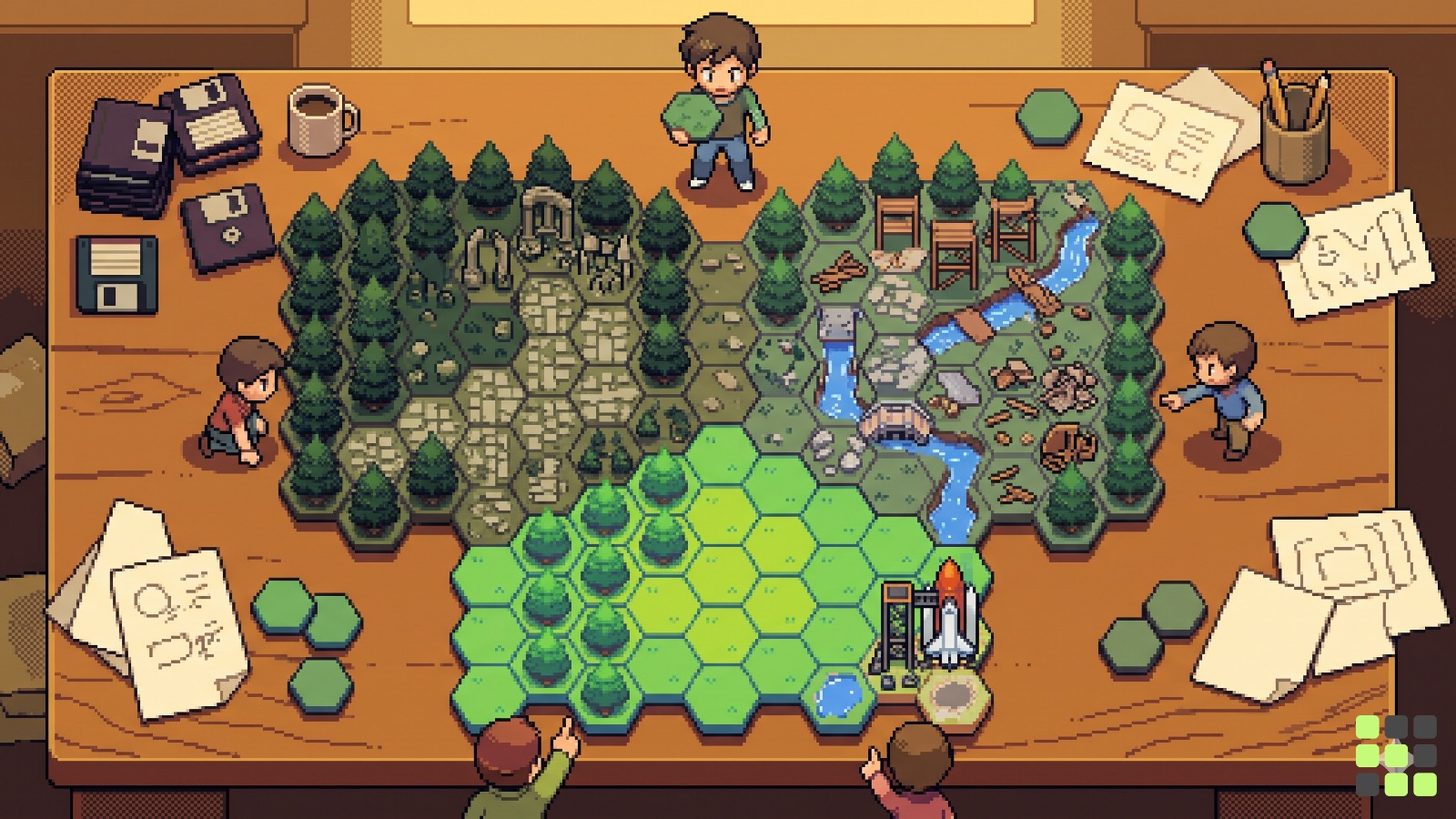
Letting Go
Once Meier finished Civilization I, he said he’d thrown in everything he could imagine and didn’t even want to think about the game anymore. So he went off to build music composition software—about as far from civilization as you can get—and when Reynolds volunteered to take on the sequel, Meier handed it over without hesitation. Watching someone else play with the same toy, he says, is genuinely fun to see. And it freed him up to build new games like Gettysburg and Pirates!. His philosophy is that decisions should come from one person’s head; all he adds is an occasional “that’s cool.” He also says he doesn’t hold onto much ownership over Civilization.
Johnson’s reason for stepping away from Civilization V was similar. Having met every demand the company threw at him on Civilization IV, he said he no longer knew what more there was to ask for. He could have stayed on as creative director alongside Shafer, but he left because he knew he’d end up saying “do it like IV” and making Shafer’s life miserable. Someone needs the chance to make their own mistakes and their own successes—and that’s exactly what Meier had given him. Still, he doesn’t hide his regret that he wished he could have done both: build his own games while staying part of the Civilization family.
Meier says he’d be fine with a tombstone that reads “Sid Meier, Designed Civilization.” Every game feels like a child of his, he says, making it hard to pick a favorite—but Civilization is probably the smart one.
Oswarld’s Lens
What held my attention longest in this documentary was Beach’s spreadsheet. He measured the amount of change he wanted to make as a ratio, judged when it had gone too far, and even after pushing through a few changes anyway, walked some of them back a year later. Most product launches these days lead with how new something is, but a 35-year-old product was keeping separate tallies of what to preserve, what to fix, and what to add. I’d argue the real point isn’t the number one-third itself, but the habit of counting those three categories separately.
The second thing is how they used the community. What the 150 testers on Episode 4 received wasn’t money — it was access a year and a half before launch, and the experience of having their own feedback actually reshape the game. The feature workshops on Episode 7 followed the same structure. In Issue No. 201, I wrote about currencies that only function inside a community — and Firaxis used that currency to buy design, not marketing. That’s exactly where the line falls between a company that treats community as just an acquisition channel and one that treats it as a design institution.
The last thing is the specificity of “I was wrong.” Beach doesn’t blur things into a vague “we incorporated feedback” — he names exactly which feature was proposed by whom, and how many hours he personally spent arguing against it. It’s common for organizations to claim they listen to feedback. It’s rare to see the person who opposed an idea change their position publicly, under their own name. If I had to pick a single reason Episode 7’s comeback was possible, this is the scene I’d point to.
Closing
Watching 35 years of product history unfold in 43 minutes is, inevitably, a summary. Even so, you can see pretty clearly where the designers trusted their own instincts and where they deferred to others. I’ve been playing this game since installment 4, but this is the first time I learned how that 4th installment actually came to be made.
Which installment did you start with, Reader? And was there something you really hoped installment 7 would preserve?
💬 Tell us in the comments which Civilization installment you played first, and what changed in the sequels that disappointed you — or delighted you. 📨 If you know a colleague wrestling with what the next version of an aging product should look like, pass this one along.
Already a subscriber? Sign in to join the conversation


References & Further Reading
Primary sources
- Polygon, “The complete history of Civilization, as told by Sid Meier and more,” YouTube, 2026.10.22. Polygon YouTube channel ··· This is the backbone of today’s piece. Watch the full 43 minutes and you’ll catch the facial expressions and tone of each era’s creators, too.
- CivFanatics, “Polygon releases full documentary on the complete history of Civilization for its 35th anniversary,” 2026.10.23. Link ··· A fan-community writeup that breaks down the documentary’s structure and chapters.
- 2K Newsroom, “Sid Meier’s Civilization VII Charts a New Course with Arc of Tomorrow Update and First Expansion, Earthrise,” 2026.9.5. Link ··· The original PAX West announcement. Confirms Earthrise’s theme and its 2027 release schedule.
- Civilization official site, “Test of Time Update,” 2026. Link ··· Explains the relationship between the free May 19 update and Firaxis’s Feature Workshop.
- Civilization official site, “Firaxis Feature Workshop.” Link ··· How the community playtest program is run.
Past issues worth reading alongside this one
- Pay for Posts and the Community Becomes a Sweatshop ··· On why rewards that only work inside a community end up meeting a different fate than rewards cashed out in the open market.
- Why Almost Every Corporate Community Fails ··· The argument that a community isn’t something you build — it’s something you cultivate.

📝 Glossary
Footnotes
-
God game: A genre in which the player looks down on an entire system — a city, a civilization — from above and grows it. Meier described it as a game where you take a tiny seed and gradually grow it into something fascinating. ↩
-
Turn-based: A format in which play doesn’t flow in real time; instead, the player and opponents each act once per turn, in sequence. This is where the Civilization series’ famous “one more turn” comes from. ↩
-
Modding: When players rewrite a game’s data or code to create new rules, maps, or civilizations. Civilization IV made this easy by writing its data in XML and its interface in Python. ↩
-
Hex: A method of dividing the map into hexagonal tiles instead of squares. Because each tile has six neighbors, movement and combat calculate more evenly. First introduced in Civilization V. ↩
-
Ages system: A structure introduced in Civilization VII that splits a campaign into several ages, with the player transitioning to a new civilization at each age change. Since the “Test of Time” update in May 2026, players can also choose to stick with one civilization throughout. ↩
Related issues
Anthropic Earned $16.8B in Q3. Why Call It 'Over'?
What comparison makes 45% quarterly growth look disappointing—and a slowdown cause I experienced firsthand.
BusinessOpenAI Fired the Researchers Who Studied AI Oversight
A DNS leak, a canceled model launch, and three researcher firings all converged at OpenAI within a single month.
BusinessBrexit at Ten: How Much Has Britain Actually Lost?
Tracing where the '6% loss' figure comes from—and how much of it is really Covid, the energy crisis, and seven prime ministers
Business
Your take shapes the next issue
What resonated most in this issue, or where has your experience been different?