

Same Day Korea's Chips Crashed, China Wanted More Nvidia
Two distinct fears — falling AI demand and China's chip self-sufficiency — collapsed into one selloff, and they hit different businesses.
BusinessThe Same Day, China Wanted to Buy More Nvidia Chips
Yesterday at 9am, the KOSPI opened down more than 5%, around the 6,400 line, and at one point during the session it broke below 6,000. Samsung Electronics closed the day down 13%, SK Hynix down 14%. Both rank among the steepest single-day drops on record for these stocks — three months of gains erased in a single session.
But that same day, a story came out of China telling the opposite tale. Beijing-based Moonshot AI was reportedly moving to secure additional Nvidia Blackwell GPUs to build its next-generation model, “Kimi K4.” The market dumped Korean semiconductor stocks on fear that “China has achieved chip self-sufficiency” — while, at that very moment, one of China’s own frontline AI companies was moving to buy more American chips.
Two fears of a different character are layered into this drop. One is demand fear: “if AI gets cheaper, fewer chips will be needed.” The other is substitution fear: “China is now making its own memory and equipment.” What’s mixed together here is a change already confirmed by production and sales data, and a forecast that hasn’t yet materialized.
From an All-Time High to a 40%-Plus Drop: One Month, In Order
Let me lay this out chronologically first.
The starting point is June 25th. On that day, Samsung Electronics and SK Hynix both hit all-time highs. SK Hynix touched ₩2,987,000 (~$2,150) intraday, and just before that, it had spent two days overtaking Samsung Electronics as the largest company on the KOSPI by market cap. Some in the industry even compared it to the moment during the 2000 dot-com bubble when Cisco overtook Microsoft as the largest company on the Nasdaq by market cap. Expectations were at their peak.
The first correction came in early July. It wasn’t so much a specific piece of bad news as it was valuation pressure and supply-demand issues. Regulations on single-stock leveraged products tracking Samsung Electronics and SK Hynix took effect, and margin-loan and leverage liquidations amplified the decline. On July 13th alone, SK Hynix fell more than 15%, and by that point the stock was already down 38% from its peak.
The second phase came on July 16th. Moonshot AI released “Kimi K3,” an open-weight model with 2.8 trillion parameters, reviving the question from DeepSeek’s debut early last year: “If AI can be built this cheaply, does the expensive infrastructure spending still make sense?” Semiconductor stocks worldwide wobbled together, and we covered this phase in detail in a previous special issue.
Then came the third phase — this week. The day before yesterday (the 27th), China’s largest DRAM maker, ChangXin Memory Technologies (CXMT), listed on the Shanghai stock exchange and surged 466% on its first day of trading. That same night, The Information reported that “China has begun mass production of immersion DUV lithography equipment1.” Yesterday, the Korean market priced in both events at once. The KOSPI fell as much as 9% intraday, briefly slipping below the 6,000 mark before closing around 6,100, and foreign investors net-sold ₩4.8 trillion (~$3.5 billion) in a single day. A leveraged product tracking 2x the combined performance of Samsung Electronics and SK Hynix collapsed 29%, even as retail investors bought ₩730 billion (~$530 million) worth of it.
Cumulatively, Samsung Electronics is down about 38% from its all-time high, and SK Hynix is down about 48% from its intraday peak. The KOSPI itself has slid more than 30% from its high. Yesterday alone, the combined market cap of the two companies shrank by more than ₩370 trillion (~$267 billion) — more than half of the Korean government’s annual budget.
It looks like the same kind of decline each time, but what the market feared changed from phase to phase.
The First Fear: If AI Gets Cheap, You Need Fewer Chips
The logic behind the demand-collapse worry goes like this: if China can offer near-frontier-performance models cheaply and even open-weight, US Big Tech’s need to keep pouring money into massive infrastructure shrinks. Fewer GPU orders mean fewer HBM2 orders for the chips inside them. Since HBM is a core revenue driver for Samsung Electronics and SK Hynix, the conclusion follows that Korean memory earnings forecasts need to be cut. This is the calculation that Kimi K3 revived.
It sounds plausible. But in just the past few days, three facts have emerged that undermine the premise of this calculation.
First, there’s Moonshot AI’s own behavior. According to reporting by The Information, Moonshot is preparing K4, a next-generation model far bigger than K3, and trying to secure additional Nvidia Blackwell chips to build it. K3 itself was already trained on Nvidia GPUs, Blackwell included. On the 22nd, Michael Kratsios, director of the White House Office of Science and Technology Policy, publicly stated that Moonshot had obtained GB300 servers and trained the model using access to a GB300 cluster in Thailand. Sources say some training was run in parallel inside China because of data-export restrictions. Alibaba’s latest model, Qwen3.8-Max, is also reported to have been trained on Blackwell. In the very middle of the panic over “efficient Chinese models” crushing chip demand, the companies building those models are hunting even harder for banned chips — including through workarounds.
Second, look at the other end of demand. That same week in the US, AMD and Core Scientific announced an AI data center partnership of up to 2.5 gigawatts. The deal starts at over 500 megawatts from 2027 and scales up in stages. 2.5 gigawatts is more output than two large nuclear power plants combined, all dedicated to AI compute. That’s not the kind of deal you sign in a market where demand is collapsing.
Third, there’s history. The fear that “cheaper AI means less infrastructure investment” also rattled markets when DeepSeek broke early last year — but what actually happened over the following year and a half was the exact opposite. As prices fell, usage exploded, and Big Tech’s capital spending actually increased. Jensen Huang made the same point bluntly last week: “free AI is good for hardware.” Granted, he sells chips, so take that with a grain of salt — but at least so far, the data has been on his side.
So my read is that the demand fear behind this latest selloff leans less on freshly confirmed evidence and more on the memory of the DeepSeek shock from early last year. The unveiling of Kimi K3 mostly just reawakened that memory.
The Second Fear: China Makes It Themselves
This week’s fear is a different animal. It’s not a demand story but a supply one — the substitution fear that “China is just going to take that market.” Two triggers set it off.
CXMT, which is already producing and selling. CXMT listed on Shanghai’s STAR Market3 on the 27th and closed its first day at 49 yuan, up 466% from its IPO price of 8.66 yuan. Its market cap hit roughly 3.28 trillion yuan — about ₩712 trillion (~$509 billion) — instantly overtaking ICBC to become mainland China’s largest listed company. The IPO alone raised 57.9 billion yuan, about ₩12.5 trillion. It’s Asia’s largest IPO this year and the biggest capital raise ever by a Chinese chipmaker, and YMTC, the top NAND maker, is also preparing to list before year-end.
And CXMT isn’t some company still stuck at the planning stage. It’s the world’s fourth-largest DRAM maker, accounting for roughly 11% of global DRAM wafer capacity last year — a share projected to climb to 15% by 2028. Right now it’s expanding its footprint by dumping commodity DRAM like DDR4 at about half the market price, and this is happening just as production shifts toward AI servers, pushing commodity DRAM prices to about 8 times what they were a year earlier, as of early this year. Rising prices can widen the room for discounting, but whether it actually turns a profit depends on production costs too. HP, Dell, Asus, and Acer have all begun quality-testing CXMT’s products, and Apple — while lobbying the U.S. government — is running certification on CXMT DRAM for devices it sells in China. Apple tried to bring in Chinese memory back in 2022 too, but backed off after pushback from Washington; this time it’s front-loading the certification and waiting on political approval. Layered on top of the picture of the Chinese government pushing from behind, you now have Western demand pulling from the front.
CXMT is also reportedly converting 20% of its Shanghai fab capacity to HBM3. It’s not the most advanced product out there, but it follows a logical sequence: plow the profits from commodity DRAM into developing higher-spec products.
Chinese-made DUV, still low in volume. The lithography-equipment news that broke the same night is a different kind of story. According to The Information, a Shanghai state-owned company has begun initial mass production of immersion DUV equipment, and plans to supply about 5 units this year to SMIC, Hua Hong Semiconductor, and CXMT, scaling up to about 20 units next year. The company’s name hasn’t been disclosed, but the industry suspects it’s Wiryangseong, a firm believed to be tied to Huawei affiliates, and the Financial Times has reported separately that SMIC has been testing this equipment since September of last year. News of this sent ASML’s stock down more than 8% in a single day. For context, China was ASML’s third-largest market by revenue last quarter — meaning that even as it champions self-sufficiency, China remains one of ASML’s biggest customers.
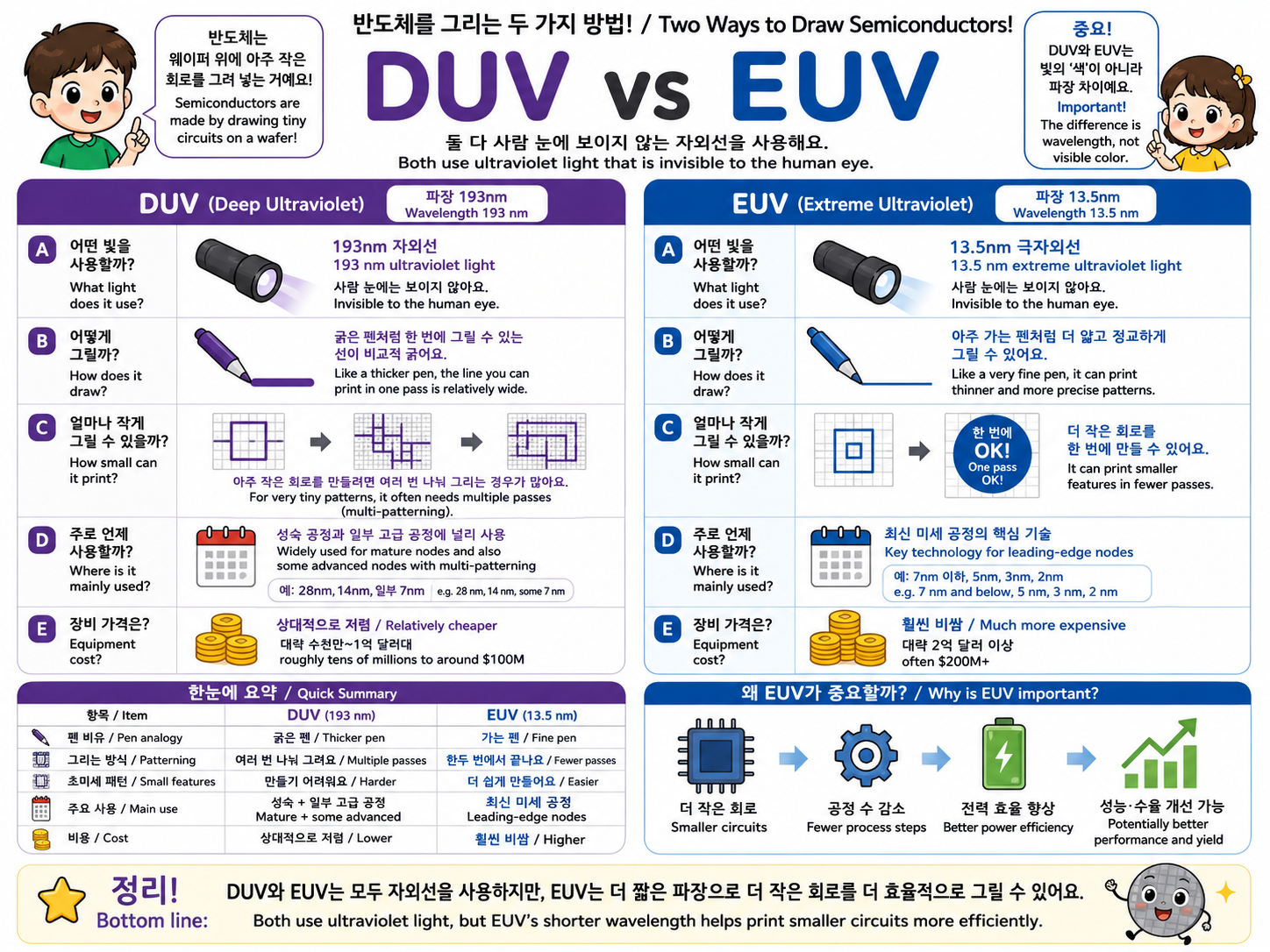 Lithography equipment has long been seen as the last bottleneck standing between China and chip self-sufficiency, so the symbolism here is enormous. But when you look at the actual volume and technology level in hard numbers, here’s what you find. (Speaking as a longtime ASML shareholder, this one stings.)
Start with scale. The 5 units this year come to less than 4% of the 131 immersion DUV systems ASML shipped last year alone (per The Information’s count). Next, the generation gap. This Chinese equipment uses 28nm-class ArF immersion technology — the same tier ASML commercialized back in the mid-2000s. That’s roughly 20-year-old technology, and some key components are still made in Japan. Compared with EUV, and high-NA EUV above that, a fundamental gap of 2 to 3 generations remains — in everything from light source to precision.
The economics are even more sobering. According to Goldman Sachs’ analysis, chasing sub-7nm chips with DUV alone, without EUV, means forcing through multi-patterning4 — etching the same circuit in multiple separate passes — and defect rates spike as the process grows more complex. To produce the same volume of chips, you need exponentially more equipment and investment, and what’s left at the end of that math is a cost structure 40-50% higher than TSMC’s. For reference, even ASML itself started EUV research in the late 1990s and didn’t get it onto a production line until the late 2010s. It took 20 years to turn a single generation of equipment into something usable for actual mass production.
So does that make the 5 units meaningless? I’d argue the opposite: the real significance of these 5 units lies not in replacement but in insurance. Right now, the U.S. Congress has a bill on the table — the MATCH Act — that names SMIC, Hua Hong, CXMT, Huawei, and YMTC specifically, and would cut off not just new exports but even maintenance and technical support for ASML equipment already installed. If that becomes reality, Chinese fabs would have to shut down even the equipment they currently own. Preparing for that scenario, even technologically-behind domestic equipment becomes a way to keep production running independently. That doesn’t mean 5 units can replace all existing equipment, though. This is a possibility I covered in an earlier issue of this newsletter, but the mere fact that it’s now materializing is enough to send shockwaves through the market.
Containment Built China — Now It’s Locking the Door · Issue No. 157 · INLEVEL9 LetterIt turns out U.S. containment actually accelerated China’s self-sufficiency.Here’s the summary. Among the replacement fears, self-sufficiency in advanced HBM and leading-edge processes remains a forecast we still need to watch play out. Production and sales by Chinese firms in mature nodes and commodity DRAM, on the other hand, are already climbing. And according to reports, more than half of Samsung Electronics’ and SK Hynix’s DRAM output is exactly that commodity product.
Demand decline and China’s rising market share need to be seen as separate issues
The two risks affect Korean semiconductor companies in different ways, and they deserve separate treatment.
Demand decline is a question of how big the overall market will grow. China’s rising market share is a question of how much Korean companies can sell within that market. CXMT’s stock surge likely reflects expectations about both the memory market and the company’s own growth, but a stock price alone can’t settle which direction overall demand is heading. It’s entirely possible for overall demand to slow down while Korean companies’ market share also falls at the same time. The two risks aren’t mutually exclusive.
 Korean memory companies in particular could be hit by both slowing HBM demand and declining share in commodity DRAM, separately. So I can’t say yesterday’s sell-off was entirely irrational. That said, I think there were other factors, beyond these two risks, that amplified the drop.
First, the starting point was simply too high. Expectations had already run ahead of themselves — enough that SK Hynix climbed to the top of the market cap rankings and drew comparisons to Cisco — and the bigger the expectations, the bigger the reversal. Second, leverage and margin trading. A 2x leveraged product collapsed 29% in a single day, margin calls cascaded one after another, and forced selling poured in regardless of why anyone actually wanted to sell. Third, correlation. With the KOSPI and the Nasdaq bound together by a single AI narrative, fear in one market now spreads directly into the other.
Goldman Sachs judged the crash to be a psychological overreaction to the news of CXMT’s listing and DUV mass production. Its view: while this represents meaningful self-sufficiency centered on mature-node production, the odds that it shakes the competitiveness of the advanced AI chip value chain or the dominance of leading firms are very low. On the other side sits the “this time is different” camp, who take the threat at face value. I think the key difference between these two views comes down to how long you think it will take China to catch up. It’s hard to imagine the gap in advanced technology narrowing dramatically within the next 5 years, but it’s also hard to dismiss the possibility of China closing that gap over a longer horizon — say, 15 years. I think yesterday’s decline also reflected concern about exactly that kind of long-term outlook.
Oswarld’s Lens
As it happens, two days before this crash hit, I said something to this effect in a media interview: the shock of Chinese AI isn’t that some specific model beat America’s — it’s that China has secured its own models and infrastructure and is now spreading them across the world. And sovereign AI isn’t a matter of having one homegrown model; it’s a question of the entire supply chain, from accelerators and memory to data centers and operating software. Two days later, the market responded to exactly that supply-chain problem, wiping out hundreds of trillions of won in market capitalization.
Building go-to-market strategy taught me something: investors price a product not on its performance today but on its future development and expansion plans. What the market priced in yesterday wasn’t the current output of 5 lithography machines, but the expectation that this fleet would grow over the coming years. Because that kind of expectation can’t be verified with today’s numbers, once fear takes hold, it becomes hard to gauge how far the decline will go.
That said, I’m not on the side of laughing this fear off. The path of starting with commodity products, pushing through on volume, and catching up on technology — it does look a lot like the early stage of something we’ve already been through once with LCDs. What’s different is the timeline. It took 10 years for that catch-up to be completed in LCDs, and memory is a far more technically demanding game than that. This is something to watch closely, yes — but it wasn’t something that should have been fully priced in within a single day.
Closing
This drop is the result of two distinct fears colliding: fear that AI demand is cooling, and fear that China is now building its own memory chips and equipment. China’s self-sufficiency in advanced processes and HBM is still speculative at this point, but its encroachment into commodity DRAM is already underway. What the market priced in yesterday wasn’t the five pieces of equipment themselves — it was a forecast of how far China’s semiconductor independence could ultimately go.
Four things to watch from here: SK Hynix’s Q2 earnings, announced this morning; Hynix’s ADR listing on the Nasdaq, planned for August; how the U.S. Congress handles the MATCH Act; and the pace of CXMT’s entry into HBM. This piece is an analysis of market structure, not trading advice. Investment decisions are your own call and your own responsibility.
Which fear weighs heavier on you in this drop — the demand fear or the substitution fear? Leave a comment with your reasoning, and I’ll round up readers’ perspectives in the next issue.
📨 If you have a colleague who was staring at their portfolio yesterday feeling conflicted, share this piece with them.
Keep the perspective, not the noise.
We choose one consequential shift and trace what sits beneath it, every other day.
Confirm once to finish subscribing.
Already a subscriber? Sign in to join the conversation


References & Further Reading
Primary sources
- Park Ju-pyeong, “Samsung Electronics down 13%, SK Hynix down 14% — three months of gains wiped out (comprehensive),” News1, 2026.7.28. Link ··· I based yesterday’s closing prices and trading-volume figures on this article.
- ”‘#1 with ₩712T (~$540B) market cap on debut day’ — China’s CXMT has Korea’s chip industry on edge too,” Kyunghyang Shinmun, 2026.7.27. Link ··· This has the cleanest rundown of the numbers and context from CXMT’s first trading day.
- “China Starts Mass-Producing Homegrown DUV Chipmaking Tools,” The Information, 2026.7.27. Link ··· The original source for the DUV mass-production report. It’s a paid outlet, so a subscription is needed for the full text.
- “Chinese AI Startup Moonshot Seeks More Nvidia Blackwell Chips for Next Model,” The Information, 2026.7.28. Link ··· The original source for the “the chip China wanted that day” story in the title. A Bloomberg piece citing it also ran.
- Kim Mun-gi, “Breaking through US sanctions with homegrown DUV mass production — is China cracking ASML’s monopoly?,” DigitalDaily, 2026.7.28. Link ··· This is where you can check the details of the MATCH Act and the “maintenance cutoff” context.
- Lee Jeong-hyun, “Apple begins testing China’s CXMT DRAM,” ZDNet Korea, 2026.7.9. Link ··· This is the basis for “CXMT pulled in by Western demand.” The 11%-to-15% capacity-share forecast is also in this article.
- Goldman Sachs, research note analyzing China’s domestic DUV mass-production issue, 2026.7. ··· The source for the 5-versus-131 figure, the 20-year technology gap, and the yield/cost simulations.
Background
- Yang Won-mo, “SK Hynix down 38% from its peak — comparing it to Cisco during the dot-com bubble,” Block Media, 2026.7.14. Link ··· Useful for understanding the trading structure (leverage, margin-call unwinding) of the first correction phase.
- “China’s CXMT pressures Samsung and SK’s HBM4 race by supplying DDR4 at half price,” Korea Herald, 2026.1. ··· The basis for saying commodity-DRAM encroachment is “ongoing.”
- “‘China begins production of DUV lithography equipment’ — ASML shares plunge,” Electronic Times, 2026.7.28. Link ··· Shows how much weight this report carries as seen from ASML’s side.
- Core Scientific, “Second Quarter 2026 Results and AMD Partnership Announcement,” 2026.7. Link ··· Cited as evidence that demand, at least, remains healthy.
Past issues worth reading alongside this one
- Issue 157: China’s review of AI export controls and reports on domestic-chip data centers
- Issue 158: Reading Jensen Huang’s defense of China-market models through Nvidia’s interests
- Issue 159: DeepSeek’s first funding-round terms and its founder’s control

📝 Glossary
Footnotes
-
DUV / immersion lithography: Lithography is the process of etching circuits onto a wafer using light. DUV (deep ultraviolet) is a method that uses deep-ultraviolet light, and immersion lithography improves resolution by filling the gap between the lens and the wafer with water. When even finer circuits are needed, manufacturers move to EUV, which uses a shorter wavelength. ↩
-
HBM (High Bandwidth Memory): Memory that stacks DRAM vertically, like an apartment building, to dramatically widen the pathways data travels through. Because it sits alongside AI accelerators and determines GPU performance, demand for it rises in step with AI investment. ↩
-
Kechuangban (Guachuangban, STAR Market): A technology-focused board of the Shanghai Stock Exchange. Think of it as similar to the US Nasdaq — a market with relaxed listing requirements designed to help advanced-tech companies raise capital. ↩
-
Multi-patterning: A technique for etching circuits too fine for a piece of equipment’s resolution to capture in a single pass, by splitting the process into multiple overlapping exposures. More process steps mean more time, more cost, and more risk of defects. ↩
Related issues
How a 33K-Follower Creator Earns $140,000 a Year
A closer look at the payout breakdown behind one micro-influencer's six-figure income.
BusinessThe Phone on the Table Nobody Asks About Anymore
AI recording has quietly become the default in meetings, and asking for consent is no longer part of the conversation.
BusinessWhy a Freelance Coder Delivers Food Every Night
A Chengdu developer's delivery earnings match his rent to the yuan—a window into freelance wages and Korea's platform labor data.
Business
Your take shapes the next issue
What resonated most in this issue, or where has your experience been different?