

How Yakult Delivery Workers Check on Their Neighbors
Japan's Yakult Ladies and Korea's hy delivery workers quietly track elderly customers' well-being during routine drop-offs.
SocietyThe Well-Being Check That Comes With Delivery
A Yakult delivery worker visits the same houses in the same neighborhood on a regular schedule. Over time, they come to know a customer’s daily rhythms — so when no one answers the door, or products keep piling up unclaimed, they notice something is wrong. Delivering a bottle of yogurt drink becomes an opportunity to check on someone who lives alone.
The BBC recently covered how Japan’s “Yakult Ladies” perform this kind of well-being check. In Korea, meanwhile, hy — formerly Korea Yakult — has been expanding its delivery lineup and building out its logistics business. Set side by side, the two stories might suggest that Japan chose care while Korea chose delivery. But Korea’s “Fresh Managers” have also long been visiting elderly people who live alone. In both countries, delivery and care have been happening together all along.
I’m interested in how a role like this emerges out of a company’s original line of business. On Shuka World, a channel I follow regularly, I came across a similar story about how convenience stores in Japan have taken on various functions that local residents need in their daily lives. With the Yakult case, I wanted to look at how the simple act of meeting the same customers on a regular basis can end up benefiting a community.
In Japan, delivery workers’ actions grew into home-visit programs
The story Yakult shared starts with a delivery worker in Koriyama, Fukushima Prefecture. After hearing that an elderly person living alone had died and gone unnoticed for some time, she began delivering drinks out of her own pocket to seniors living by themselves. Local sales offices and social workers responded, and as municipalities joined in, the practice spread to other regions.
According to official materials, as of 2020, roughly 3,000 Yakult Ladies were making regular visits to over 37,000 elderly people at the request of 131 municipalities and institutions. The delivery routes already existed for sales purposes, and this is a case of that same route being used to check on residents’ wellbeing. This figure reflects the scale of the program at that time — it doesn’t represent the current total number of delivery workers across Japan.
If a worker notices something unusual during a visit, they can contact the police or relevant institutions for help. It’s not that delivery workers handle all medical and welfare tasks themselves. Rather, someone who regularly sees a customer notices a change and connects them to an institution capable of responding.
The case from the 2011 Great East Japan Earthquake is also striking. In a story about a Yakult organization in the affected area, shared by Harvard Business School, when factory operations stopped and drink supplies ran short, some delivery workers voluntarily distributed water and instant cup noodles for free. Management supported this effort, and rather than proposing layoffs, chose to maintain employment.
What stands out here is that the company supported action that started on the ground. The people who knew what customers needed right away moved first, and the organization helped make sure that work could continue.
Korea Has Combined Delivery Business with Welfare Check-ins Too
Korea’s Yakult door-to-door sales began in 1971. Since then, the delivery lineup and methods have changed. The company launched its online mall Freddit at the end of 2020, and in 2021 it renamed itself hy. Beyond dairy products, it now sells fresh food, cosmetics, and household goods through its existing delivery network. The refrigerated electric cart “Coco” is also part of this operation.
hy has tried food delivery apps too, but the effort never really scaled up. hy acquired Vroong in 2023, and “Knowk,” a delivery app run by its subsidiaries, launched in June 2024. The pilot service, run in Gangseo-gu, Seoul, ended in December 2025. At the time, the company said it had tested the viability of a regional market but concluded it wasn’t profitable. This can’t be read as evidence that Fresh Managers as a whole shifted into food-delivery riders.
Separate from these business pivots, hy’s welfare check-in program for elderly people living alone has run continuously since 1994. The company explains that when Fresh Managers deliver health drinks, they also check on residents’ health and living conditions, and contact the local community center or 119 (Korea’s emergency hotline) if something seems wrong. It also runs an “Anbu+” (“anbu” meaning “well-being check”) program in partnership with public agencies.
Yakult Japan’s own earlier official materials likewise describe a program checking on roughly 30,000 elderly people living alone in Korea. There’s little basis for treating only Japan’s version as a social safety net while dismissing Korea’s as a mere side effect. Korea, too, has a track record of linking its delivery network to welfare institutions.
For Regular Visits to Actually Help
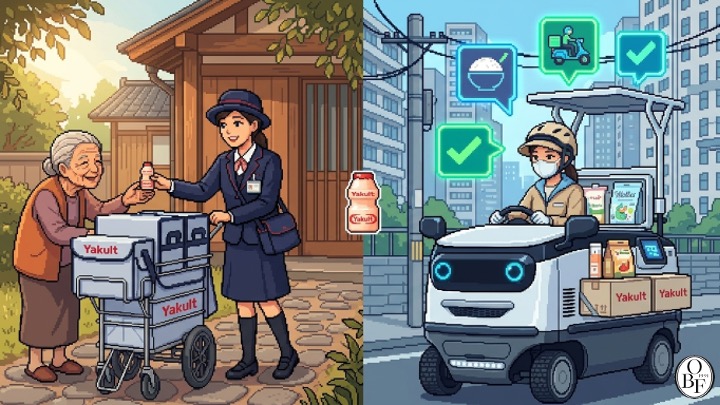
Both Japan and Korea have used beverage delivery networks to check on residents’ wellbeing.
In Japan, welfare-check and isolation-prevention activities for the elderly are called “mimamori.” A 2020 report by the Korea Institute for Health and Social Affairs describes a structure involving local governments, community residents, and private businesses. The Tokyo Metropolitan Government signed agreements with private companies so that employees who notice something unusual during their routine work would contact local authorities or specialized agencies.
What matters in this structure is what happens after something is spotted. Even if a delivery worker notices that someone seems different from usual, it’s hard to actually help if they don’t know who to call. The person making the visit and the institution responsible for follow-up need to be connected. The report also explains that routine welfare checks, regular visits by assigned staff, and responses from specialized agencies need to be linked together in a way that fits each person’s circumstances.
Korea needs to look more closely at this kind of connection too. According to the Ministry of the Interior and Safety, the share of registered residents aged 65 or older had already reached 20% as of December 23, 2024. That’s why elder care in Korea can’t be treated as something to prepare for in the 2030s.
Oswarld’s Lens
Looking at this case, I found myself thinking about what companies can discover within their existing customer relationships. An organization built to deliver beverages on a regular schedule ended up helping notice changes in the life of someone living alone. Needs that weren’t anticipated when a business was first designed can surface in the course of actual operations.
I think turning discoveries like this into a business initiative or a social contribution program requires an organization that listens to what’s happening on the ground. What one delivery worker in Koriyama started grew into something larger only because local distributors, social workers, and municipal governments got involved. Goodwill from a single individual alone would have been hard-pressed to sustain a nationwide effort.
It also makes sense that hy is looking to its existing delivery network for a new growth engine. The ability to reliably deliver a range of products and the ability to notice changes in someone’s life through repeated, long-term contact can coexist within the same operation. As the business scales, it’s worth watching how the latter capability gets preserved.
Delivery efficiency can be measured by how many parcels were delivered and how fast. Checking in on someone’s wellbeing, by contrast, requires time to talk and a procedure for flagging anything unusual. If companies and municipal governments genuinely recognize the value of this kind of work, I think they also need to give the people doing it on the ground the time and support it requires.
Even as automation spreads, there are things you come to know only by seeing the same person, consistently, over time. That relationship is exactly what caught my attention in the Yakult case. Korea already has its own wellbeing check-in efforts underway — it would be worth examining how effectively they translate into real support for residents who need it.
Keep the perspective, not the noise.
We choose one consequential shift and trace what sits beneath it, every other day.
Confirm once to finish subscribing.
Already a subscriber? Sign in to join the conversation


References & Further Reading
- BBC, The yoghurt delivery women combatting loneliness in Japan, March 2026. An article covering the door-to-door visits of Japan’s Yakult Ladies.
- Yakult Europe, Yakult Ladies social pioneers. Introduces the program’s origins in Koriyama and the scale of household visits in Japan and Korea in 2020.
- Harvard Business School Working Knowledge, Why Japanese Businesses Are So Good at Surviving Crises, 2020. Covers how companies and frontline workers responded during the Great East Japan Earthquake.
- hy, Giving, History, Subscription. Official materials explaining the origins of the elderly-living-alone care program, the company’s history, and the Fresh Manager and Fredit programs.
- IB Tomato, hy Ends Business with ‘Vroong’… Prelude to Cleaning Up Loss-Making Subsidiaries?, December 4, 2025. Covers the end of the trial operation of the delivery app Knock and the company’s explanation.
- Deokyoung Lim, Japan’s Safety Confirmation Services: The Potential of Multi-Layered Care Combining IoT and People, International Social Security Review, Spring 2020 issue. Covers a safety-confirmation system linking residents, businesses, and specialized institutions.
- Ministry of the Interior and Safety, Population Aged 65 and Over Reaches 20%, December 24, 2024.

Related issues
Claude's Military Use: Do Principles Hold in Contracts?
I trace Anthropic's clash with Washington through statements and contracts, separating military AI use from human control.
SocietyWhat Huxley's 1961 Interview Taught Me About Algorithms
Huxley's 1961 BBC interview and Island made me question what recommendation algorithms actually optimize for.
SocietyKorea's Top 10 Groups Plan 51,600 Hires—But Where?
Behind Korea's big hiring numbers, most students I meet still picture a Seoul headquarters, not a regional factory floor.
Society
Your take shapes the next issue
What resonated most in this issue, or where has your experience been different?