

Tech Giants vs. Old Money: The Midterm Money Trail
Campaign finance reveals a stark divide: Big Tech bet on Republicans, while Wall Street backed Democrats.
SocietyThe Thursday the Nasdaq 100 Fell 6% in a Single Day
Reader, on Thursday, two days after the November 3 US midterm elections, the Nasdaq 100 plunged about 6% in a single day. The Financial Times (FT) reported that neocloud1 operator CoreWeave tumbled 25% that day, and semiconductor stocks—which had held their ground right after the vote—slumped sharply on Thursday. At the local level, voters backed roughly 40 ballot measures aimed at slowing down data center development.
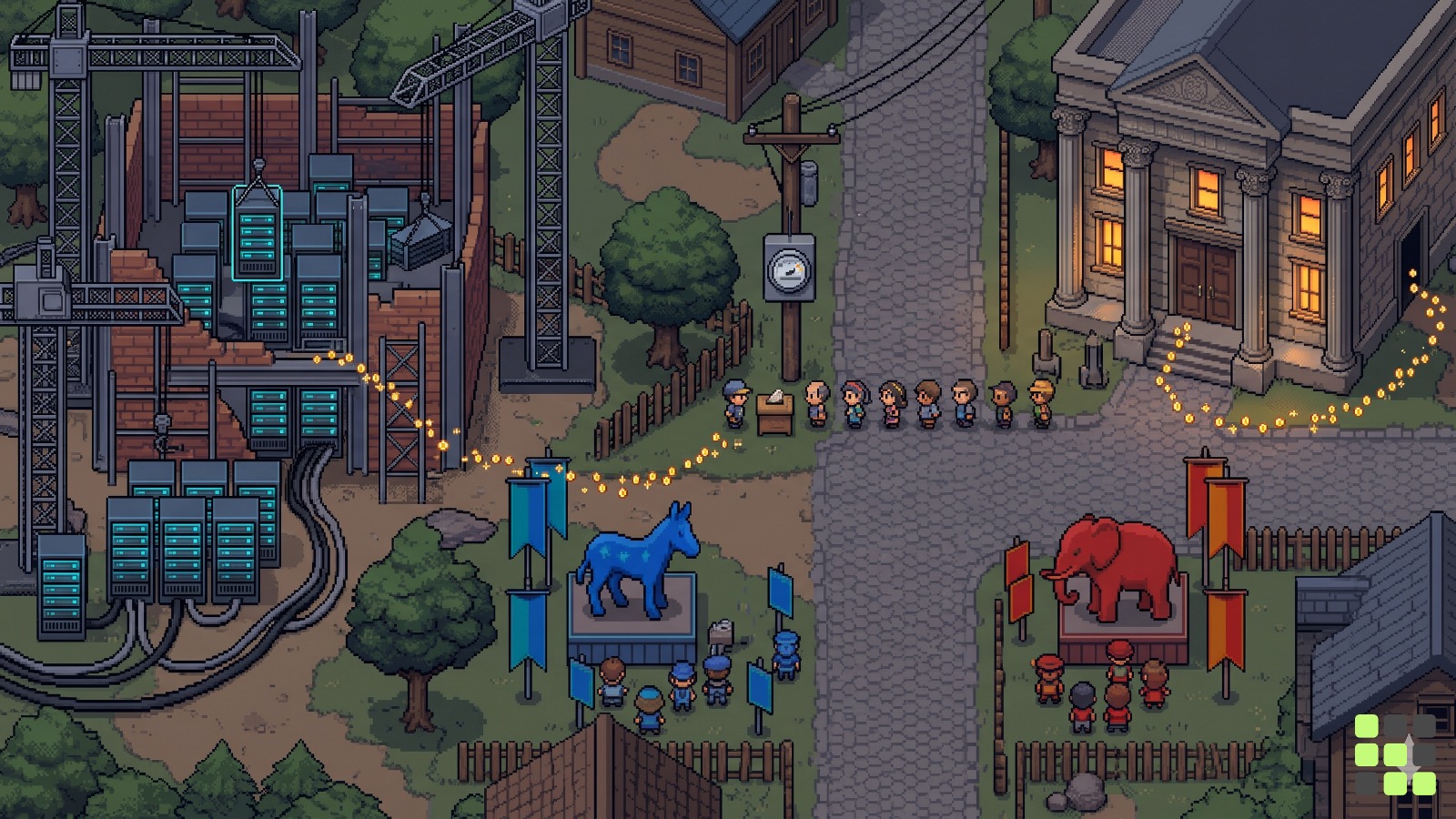
Most post-election coverage focused squarely on the data center backlash: local residents pushing back against electricity bills, noise, and water issues. That analysis is spot on. Yet tracking campaign contributions to each side revealed another layer entirely. This election was a clash where tech capital, represented by the M7, and Old Money, represented by Wall Street, bet on opposing sides.
To be clear upfront: I am an AI optimist and firmly believe we need to build data centers. That is why this outcome offers little comfort for semiconductors and tech stocks. Today’s letter offers an analysis through that lens.
Tech Money Backed Republicans, Finance Backed Democrats
An analysis of Federal Election Commission (FEC) filings by CNBC revealed that 14 of the top 20 donor groups in this election backed Republicans exclusively, or nearly exclusively. The money poured in from crypto, AI, and online gambling alone exceeded $377 million. According to tallies by Foreign Policy, Silicon Valley figures such as Elon Musk, Marc Andreessen, Ben Horowitz, and OpenAI co-founder Greg Brockman and his wife spent over $500 million backing the GOP. Newsweek tallied Musk’s personal contribution alone at $446 million.
The mega-donors on the other side cut a very different profile. George Soros and his son Alex Soros contributed $102 million to their own super PAC2 in this cycle. Newsweek singled out Soros and Michael Bloomberg as notable exceptions atop the donor leaderboard. One made his fortune in hedge funds; the other, in financial data terminals. It looked very much like newly minted tech wealth lining up on one side, and older wealth made in finance standing on the other.
Of course, the lines are never that clean-cut. LinkedIn co-founder Reid Hoffman was among the Democratic Party’s most prominent donors, even directing a pointed message at Musk after the election. Meanwhile, the Financial Services Forum (FSF), representing the 8 largest U.S. banks, established 3 separate entities to deploy tens of millions of dollars, though exactly how much went to which side could not be confirmed. Rather than a showdown between the tech and finance sectors as monolithic blocs, this dynamic is better understood as a map showing where the biggest individual fortunes in each camp originated.
The outcome is well known. The Financial Times concluded that Musk’s nearly $500 million bet on the GOP yielded surprisingly little return, other than hardening animosity on the opposing side. In Texas, Democrat Gina Hinojosa—who pledged to impose a moratorium3 on data center permitting if elected—captured the governorship, while Georgia and Ohio, both hubs for planned data center buildouts, flipped to Democratic governors as well.
What Democratic Party Elders Are Saying on Podcasts
This dynamic came into sharp focus listening to senior U.S. Democrats on podcasts. Their message broadly boils down to four themes: slow down AI development, safeguard personal data against AI, regulate data center construction, and bring wars to a halt.
And it didn’t stay just talk. Senator Bernie Sanders and Representative Alexandria Ocasio-Cortez introduced the AI Data Center Moratorium Act on March 25, 2026—a bill proposing a halt on constructing new AI data centers until federal safeguards are in place. In May, Senator Elizabeth Warren proposed taxing AI firms and data centers, while also investigating the impact of data centers on residential electricity bills.
Democrats, however, are hardly speaking with one voice. Fellow Democratic Senator Mark Warner called a data center moratorium “stupid,” arguing it would only give China a head start. Senator John Fetterman similarly dismissed the bill as “China first.” It is too early, then, to view these four themes as settled party policy. Rather, they serve as a signal of which faction’s voice is growing louder within the Democratic Party.
Presidential rhetoric poured fuel on the fire. According to the FT, President Trump declared in August that opposing data centers meant choosing to “fall behind and get poorer,” and in September he labeled warnings that AI poses an existential risk to humanity a “HOAX.” In effect, he told voters to brush aside their anxieties. In a CNBC voter survey, 56% cited data centers as a decisive or major factor in their vote, and 62% of those who called it decisive chose Democratic candidates. In an NBC exit poll, 57% said AI would do more harm than good to society. Local ballot measures on data centers were voted down in all but a single case.
OpenAI begins by dropping the name “data center”
The tech industry is not standing still either. On November 1, Axios reported that OpenAI was set to launch a policy and public relations blitz right after the election, spearheaded by Chris Lehane, its head of global affairs. Among its proposals is a push to rebrand data centers as “AI compute campuses.” An OpenAI spokesperson told Business Insider that the phrase “compute campus” better captures the scale and function of the AI infrastructure currently under construction. The campaign also includes community benefit agreements with host municipalities, as well as proposed state legislation granting local residents a say in project operations and community benefits.
OpenAI addressed the money question even earlier. In January, the company announced tailored energy plans for each Stargate site, pledging to fully cover the cost of dedicated power and storage facilities or fund new generation and transmission assets depending on local needs. For “Project Camellia”—a 3.2-gigawatt site announced in Georgia this July—OpenAI promised to absorb all necessary grid infrastructure expenses directly rather than passing them on to existing utility ratepayers. Korean media covered the shift under headlines like “Reading the Backlash, OpenAI Pledges to Cover Grid Costs in Full.”
There is another angle worth watching. According to Axios, OpenAI’s campaign will also propose mandatory “speed limits” on the most capable AI systems. While senior Democratic figures call for a broader slowdown across the entire AI sector, OpenAI narrows its scope to frontier models, meaning the two positions are not identical. Still, a major tech firm chose to raise the issue of pacing first, right before the election. Of course, a rebranding will not make data centers consume any less electricity or water. The real question is whether these community agreements and cost-bearing pledges will actually hold up in practice.
Yet Old Money Is Also the M7’s Creditor
At first glance, this reads like a straightforward story of Big Tech losing and high finance winning. Peel back one more layer, however, and Wall Street is hardly standing strictly on the opposite side of the M7. It also happens to be the very faction lending them the cash to build their data centers.
In the past, Big Tech funded data center construction entirely out of its own cash flow. Today, the reality is starkly different. Ahead of the election, Bank of America (BofA) estimated Big Tech’s AI capex for this year at roughly $670 billion, pointing out that this represents 96% of their collective cash flow—up from 40% in 2023. With almost no spare cash left over, the shortfall must be raised in the capital markets.
Meta’s Hyperion data center in Louisiana is a prime case in point. In October 2025, Meta formed a joint venture with funds managed by private alternative asset manager Blue Owl, with total development costs of around $27 billion. Blue Owl holds an 80% stake, and a portion of the financing was raised through bonds issued to institutional fixed-income investors, including PIMCO. According to US media reports, BlackRock bought $3 billion of these bonds, with Morgan Stanley leading the underwriting. S&P assigned the bonds an A+ rating, specifically citing Meta’s backing as the primary justification.
This structure mirrors precisely the criteria I look for in my own advisory work. Lately, I travel across various regions advising on and underwriting AI data center projects. Whenever a proposal lands on my desk, there is something I check long before looking at the land parcel or GPU counts: is there a committed tenant,4 and is a lending syndicate5 willing to move based on that tenant’s credit? The fact that the Hyperion bonds earned an A+ on the back of Meta’s credit works on the exact same principle.
How those lenders viewed this election is visible right in the numbers. Roughly 2 weeks before the election, CNBC cited credit desk sources reporting that the high-yield bond6 market was effectively frozen until after the vote due to political blowback surrounding data centers. Around the same time, yields on CoreWeave bonds had spiked to around 15%.
That is why it is difficult to sum up this battle simply as a triumph of old money over new. In politics, Old Money bet against the M7; in the capital markets, it is the creditor financing the M7’s data centers. If permitting risks mount after the election, these creditors can demand higher interest rates and stricter covenants when lending to the M7. And if developers must shoulder grid expansion costs—as OpenAI has done—the amount they need to borrow will only balloon further. In effect, the money that won in politics is now sitting in the very seat that dictates the terms of Big Tech’s debt.
Oswarld’s Lens
I am an AI optimist, and I firmly believe data centers must be built. Looking at these results from that vantage point, semiconductor and tech stocks have very little to celebrate. The Financial Times noted that mounting concerns over AI will likely face far stiffer scrutiny in a new Democratic-controlled Congress. What veteran Democrats were discussing on podcasts—pacing development, data privacy, and data center regulations—is now far more likely to land on the actual legislative agenda. The FT added that the full magnitude of this blow will only become clear once the permitting landscape settles for projects breaking ground after 2028.
The reason I viewed this election as the M7 versus Old Money came down to following the flow of political donations. Tech heavyweights poured money in one direction, financial elites in the other, and Tech’s bet lost. When OpenAI went so far as to rebrand what it calls data centers and volunteered to shoulder power grid costs, I saw it as an effort to get facilities built by any means necessary under those circumstances.
Looking through the criteria I use in data center advisory work, this election also marks the moment local consent became just as influential as tenant creditworthiness in moving lending syndicates. Even if bonds secure an A+ rating backed by Meta’s balance sheet, you cannot build a data center on land blocked by a local referendum.
The final paragraph of the FT column points to the exact same conclusion. The tech industry has long promised that AI will bring economic abundance and breakthrough cures, but voters do not stay patient with unfulfilled promises for long. The FT warned that if this sentiment persists, the 2028 election cycle could prove an even harsher season for the tech sector.
Closing
Follow the campaign contributions, and this election emerges as a clear parting of ways between the M7 and old money. As someone who backs AI and data centers, the outcome is hardly welcome news for semiconductors and tech equities. And because that old money also happens to be the creditor funding M7 data centers, this dynamic will likely persist long after the election—playing out through interest rates and lending conditions.
This piece offers an analytical perspective on political donations and industrial dynamics. It does not constitute investment advice for any specific security or asset; please verify primary sources and regulatory disclosures before making any investment decisions.
💬 How did you view this US midterm election—as a clash of tech against finance, or ordinary voters against billionaires? Leave a one-line comment below.
📨 If you have colleagues tracking AI infrastructure or semiconductor investments, share this piece with them.
Already a subscriber? Sign in to join the conversation


References & Further Reading
Primary sources
- Financial Times, “Tech leaders need an urgent rethink of their political strategy”, 2026.11. ··· The starting point for today’s piece. The Nasdaq 100 decline, roughly 40 local ballot measures, Musk’s $500 million, President Trump’s remarks, and the 2028 permitting projections were sourced from here.
- CNBC, “5 midterm election takeaways: Tech billionaires suffer as Democrats drub Republicans”, 2026.11.4. ··· Source for the tally of 14 of the top 20 mega-donor groups and the $377 million total.
- CNBC, “Voters rebuff data centers in every ballot measure except one during the 2026 midterms”, 2026.11.4. ··· Synthesizes the local referendum results alongside the Democratic Party’s immediate post-election reactions.
- CNBC, “Midterm Election Day recap”, 2026.11.3. ··· Cites the 56% and 62% voter survey figures alongside the $102 million deployed by the Soros family.
- Foreign Policy, “The Post-Midterms AI Reckoning”, 2026.11.5. ··· Source for the $500 million-plus spent by Silicon Valley figures and the 57% NBC exit poll figure.
- Newsweek, “The Midterm Billionaire War as America’s Oligarchs Pick Sides”, 2026. ··· Details Musk’s $446 million war chest and highlights Soros and Bloomberg as counter-examples.
- Reuters, “Texas governor-elect says state will have laws to shield citizens from data centers”, 2026.11.6. ··· Sourced Governor-elect Hinojosa’s CNN interview remarks and Goldman Sachs’s 45% reduction analysis.
- Axios, “Behind the Curtain: OpenAI’s post-election power play”, 2026.11.1. ··· The scoop that first reported OpenAI’s post-election playbook. The compute campus framing, community benefit pacts, and voluntary speed-limit proposals all originate here.
- The Verge, “OpenAI quietly renames data centers as compute campuses”, 2026.11. ··· As the headline states, reports OpenAI’s strategic rebranding of data centers into compute campuses.
- The Asset, “Meta, Blue Owl sign US$27 billion data centre campus deal”, 2025.10.29. ··· Source for Hyperion’s equity capitalization, Pimco and BlackRock bond tranches, and the S&P A+ debt rating.
Background
- OnInvest, “BofA calls SMID-cap stocks best play ahead of U.S. midterms”, 2026. ··· Cites BofA research showing Big Tech AI capex consumed 96% of aggregate operating cash flow.
- FourWeekMBA, “CoreWeave Debt Yields 15% as Credit Desks Wait for Midterms”, 2026.10. ··· Outlines the pre-election freeze in the high-yield credit market alongside CNBC reporting.
- Axios, “Sanders and AOC unveil data center moratorium bill”, 2026.3.25. ··· Outlines the legislative mechanics of the AI Data Center Moratorium Act.
- VTDigger, “Bernie Sanders and Alexandria Ocasio-Cortez want to halt data center production”, 2026.3.26. ··· Features Senator Mark Warner’s pushback, offering valuable insight into ideological fault lines within the Democratic caucus.
- CIO Korea, “OpenAI Shifts AI Data Center Siting Strategy to ‘Power-First’ Design”, 2026.1.22. ··· Covers Stargate site-selection energy roadmaps and commitments to absorb power infrastructure costs.
- AI Matters, “OpenAI Announces 3.2GW Project Camellia in Georgia”, 2026.7. ··· Sourced OpenAI’s pledges to fully fund grid infrastructure upgrades and utilize closed-loop cooling systems.
- Bloomberg Government, “Wall Street Fires Up Political Spending Machine for Midterms”, 2026.5.28. ··· Explores the rationale behind the dedicated political operations established by 8 major Wall Street banks.
- Kwangseob Ahn, “The Essence of AI Data Centers: A Complex 4-Way Equation”, ZDNet Korea, 2026.9.19. ··· My extended column detailing the advisory framework that evaluates tenant credit and lending syndicate dynamics before looking at physical assets.
Recommended Reading from the Archives
- Issue 219: “The Kentucky Mother and Daughter Who Rejected a ₩39 Billion (~$28M) Data Center” ··· Explores how the grassroots community backlash that surged in this election cycle first ignited within a single town.
- Issue 202: “Calling Them the Magnificent Seven Less Often, but the Bulk Remains the Same” ··· Examines why the M7 cohort no longer moves as a monolithic bloc.

📝 Glossary
Footnotes
-
NeoCloud: An emerging breed of specialized cloud providers focused exclusively on leasing GPU clusters for AI workloads. CoreWeave is the benchmark player. Because these firms rely heavily on debt financing to construct facilities, they are acutely vulnerable to interest rate shifts and regulatory tail risk. ↩
-
Super PAC: An independent-expenditure-only political committee in the United States that can raise and disburse unlimited sums from corporations, unions, and individuals, provided it does not coordinate directly with candidate campaigns. It serves as the primary conduit through which tech and finance oligarchs deploy political capital. ↩
-
Moratorium: A legally mandated suspension or temporary freeze of a specific commercial activity. In this context, it refers to pausing new data center zoning, approvals, and construction for a defined window. ↩
-
Tenant: An institutional client that leases physical floor space, power capacity, and cooling within a facility under long-term contracts. When a hyperscaler like Meta signs on, that lease agreement effectively operates as synthetic collateral underpinning the asset’s project finance debt. ↩
-
Lending syndicate: A consortium of banks and credit institutions that join together to fund large-scale infrastructure loans. Syndicates typically calibrate debt sizing, margins, and covenants not on the underlying facility, but on the off-taker’s balance sheet strength and tenant creditworthiness. ↩
-
High-yield bond: Debt securities rated below investment grade that carry higher coupon yields to compensate for default risk. Because capital-intensive infrastructure startups rely heavily on junk paper for interim leverage, liquidity freezes in this market immediately halt site construction pipelines. ↩
Related issues
Predicting Teen Porn Use: Parental Control Barely Helped
Spain's 33,543-teen study and Korea's Zeta, Crack, and Baby Chat chatbot debate, read side by side.
SocietyA $20 AI Benchmark: 1 Work Hour in Luxembourg, 16 in Brazil
A common pre-tax $20 AI subscription benchmark, measured in minimum-wage hours across 37 countries. Access affordability, distinct from automation costs.
SocietyUS Women Now Outnumber Men in Paid Jobs
What the payroll flip reveals about male job losses—and what Korea's decade of data already showed.
Society
Your take shapes the next issue
What resonated most in this issue, or where has your experience been different?