

Why Samsung and Nike Line Up for These Two Firms
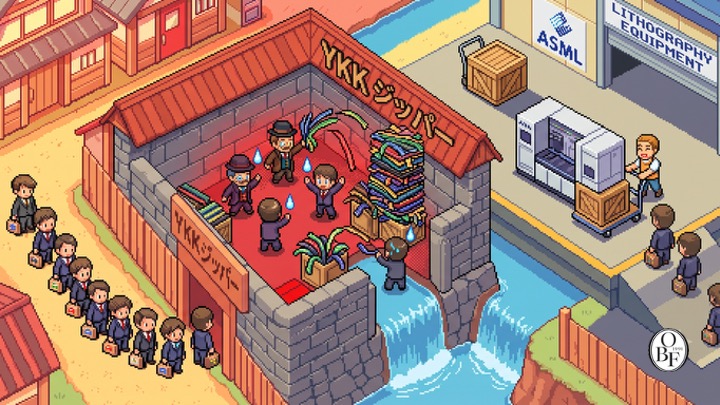
ASML sells its machines; YKK never sells the ones that make its zippers.
BusinessWhat “Super-Eul” Companies Have in Common
Samsung Electronics executives fly out to a Dutch town of just 40,000 people to secure even one more EUV lithography machine1. Nike, Levi’s, and Patagonia specify, by name, a zipper made by a company in Toyama Prefecture, Japan, when they draw up their manufacturing orders. In effect, the companies known as “gap”—the stronger, ordering party in a Korean business relationship—end up lining up before their “eul,” the weaker, supplying party. That’s exactly why Korean media nicknamed ASML the “super-eul.”
Yet the two companies arrived at that position by opposite paths. What they have in common is that both came to dominate “the machine that makes the product”; what sets them apart is that ASML sold that machine to outside buyers, while YKK never did. Let’s look at how these opposite choices led to the same outcome, and what conditions split the two companies’ paths in different directions.
The Company That Hides Its Machines: Why YKK Never Sells Its Equipment
YKK sold 10 billion zippers in fiscal year 2024. Lined up end to end, that’s 3 million km — 80 times around the Earth. By Harvard Business Review’s estimate, this one company captures roughly 40% of the global zipper market by value and about 20% by unit volume. Its products span everything from NASA spacesuits to blue jeans — in Japan alone, YKK makes over 100,000 distinct zipper types.
Quality is the answer people usually give for its success, but I think that’s only half right. The principle founder Tadao Yoshida laid down in 1934 wasn’t “make a good zipper” — it was “build a process that can’t produce anything but a good zipper.” YKK smelts its own brass, spins its own polyester yarn, and weaves its own zipper tape in-house. And crucially, it designs and builds, at its own facility in Kurobe, Toyama Prefecture, every machine that performs all of this. These machines are never sold externally, at any price. Competitors can copy the zipper — they can’t even lay eyes on the machine.
The power of owning your own machines showed up clearly in the US market. When YKK opened its New York office in 1960, Talon — America’s number one — held 7 out of every 10 zippers sold. But once YKK started leasing its own machines into American garment factories, the board flipped. According to Bloomberg, within 10 years of starting the machine-leasing push, YKK’s US subsidiary’s revenue jumped from under $100 million to roughly $450 million, and by the late 1980s it had taken the number-one spot in America. The moment your machine is running inside a customer’s factory, switching zipper suppliers stops being a parts swap — it becomes a production-line swap. Talon’s market share today sits in the single digits.
There’s an extreme customer whose experience shows exactly why the quality this machinery produces is so decisive: Switlik, which supplies survival gear to the US military. In this company’s dry suits, the zipper is the last line of defense against water — the moment it leaks, a piece of equipment meant to save a life becomes one that endangers it. That’s why Switlik co-developed with YKK a “quick-burst” zipper — one that bursts open on its own when inflated — used in US Air Force life vests. A zipper is a component worth less than 1% of a garment’s price, but buyers like this aren’t calculating price — they’re calculating the cost of failure. In this market, undercutting on price simply doesn’t work.
YKK’s response to China’s low-price offensive follows the same logic. SBS, founded in Fujian Province in 1984, is a company that has publicly stated its ambition to knock YKK off its perch. In a WSJ video, a YKK executive described the company’s countermeasure — not a price cut, but developing new in-house machinery capable of producing cost-competitive zippers without sacrificing quality. In other words: rather than lowering prices, build a new machine and fight on those terms. The fact that YKK remains privately held today — free from quarterly earnings pressure and able to commit to equipment investments on a 10-year horizon — is part of what makes this kind of response possible.
Of course, there’s a shadow side too. In 2007, the European Commission fined seven corporate groups a combined €328 million for price-fixing on zippers and fasteners, with YKK’s share — around €150 million — the largest of all. It’s a record that shows how, in markets where competition is limited, the incentive to collude on price only grows stronger.
The Company That Sold the Machine, ASML: Outsource the Parts, Lock In the Suppliers
Now let’s flip to the other side. In 1984—exactly 50 years after YKK’s founding—about 30 people started ASML in Veldhoven, Netherlands. Today, this company is the only one on Earth making extreme ultraviolet lithography equipment, posting €32.7 billion in revenue in 2025 with a 52.8% gross margin. Its next-generation High-NA2 machines reportedly cost around ₩500 billion (~$360 million) apiece. If YKK became king by selling 10 billion parts priced at a few dozen to a few hundred won wholesale, ASML became king by selling a few dozen units a year of the world’s most expensive machine.
But one common assumption needs correcting. ASML isn’t a company that makes everything in-house. It’s actually the opposite. Over 80% of the machine’s components are outsourced, and ASML has more than 5,000 suppliers. A single EUV machine contains roughly 100,000 parts, and shipping one requires 40 containers and 3 cargo planes. Unlike YKK, which made everything itself from raw materials to finished machines, ASML entrusts most of the work to outside suppliers.
Instead, ASML has locked those suppliers into having nowhere else to sell. Germany’s Zeiss, which makes the optics, is ASML’s sole supplier—and ASML is Zeiss’s sole customer in return. Over 25 years of joint development have made them mutually irreplaceable, and ASML holds a 24.9% stake in Zeiss’s semiconductor division. The multilayer mirrors Zeiss makes for EUV are polished to a flatness that’s effectively atomic-scale, so there’s simply no other company on Earth capable of making them instead. As for light-source maker Cymer, ASML outright acquired it in 2013. ASML buys the parts, but it has bound the companies capable of making those parts to itself through equity stakes, acquisitions, and long-term joint development. Rather than owning everything, it engineers relationships in which suppliers can sell to no one else.
The year this relationship showed most clearly was 2012. As the funding needs for EUV development ballooned, ASML reached out to its own customers. Intel, TSMC, and Samsung Electronics together bought a combined 23% stake for €3.85 billion, and separately paid €1.38 billion in R&D funding spread over 5 years. Samsung alone put in €500 million for equity and €276 million for research. Yet every share of this equity carried no voting rights. The deal took their money while giving them not an inch of management control. Three buyers funding one seller’s R&D—a scene rarely seen in industrial history. Why did they pay up? Because the customers themselves understood first that without this machine, they had no future.
To sum up: YKK made everything itself but never sold the machine; ASML makes almost nothing itself but sells the machine. Why did these two paths diverge so sharply?
Two Reasons Two Companies Chose Opposite Paths
I see two separate reasons why these two companies gave opposite answers to the same question.
The first is whether the process know-how is fully embedded in the machine itself. You need ASML’s equipment, but owning the equipment alone isn’t enough. Even when TSMC and later entrants buy the same EUV tools, their yields diverge sharply. The fact that identical machines produce different results tells you that the process know-how lives somewhere outside the machine. Since customers still have to build up that know-how themselves even after buying the machine, ASML can sell the hardware and still occupy a position that’s hard to replace. YKK’s zipper machines are the opposite case: most of the process knowledge is baked directly into the machine. Selling the machine would mean handing over decades of accumulated process knowledge in one transaction — so YKK chose to keep it hidden rather than sell it.
The second reason is the size of the market for the machines themselves. The semiconductor equipment market alone exceeds $100 billion a year, which is large enough to sustain a world-class company built purely on selling tools. But a standalone “zipper-manufacturing-equipment market” is simply too small. The only way to convert a good zipper machine into money was to use it yourself to stamp out 10 billion zippers. This is exactly why equipment specialists like Applied Materials or Tokyo Electron exist in semiconductors but have no counterpart in zippers.
This choice even determined where each company located its production. YKK, which builds its own machines, could replicate factories of identical quality across 69 countries, and its principle of “manufacture where you sell” also helped it cut tariff exposure — passing the Berry Amendment3, a U.S. requirement for military procurement, through its Georgia plant, for instance. ASML, by contrast, is stuck concentrating assembly in a single location, Veldhoven, because the machine itself is the product — which is precisely why it ended up standing at the epicenter of the U.S.-China export-control fight. Both companies started from the same logic, but the kinds of risk they now carry are exact opposites.
 Both companies currently have a foothold in Korea. YKK Korea has its headquarters in Bangbae-dong, Seoul, and a factory in Pyeongtaek, supplying zippers to the domestic apparel and bag industry. ASML completed its Hwaseong Campus last year at a cost of ₩240 billion (~$172 million); the core facility there is a remanufacturing center that repairs and restores lithography equipment components. ASML has also announced plans to raise the share of domestically sourced parts used there from 10% to 50%. Even a company that sells the machine wants to stay close to its customers when it comes to managing the machine’s lifespan. Meanwhile, in 2023 YKK moved its global sales headquarters to Vietnam, outside Japan for the first time since the company’s founding decades ago — a reflection of the fact that 90% of its production already happens outside Japan. YKK replicates its own factory format across many countries, while ASML keeps assembly at headquarters but places only repair and parts hubs near customers. Where each company chooses to plant its footprint follows directly from the choice it made in the first place.
Oswarld’s Lens
There’s a question I always ask when I’m running a product-definition workshop as part of GTM strategy consulting: “Among everything your company makes, what should you refuse to sell?” Most people find the question strange at first, because they’ve been managing what they make and what they sell as if they were the same list. The two companies we’ve looked at today are companies that decided these separately. They show that a company gets to decide, on its own terms, what to sell and what not to sell. The same logic applies to power dynamics between contractors and clients: what determines real leverage isn’t company size or brand name, but whether the other party can actually replace you with someone else. Both companies simply made the part they’re responsible for difficult to replace.
You can extract a decision rule from this case. Find the part of your capabilities that’s hardest for other companies to replicate, then check whether a standalone market exists for selling just that part. If that market is large enough, package it as a product like ASML did. If no such market exists, don’t sell it externally and instead make your money only through the final product, as YKK does. For Korean parts-and-equipment suppliers accustomed to the practice of building whatever the client demands, I think this framework offers a way to reconsider the question: which drawings can you hand over, and which jigs and equipment must never leave the building?
Still, refusing to hand something over comes at a cost. YKK’s antitrust fine shows that restricted competition in a market increases the incentive toward price collusion, and ASML’s exposure to export controls shows that concentrating assembly in one location makes you vulnerable to regulation. Deciding what not to give up is also, inevitably, deciding what risks you’re willing to take on.
Closing
Here’s the summary. First, both companies’ power comes not from the finished product but from holding “the machine that makes the product.” Second, YKK builds everything in-house — from raw materials to the machines themselves — and never sells its production equipment externally. ASML instead builds tight relationships with outside suppliers through equity stakes, acquisitions, and joint development, then sells the equipment made from those components to customers. The two firms took different approaches to deciding what to sell while retaining production capability. Third, that means it’s not enough to ask how good our product is — we also need to ask who, in our value chain, holds the machine that makes the product.
In your line of work, Reader, which company is “the one holding the machine”? And conversely, is there something your company absolutely never sells — or something it shouldn’t have sold? Tell me in the comments. I’ll dig into the most interesting cases in the next issue.
💬 Share your industry’s “hidden machine” story in the comments — I might feature it in the next issue. 📨 If you have a colleague working in components, equipment, or B2B, please pass this issue along.
Worth reading alongside this issue
Keep the perspective, not the noise.
We choose one consequential shift and trace what sits beneath it, every other day.
Confirm once to finish subscribing.
Already a subscriber? Sign in to join the conversation


References & Further Reading
Primary sources
- YKK, “YKK Surpasses 10 Billion Annual Global Zipper Unit Sales in FY2024”, 2025. Link ··· the original source for the 10 billion units and “80 times around the globe” figures.
- WSJ, “YKK Sells 10 Billion Zippers a Year. How Did It Get So Big?” (video), 2026. ··· the video that sparked today’s piece. It covers YKK’s in-house machine-building and its supply deals with the U.S. military.
- Bloomberg Businessweek, “How the World’s Largest Zipper Maker Is Weathering the Tariffs Era”, 2025. Link ··· has the detail on how leasing machines drove a 4.5x revenue jump, plus the story of Kurobe’s secretive facility.
- ASML, “2025 Fourth Quarter and Full-Year Results”, 2026. Link ··· the original source for revenue of €32.7 billion and a gross margin of 52.8%.
- ASML, “Samsung joins ASML’s Customer Co-Investment Program”, 2012. Link ··· the primary source for the 2012 scene where three buyers funded a supplier’s R&D.
- European Commission, “Antitrust: Commission fines members of fasteners cartels over EUR 328 million”, 2007. ··· the original record of YKK’s €150 million fine. Seeing the shadow side of its dominance keeps the picture balanced.
Background
- The Fashion Law, “The Humble Zipper is at the Center of an Almost $20 Billion Global Battle”, 2020. Link ··· a good one-stop read on zipper industry history, from Talon’s decline to SBS’s challenge.
- The Lec, “ASML Invests ₩240 Billion (~$180 million) to Build Hwaseong Cluster”, 2022. Link ··· covers ASML’s Hwaseong campus and its plan to localize refurbished-parts production, raising the domestic share from 10% to 50%.

📝 Glossary
Footnotes
-
EUV (Extreme Ultraviolet) lithography: the most advanced type of equipment used to draw circuit patterns on wafers with light. The shorter the wavelength, the finer the lines it can draw — EUV represents the extreme end of that, making it essential for producing cutting-edge chips. ↩
-
High-NA: the next generation of EUV. It increases the lens’s light-gathering power (numerical aperture) to draw even finer circuits. Think of it as opening up a camera’s aperture much wider. ↩
-
Berry Amendment: a U.S. rule requiring that clothing, textiles, and similar items procured by the U.S. military be made in America. To supply the U.S. military, a company’s supply chain has to sit inside the United States. ↩
Related issues
Warsh's Real Choice Isn't Tightening or Easing
There's a third path the Fed chair never announced — and on July 29, bond markets finally priced it in.
BusinessSanDisk's Customers Just Guaranteed $16.5 Billion
Even as demand explodes, neither company will build new factories—so buyers are locking in four-year deals instead.
BusinessZero Solo Unicorns Yet, But $1M Solo Companies Have Doubled
No one-person unicorn exists yet, but verifiable evidence of solo-founder success is piling up fast.
Business
Your take shapes the next issue
What resonated most in this issue, or where has your experience been different?